
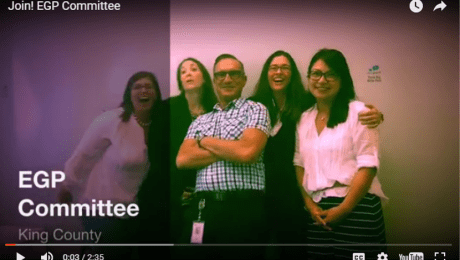
Who is the EGP Committee? Find out!
Crossposted from KC Employee Giving
If you are interested in joining the EGP Committee, know that coffee is on us! What? You read that right. A cup of coffee on us.
The King County Employee Giving Program (EGP) is currently recruiting for 5 open slots on the EGP Committee.
The Committee is made up of King County Employees from across the County and provides the strategic vision of the program and are key participants in its success. Additionally, the Employee Giving Program provides leadership and development opportunities that may not otherwise be available in the context of your current position.
Read more at KC Employee Giving
Share this:

2017 MLK celebration draws crowd and highlights work being done to achieve fairness and opportunity for all
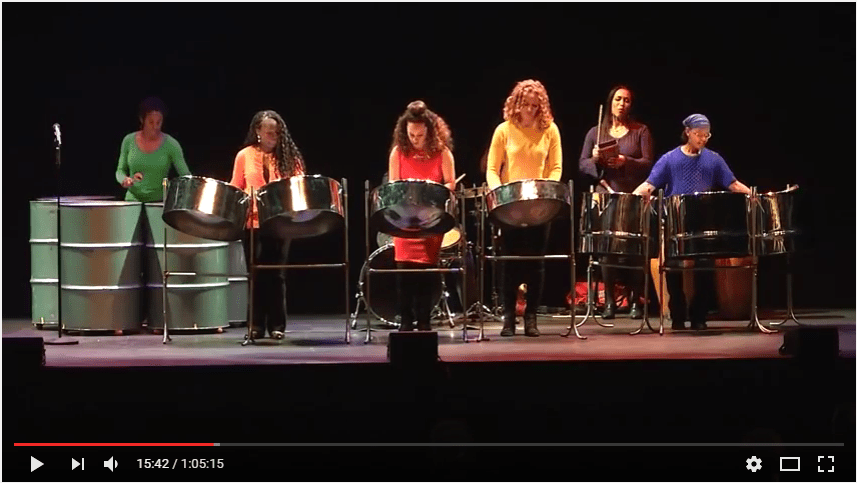
On Thursday, January 12, King County’s 30th annual Rev. Dr. Martin Luther King, Jr. Celebration was held at the 5th Avenue Theatre in downtown Seattle.
The celebration recognizes the impact that Dr. King had on our community and our nation, and reminds us to keep striving toward his dream of equity and justice.
The event featured keynote speaker Alexs Pate of the Innocent Classrooms program, which strives to help teachers connect more effectively with students of color, and the Seattle Women’s Steel Pan Project as guest performers.
For more information about the annual celebration of King County’s namesake, visit the King County website.
View the entire 2017 MLK Celebration in the video below.
Share this:

Beyond the Call of Duty
Crossposted from Clean Water Stories
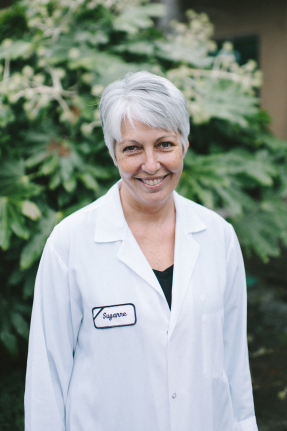
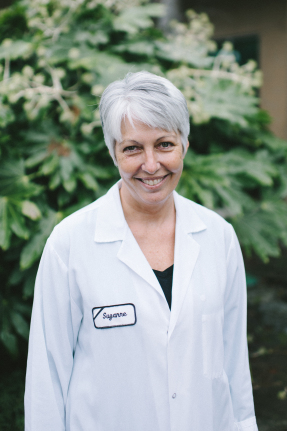 With over 20 years in the water quality industry, Suzanne Potts, process laboratory specialist, has garnered the reputation of going “beyond the call of duty.” From mentoring new staff to being the go-to person for key projects like a Laboratory Information Management System update, she’s recognized as a role model not only for the laboratory, but for the entire utility. This is apparent by a recent award she received after being nominated by five of her co-workers.
“She keeps me on my toes. Sometimes when I just cannot see a solution to a problem, she’ll come up with something from a completely different perspective,” Teresa Allen, process chief analyst, said.
Read more at Clean Water Stories
Share this:

Save 30 percent on Seattle Symphony performances in January

King County employees can receive a 30 percent discount on tickets to two upcoming Seattle Symphony concert performances this January:
- Shostakovich Concerto Festival I and II – Held January 19 at 7:30 p.m. or January 20 at 8 p.m.
- Mendelssohn and Schubert – Held January 26 at 7:30 p.m. or January 28 at 8 p.m.
To receive the discount, please use promo code Ludovic1617 when purchasing tickets online, via phone at 206-215-4747, or in person at the Benaroya Box Office, located at Third Ave and Union Street (hours here).
Find all King County employee discounts on the Employee Discount webpage.
Share this:

Improving food safety in restaurants, one smiley face at a time

 King County’s food safety employees want to ensure that the County’s restaurant safety ratings are as simple and user-friendly as possible for residents so they turned to a new system that everyone understands: emojis.
“[Diners] were telling us that they wanted the information to be easy to understand, and to see it at the restaurant, helping them make decisions on the spot,” Becky Elias, Food Program Manager with Public Health – Seattle & King County, said. “People can walk down the street, see a window sign outside of a restaurant and be able to easily understand that restaurant’s food safety practices at a glance,”
Under the new first-of-its-kind system, restaurants will receive one of four food safety ratings that will be posted on restaurant window signs that indicate how well a restaurant practices food safety – “Needs to Improve,” “Okay,” “Good” and “Excellent.”
In creating the new system, the County began by learning what sort of rating system would work best for local diners and restaurant operators.
“Students from UW asked focus groups about using stars and letter grades,” Damarys Espinoza, Community Engagement and Outreach Manager, said. “They found that people associate stars with consumer reviews or how a food tastes, and not how safe it is. Letter scales, such as ABC, were found to be confusing by many people…Through additional focus groups and surveys, we learned that emojis, or smiley faces, are something that most everyone understands.”
While simplicity was a key goal in the new system, employees also wanted to make the information more comprehensive, so inspectors will now use the last four inspections to determine ratings rather than just one.
“Using four routine inspections gives a better idea of how that restaurant practices food safety over time instead of just a snap shot of one inspection,” Espinoza said.
To be truly effective the food safety ratings also have to work for restaurant operators.
“We listened to the concerns of restaurant operators about food safety inspection consistency,” Espinoza said. “One way we are improving our work is by having inspectors do inspections side by side once a month. This helps them share skills and learn from each other. This has been a great way to build teamwork and with our staff create a more consistent way of doing inspections.”
The rating system is being rolled out in phases across the county, starting with the northwest part, so you may not see the new signs in all restaurants until the end of 2017.
Share this:

Using the sun’s energy to illuminate bus shelters

 King County is harnessing the power of the sun and the innovations of its employees to provide lighting at its bus shelters.
King County Metro Transit is one of the largest transit systems in the country, and its network of more than 8,000 bus stops and 1,800 bus stop shelters is growing!
Metro’s employees are using solar power as a climate- and budget-friendly solution to providing lighting at bus shelters.
Solar lighting is being installed in about 50 new shelters each year, as well as in another 50 shelters through refurbishment. “Solar shelter lighting helps us address safety concerns without incurring the cost and climate impacts of hard-wired electrical infrastructure,” said Dale Cummings, King County Transit Planner and project manager for the shelter lighting improvements.
In addition to the 100 new fittings each year, 230 existing shelters with solar lighting are being upgraded for Metro by Urban Solar Corp., Metro’s solar lighting supplier. The upgrades include new controllers to standardize systems and improve battery life, brighter light-emitting diode (LED) bulbs, and new battery harnesses.
 The new harnesses are another example of Metro’s team embracing innovation to deliver important services to commuters. Brian Cady, Chief of Power Distribution, proposed a maintenance simplification and led the design of a plug-and-play system that could be replaced safely and quickly when needed, greatly reducing time spent on ladders in busy bus zones. “I love the prewired batteries, plug in harness, and the flip-up battery cover that stays up with no worries of dropping near customers,” said John Campagnaro, Metro electrician.
Prior to receiving upgrades, sites are reviewed for light levels, ridership, known security issues, maintenance history, and complaints about poor lighting from either customers or operators.
Visit Metro’s site to learn more about their programs and projects, and how you can benefit from the Metro team’s great work!
Share this:




Be Informed! Veteran Services and Benefits Lunch and Learn

Come learn about the variety of services and benefits available to veterans, spouses and dependents offered through the VA, other government agencies and local community service organizations.
You will learn about the benefits and services related to housing, employment, education, medical, dental, burial and pension. You will also learn the processes used in connecting with VA benefits earned as a result of military service and receive applications for accessing these earned benefits.
- Thursday, February 9, 2017 from noon to 1 p.m. Chinook Building, Rooms 121/123, 401 Fifth Avenue
This information will be relevant to all veterans, spouses or dependents of veterans, regardless of when the veteran served. This event is open to all King County employees and family members.
Click here to register and for more information.
Share this:

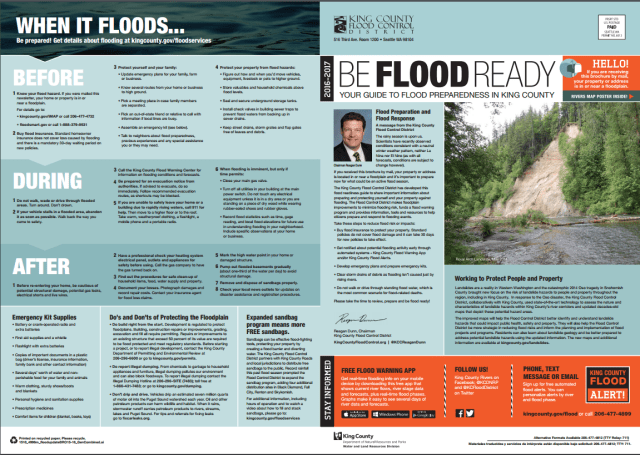
2016-2017 Be Flood Ready brochure in 21 languages

Flooding is the most common winter weather disaster and one which many residents are unprepared. From river flooding to urban drain and stream flooding, “Be Flood Ready” is a print resource available in 21 languages to raise awareness about available resources and best practices for reducing risks associated with flooding.
The brochure is available as a PDF online at www.kingcounty.gov/floodservices or in print, by request. The web site also has videos in the same 21 languages on flood preparedness that are available for sharing to your web site, social media or in communications.
Share this:

Yesler Bridge Rehabilitation Project: Reminder, January 2017
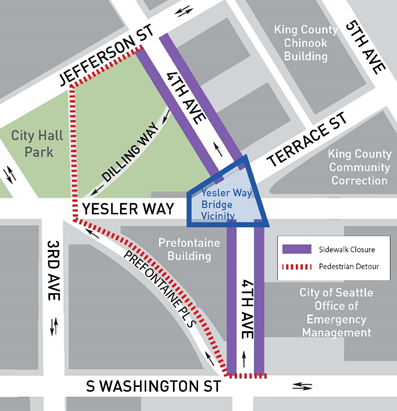
From Tuesday, January 3 through mid-February, crews will close the sidewalk on the east side of 4th Ave S between S Washington and Jefferson streets. This sidewalk closure is in addition to the sidewalk closure on the west side of 4th Ave S, check out the detour map here. Crews will be widening the bridge footings (beneath the sidewalk) during the weekdays, and other crews will be installing a large electrical utility duct bank next to the eastern bridge abutment on weeknights. The right lane on 4th Ave S will be closed during weeknights to safely complete these activities.
A reminder that the left lane of 4th Ave S between S Washington and Jefferson streets is closed until early spring 2017. The center lanes will remain open to traffic, please use caution and follow detours around the work areas.
The Yesler Way Bridge Rehabilitation Project, which will improve safety and reliability while preserving the bridge’s historical elements, will continue through fall of 2017. If you have any questions or would like to discuss the project further, please contact YeslerBridge@seattle.gov or 206-684-8684. To learn more about the project, visit the project website.






 Employee News