
2016 Special Election ballots mailed out

 The Elections Department has mailed ballots for the April 26, 2016 Special Election to all registered King County voters. Only certain jurisdictions are participating in this month’s election so not everyone will receive a ballot. For a detailed list of what is on the ballot, please visit the King County Elections website.
The May Presidential Primary Election ballots will be mailed on May 4.
Please remember: Do not use interoffice mail service to return a ballot. Also, do not return ballots to the Voter Registration Annex.
The April election day deadline is April 26 and the May election deadline is May 24. You may vote as soon as you receive your ballot. If you should have received a ballot for the April election but have not contact Elections at 206-296-VOTE (8683).
Share this:

Kudos! Courteous, engaging bus driver makes this rider’s commute “the best”

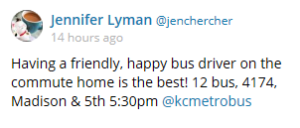 Recently, this bus rider took to Twitter to share her praise for a particular driver.
Kudos to this King County employee for providing excellent, high quality customer service!
Share this:

Featured Job: Climate Engagement Specialist

Closing Date/Time: Mon. 04/25/16 4:30 PM
Salary: $78,644.80 – $99,673.60 Annually
Job Type: Career Service, Full Time, 40 hrs/week
Location: King Street Center – 201 S Jackson St, Seattle, Washington
Department: Department of Natural Resources & Parks – Director’s Office
Description: This position will act as King County’s climate engagement and communications lead and will work across King County agencies to implement the commitments of King County’s 2015 SCAP. This position will require strong engagement in ways that help support, communicate and bring funding to diverse climate-related projects and programs. This role will expand, diversify and strengthen alliances with public, private, and civic sector partners to develop, communicate, and implement regional climate solutions and shape decision-making in ways that advance equity and social justice and benefit public health, mobility, and the economy.
Learn more about this position or view all available jobs.
Share this:

Administrative Professionals Recognition Day, April 27

 Wednesday, April 27, 2016 is National Administrative Professionals Day!
A special event will be held to honor and recognize the contributions of all King County government administrative professionals on Wednesday, April 27th from 11:45 a.m. to 1 p.m. in Rooms 121 and 123 of the Chinook Building. If you are an administrative professional, manager/supervisor of an administrative professional, or a customer, please join us. Space is limited.
Share this:

Good Food Champion: Eat healthy, support local

Crossposted from the It’s Easy Being Green blog
 Everyone can help to build a stronger food system by working to become better “food citizens.” Be aware of what you’re consuming, where it is grown or produced, and whether others also have the opportunity to eat healthy, local food. Through wise food purchasing and consumption we can keep our farms productive, our food businesses thriving, and ensure that everyone has access to affordable, healthy food.
Here are 10 ways to become a local food champion:
1. Buy local Few places do food better than King County with more than 100 products grown in the region. And buying local is a great way to cut down on the environmental impact of your food. Whatever your reason for choosing local – supporting local farmers, sourcing what’s fresh and in season, better nutrition and advocating for food access – learning about farming in your region and appreciating the seasonal foods available is a great place to start.
Share this:

Welcome Julie Long!
Crossposted from the DES Express blog
 Julie Long has been chosen to serve as the Executive Assistant in the DES Director’s Office.
Julie has been serving as a Confidential Secretary at King County International Airport since 2014, providing extraordinary customer service and executive-level support. She has more than ten years of executive-level support experience in government and the private sector and is extremely excited about her new role. Julie will be transitioning into her new position this week, and splitting her time between the Airport and downtown for a few weeks.
We look forward to having Julie join our small yet mighty team to ensure we are providing great value and Delivering Excellent Service throughout DES and all of King County.
Share this:

Latest edition of King County @ Your Service show

View this video to get the latest information on a few of the most recent King County hot topics. See how the county is transforming Animal Services, and you’ll be seeing more cameras on Metro buses. Join host Matt Sampsell for King County @ Your Service.

Share this:

National Animal Control Officers Appreciation Week

Crossposted from the RASKC blog
Meet our amazing Animal Control Officers! We value and greatly appreciate the work that our Animal Control Officers (ACO) do on a daily basis.
Their genuine commitment to serve the community helps maintain RASKC’s mission to provide collaborative and compassionate animal care services throughout King County.
Thank you for all you do! Read more to view their picture and learn about why they love what they do!
Share this:

From the Hip: Patty Hayes, Director of Public Health

How I Spent National Public Health Week
Crossposted from the Public Health Insider blog
 Last week we celebrated National Public Health Week, my favorite time of year. As the director of the department, I am steeped in public health on a daily basis, but I am always ready to learn more. I met with different staff – people I don’t get to see too often – to find out more about what they do. As always, I was inspired by their work and their dedication to our important mission.
Share this:

Nationally acclaimed RainWise program brings together mosques, employees and others through green, eco-friendly practices
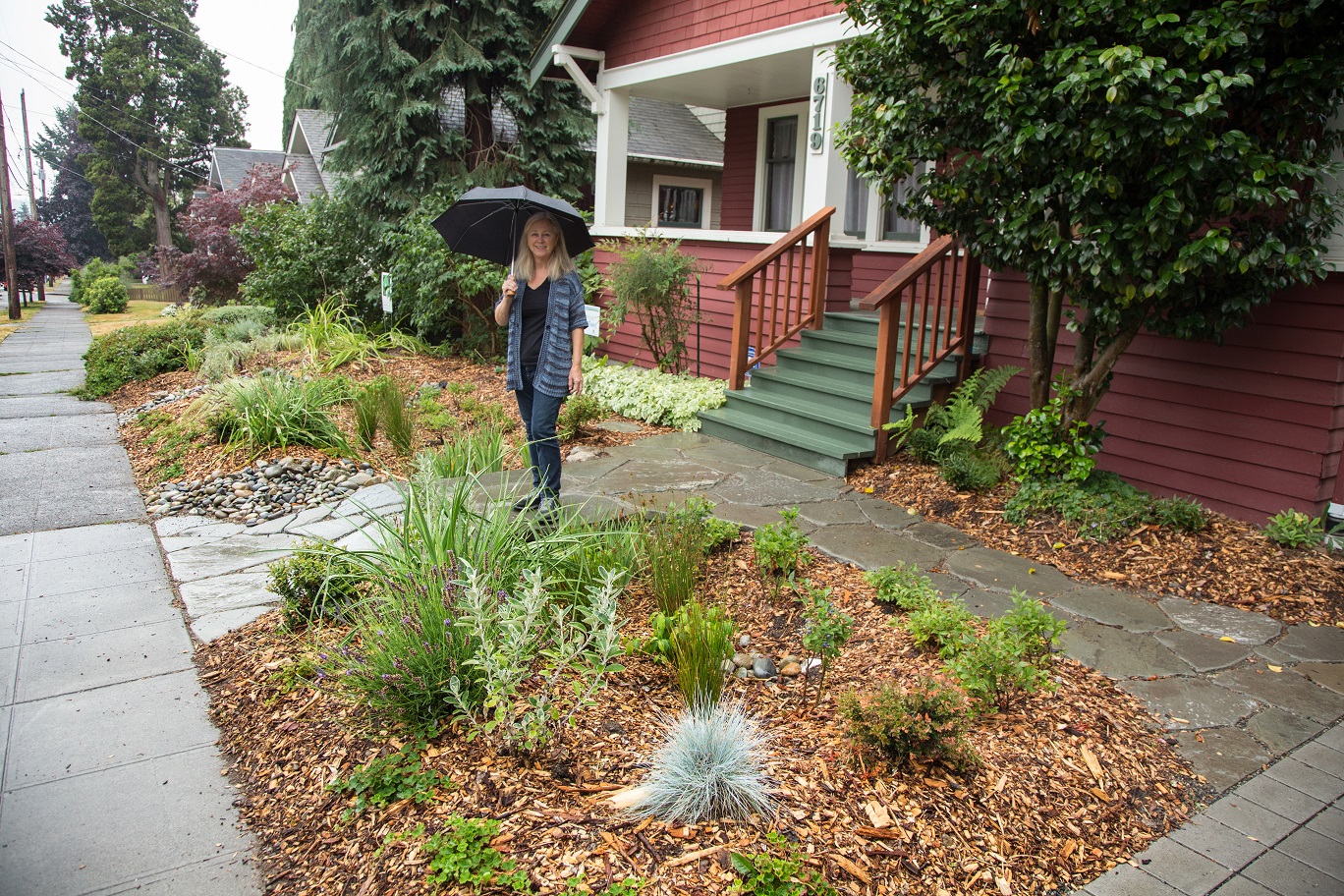
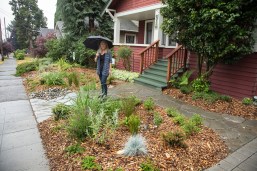
Employee Roberta King in her RainWise garden.
In just a few years the RainWise program has become a national model for other organizations interested in effectively addressing combined sewer overflows (CSO). It’s well renowned for its fruitful community partnerships and by offering rebates that cover most of the installation costs for rain gardens and cisterns to qualifying property owners.
“It’s a great County collaboration with the City of Seattle to showcase our environmental efforts and Best-Run Government initiative,” said John Phillips, King County’s Program Manager for RainWise. “I get calls for more information weekly from all over the country.”
“This is being seen as one of the best CSO programs that provide an incentive to manage runoff on private property.”
Essentially, during a storm, the rain carries pollutants from hard surfaces like roofs, streets and driveways to local creeks and waterways. Here in King County that includes Lake Washington and Puget Sound. This stormwater can cause sewer overflows. Building a rain garden or adding a cistern to a large building or area helps control the impact this stormwater has on the environment.






 Employee News