Taking action on September pulse survey responses
The most recent employee engagement pulse survey found that Engagement, Well-being, and Belonging indices are all trending upwards since the previous survey, and that a sense of belonging among teams can help reduce stress and increase well-being.
The pulse survey, conducted in September 2021, took a deeper dive into belonging to better understand how our public service work benefits when employees have a strong sense of belonging and well-being.
Key findings included:
- Well-being, engagement, and belonging are all trending up for most demographics, except 51 and older where belonging and engagement have decreased.
- There were significant increases in employee concerns about contracting COVID-19, mental health, and emotional demands of work.
- At King County, a strong sense of belonging is associated with:
- Much lower levels of workplace stress:
- Only 23% of employees with a high sense of belonging report regularly feeling excessive stress at work compared to 52% of employees with a low sense of belonging.
- Employees with a low sense of belonging are more likely to experience stress related to conflict with co-workers, uncertainty about their role/work, a lack of control over their work, or a poor relationship with their manager.
- Much greater willingness to stay at the organization if offered a similar job at another company:
- 84% of employees with a high sense of belonging are willing to stay at the organization compared to only 38% of employees with a low sense of belonging.
- Much greater enthusiasm for work:
- 94% of employees with a high sense of belonging are enthusiastic about their work compared to only 67% of employees with a low sense of belonging.
- Much lower levels of workplace stress:
At the same time, more than three-quarters (76%) of expected action plans have been entered. Of those, almost half (44%) are focused specifically on improving employees’ sense of belonging.

Popular actions include:
- Team activities to build belonging
- 3 things that have most shaped people
- “I am, but I am not”
- Rose and thorn
- Regular practices to promote connection
- Ice breakers at the beginning of meetings
- 1-5 check ins
- Recognizing people for effort and growth
- Creating opportunities for collective problem solving
- Engaging people in decisions impacting them
- Make it a practice to ask team for input and incorporate what is shared.
Summary of key findings and recommended responses
| Finding | Recommendation |
| Engagement, Well-being, and Belonging indices are all trending upwards since the June 2021 survey. | Continue to execute action plans focused on belonging and well-being. |
| Employees feel that they have the resources to manage their health but mental health concerns and concerns about contracting COVID-19 are increasing. | Leaders and managers should continue to show support for employee health and well-being especially around issues of mental health. |
| A sense of belonging among teams can help reduce stress and increase well-being. Leaders and managers play a critical role in creating this sense of belonging. | Leaders and managers can help build a culture of belonging and well-being by shifting away from trauma holding crisis management and toward a healing, relational culture. Specifically, leaders and managers should be intentional about including employees in decision making, showing appreciation, and creating safe spaces for listening/sharing different perspectives. Senior and department leadership can help this by demonstrating behaviors that model vulnerability, empathy, and inclusion. |
| On-site workers are less familiar with important Office of Equity and Social Justice (OESJ) communication topics compared to remote workers. | OESJ topics should be communicated using channels that are inclusive of on-site workers that may not work at a computer with regular access to email. |
The survey was a random sample of Executive Branch employees, conducted via email and QR code invitation. A total of 877 responses were collected between Sept. 8 – 27, 2021.
Let us hear your stories of hope, MLK Committee seeks employee testimonials
Posted by the King County Martin Luther King Day Committee
Since COVID-19’s emergence, our community has been rocked by despair, tests and trials, grief, and struggle. In the midst of what some may deem the greatest turmoil we have ever experienced, we still fight and work towards solutions that bring our community together, ever better.

Every year the King County MLK Day committee chooses a theme that honors Dr. Martin Luther King Jr. and that guides the tone of the event and the recognition.
This year, the committee chose to focus on stories of hope and these words from author and activist James Baldwin:
“Not everything that is faced can be changed, but nothing can be changed until it is faced.”
With this in mind, the MLK committee would like to hear from you, our beloved King County employees, and asks that you share with us your stories of hope, strength, resilience, compassion, and determination in the wake of the COVID-19 crisis. King County employees have faced this crisis head on, among other challenges, and show tremendous determination to deliver needed services to our communities. Employees have continued working to make our King County community better and stronger. The MLK Committee wants to hear your story of hope, strength, and resilience, so please consider sharing.
If you have a story you would like to share, we ask that you email it to Brooke McConnaughey at BMcConnaughey@kingcounty.gov with the subject line “Story of Hope.” We kindly ask that submissions be 500 words or less. We will be collecting and featuring selections throughout the month of January and featuring six selections for the Dr. Martin Luther King, Jr. annual memorial event on Jan. 13.
We look forward to sharing in your journey and building up hope through your words.
Supporting human and civil rights organizations through the 2021 Annual Giving Drive
As part of the 2021 Annual Giving Drive, we are highlighting nonprofits whose work supports organizations committed to human and civil rights issues. These and hundreds of nonprofits are participating in this year’s Annual Giving Drive.
- Businesses Endling Slavery and Trafficking (10972) – Provides training, education and awareness to prevent human trafficking and help to identify trafficking victims, prevent exploitation and provide safe employment to survivors.
- Northwest Justice Project (9739) – Free civil legal services ensure that low-income persons in WA can pursue justice when faced with eviction, foreclosure, domestic violence, loss of income, consumer fraud and more.
- Project HOPE (3513) – Working with health care workers and their communities, addressing the greatest public health challenges enabling people to live their best lives.
You can go online or use a paper form by Friday, Nov. 19, to make a pledge to your favorite Employee Giving Program nonprofits by:
- Payroll donation: One-time, once–per-month, or twice-per-month.
- Time donation: Eligible vacation or comp time. See your department Lead Ambassador for details in your office.
- Check or credit card: Made out directly to the nonprofit.
- Volunteering: Up to three sick days per calendar year at a nonprofit in the EGP (for non-represented and employees whose union has approved this benefit, including those covered by the Master Labor Agreement).
For more information, contact your Employee Giving Program Ambassador, visit www.kingcounty.gov/giving, email EmployeeGiving@KingCounty.gov, call 206-263-9372, or attend an online Nonprofit Expo.
Powering regional recovery by inclusion
Every October, King County recognizes Disability Employment Awareness Month, celebrating the many contributions of people with disabilities to our communities, workforce, and country.
In 2021, the Disability Awareness Month Committee gathered stories about King County employees working to improve accessibility, provide services, and engage people with disabilities.
Employees get airport ready for snow

The National Weather Service is predicting a double-dip La Niña winter, similar to last winter. This weather pattern typically results in colder, wetter conditions in our region – including more snow. The teams at King County International Airport-Boeing Field are ready for whatever Old Man Winter brings. At a recent discussion, the Operations and Maintenance teams detailed their winter weather preparations:
- For 2021-22, the airport will use a new Priority surface clearing map, including taxiways A and B as Priority I.
- Thanks to some new hires, Operations now has 24-hour coverage. Both Operations and Maintenance will go into 24-hour coverage during any snow event.
- 27,000 gallons of liquid E-36 de-icer (airside) and 31,000 pounds of NAAC solid de-icer (landside) are available for use. Three additional E36 tanks are being installed in mid-November and will add 27,000 more gallons of capacity, for a total capacity of 54,000 gallons of liquid de-icer.
- Operations, Maintenance and Fleet Services will do practice snow removal runs in early November. These allow the team to ensure the equipment is in perfect working condition and give the drivers hands-on practice for navigating the airfield as a team.
- A request for new snow and ice removal equipment is under review for FAA funding, but won’t be here in time for this winter season. KCIA is requesting Multi-tasking Equipment (MTE) units – single operator units that include a snow plow and a snow broom.
Join the Walking Bus pilot program
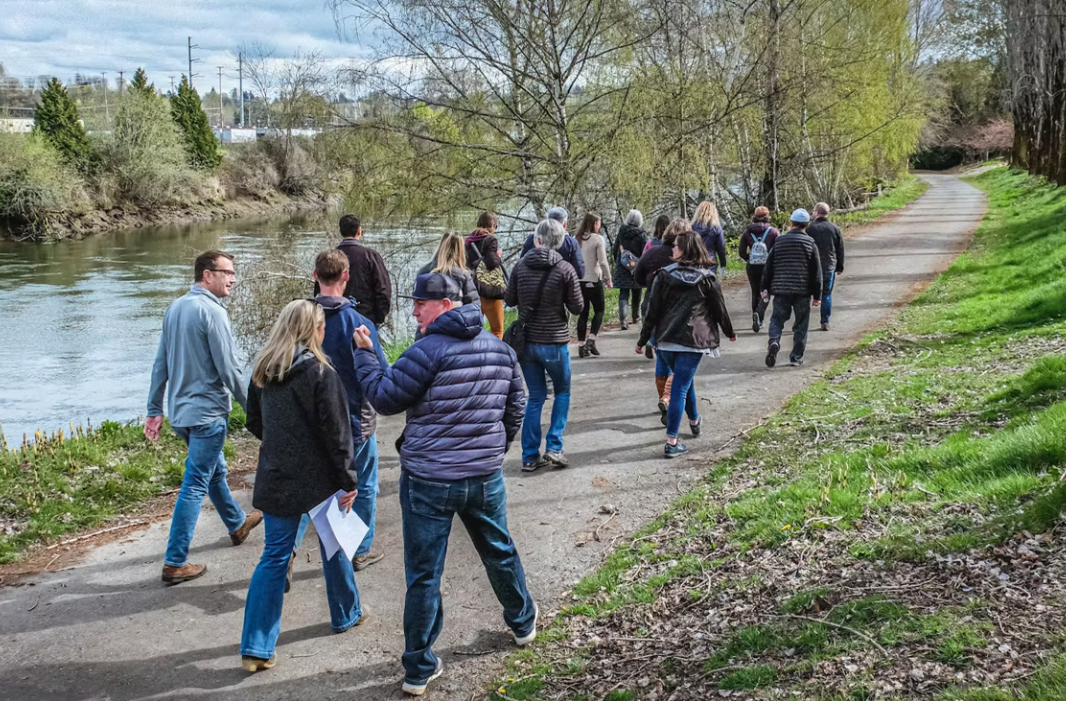
King County has launched a “Walking Bus” pilot program where county employees can join their colleagues and a Facilities Management Division (FMD) Security Escort each evening walking to the King Street Station and the Colman Dock from the downtown campus.

In this initial pilot phase, two dedicated security escorts will depart daily, Monday-Friday, from the King County Courthouse: one to the King Street Station and one to the Colman Dock ferry terminal:
Meet Location: King County Courthouse, 4th Avenue Entrance
Walking Time to King Street Station: 5-10 minutes
Walking Time to Colman Dock: 12-20 minutes
- To King Street Station – Depart 4th Avenue Entrance at 4:40 p.m.
- 4:55 p.m. train (southbound)
- To Colman Dock – Depart 4th Avenue Entrance at 5:05 p.m.
- 5:30 p.m. sailing to Bremerton (car)
- 5:30 p.m. sailing to Vashon Island (foot ferry)
- 5:40 p.m. sailing to Bremerton (foot ferry)
- 5:45 p.m. sailing to Bainbridge Island (car).
For additional information, please contact the FMD Security emergency dispatch center at 206-296-5000 or FMD.Security@kingcounty.gov.
The Walking Bus pilot program is in addition to security escorts offered by FMD Security Officers, who can escort you for several blocks from the building you work in, from downtown buildings to Goat Hill Garage or immediate vicinity bus stops. Please contact the FMD Security emergency dispatch center at 206-296-5000 or FMD.Security@kingcounty.gov to arrange for a security escort whether coming in to work or leaving work. Advance notice for a Security Escort is appreciated. You can learn about the many employee transportation and safety programs on the Future of Work Personal Safety site (employee access only).
Trading a sick day to help end homelessness
Team members from King County Department of Natural Resources and Parks (DNRP) Director’s Office traded a sick day to volunteer with Sound Foundations NW (SFNW) and be part of the solution to end homelessness in our community.
At the Hope Factory in SODO, they worked as a team on an assembly line to construct the frame of a tiny home which will provide shelter for someone experiencing homelessness. This tiny home is 96 square feet and will be set-up at the new Friendship Heights Village at Aurora and 125th in Seattle later this month.
SFNW says the main function of a tiny home is to get the person off the streets and into a space that is warm, safe, and dry. Many of the village residents then go on to move into long-term or permanent housing.
This DNRP team volunteer event was also part of the King County Employee Giving Program’s annual giving drive, as SFNW is associated with Low Income Housing Institution (LIHI), which is one of the nonprofits in the giving drive.
To learn how to help out in the community and volunteer with Sound Foundations NW visit www.soundfoundationsnw.org.
Meaningful ways to thank a veteran for their service
This article is courtesy of the King County Veterans and Military Affinity Group

This Veterans Day, America will pause to honor those who have served in the military. Most Americans hold those who have served in high regard, yet sometimes are unsure how to properly thank a veteran without unintentionally saying the wrong thing, appearing intrusive, or somehow offending them.
While it is customary to offer a “thank you for your service” to veterans, you could instead say:
- “Thank you for putting your life on hold to serve our country.”
- “Thank you for the sacrifices you made being away from your family.”
- “Thank you for stepping up and choosing to serve when many others didn’t.”
But don’t stop there. Follow up by asking them if they have an interesting military story they might like to share. In fact, most veterans would be happy to share their military stories about coming of age, lifelong friends they’ve made, humorous situations, locations they’ve traveled to, cultures they’ve explored, and more. Here are examples of questions you could ask to begin the conversation:
- What inspired you to join the military, and how did you choose your branch of service?
- What was your job and what was the most rewarding part of doing it?
- What was your training like?
- What is the funniest thing that ever happened to you in the military?
- Was the food as bad as we hear?
- What are some of the things you remember about military life that you enjoyed?
- If you saw multiple deployments, how did they differ from each other? What did you enjoy about them?
- Did you go overseas? If so, what surprised you the most about serving abroad?
It is also important to know the types of questions to not ask. These questions include: Did you ever kill anyone? Did you see dead bodies? What was the worst thing you ever saw or that happened to you? Do you have PTSD? Did you see any action? How could you leave your family for so long? These sorts of questions often make those who served feel uncomfortable, and can be deemed as disrespectful.
So, on this Veterans Day and every day, the biggest sign of respect you can show to a veteran is to get to know them. Asking them about their military service and showing interest is the best way to express your gratitude for the many sacrifices they have made. For more information about those who choose to serve, please see this article from the Veterans Administration, 15 Things Veterans Would Like You to Know.
Showing support for employees who serve in the U.S. National Guard or Reserves
This article is courtesy of the King County Veterans and Military Affinity Group
People join the National Guard and Reserves for a variety of reasons. Participating in the Guard and Reserve enables them to continue with their civilian jobs while still serving our country and being part of something greater than themselves. Their success and ability to focus on their varied missions depend on the support they receive not just from their families but also from their employer, direct supervisor, and fellow co-workers.
King County is truly proud to have more than 100 employees who choose to serve in the National Guard and Reserves. In fact, King County was bestowed the “Above and Beyond Award” in 2018 by the U.S. Department of Defense, Employer Support of the Guard and Reserve, for the generous benefits we offer those who serve. However, benefits are just one piece; the support each of us chooses to provide to our fellow co-workers who serve can be very impactful and meaningful.
Below are some ways in which to show our support for those who serve:
- Plan and prepare: The supervisor and coworkers can work with the service member to prepare for both planned and unplanned emergency (e.g. natural disaster) mobilizations and deployments, and create a plan of action in advance to make sure staff are trained and know how to step in to handle the work.
- Meet with service member: The supervisor, HR and co-workers are encouraged to meet with the Reserve or National Guard employee and ask, “How can I support you?” and if comfortable, also ask, “Is there some way in which I can support your family?” Unplanned deployments and mobilizations can be hard on the employee’s family. Offering to check in with the family or offer help in some other way can go a long way in alleviating some of the service member’s stress.
- Stay in touch: Keep the service member “in the loop” with what is going on at work. Information to share might include positive changes in the workplace (e.g., new projects or hires) and social information (e.g., a coworker had a baby, a new walking group started). This can be done with monthly letters and occasional e-mails. Staying in touch helps enhance the service member’s morale and feel remembered, especially if they are away during holidays. It is helpful to even consider sending a “care package” when they are deployed.
- Develop a reintegration plan: When it is time for the employee to return, the supervisor can discuss with the service member:
- What the employee can expect (e.g., what tasks have been delegated to others, if they will be working in the same or a different role, if and how procedures have changed).
- What the employee would like or find helpful in returning to work (e.g., written instructions for new procedures, additional meetings with management to get caught up on what they have missed, flexible work schedule).
- How the employee would like to be treated regarding their deployment (e.g., would they prefer not to discuss it, would they like to share what they did while they were away).
- What training, re-training, or accommodations need to be put into place.
Given this list, let us each now consider ways in which we can recognize and support our co-workers who choose to serve.
KingCare Select members: Choose your Primary Care Provider
A Primary Care Provider (PCP) can make a big difference in your health by delivering continuity of care. This means you and your PCP establish a partnership over time to achieve the best possible health outcomes.

Next year, if you are enrolled in the KingCare Select medical plan, you must choose a PCP and let Regence know who you selected by calling them at 888-367-2112, visiting regence.com/pick-a-pcp, or emailing cs@regence.com.
If you’re not sure which medical plan you are enrolled in, check your medical ID card or login to PeopleSoft and go to the Benefits tile.
Each person covered on KingCare Select will receive an ID card with their PCP listed. If you don’t choose a PCP, Regence will assign one to you based on providers you have seen in the past or based on where you live.
You can change your PCP at any time.
To learn more, including how to find an in-network PCP:
- Read Having a primary care provider is good for your health
- Watch the KingCare Select PCP video
- See the PCP FAQ.
For information about Open Enrollment, attend a virtual information session. Register at: Open Enrollment Education Session or Transit Open Enrollment Education session. If you can’t attend an information session, watch the Open Enrollment Overview video.
For additional information, contact the King County Benefits Team at KC Benefits or 206-684-1556.