
Cecelia Hayes recipient of Executive’s Individual Contributor Award

The Leadership Excellence Awards, part of Executive Constantine’s Performance Excellence Awards, honor King County leaders who embody our Executive Branch values and who strive to reach our True North: Making King County a welcoming community where every person can thrive. The Individual Contributor Award honors an employee who does not directly manage staff, but who makes significant and tangible leadership contributions.

The 2020 honoree for the Individual Contributor Award is Cecelia Hayes, a Senior Practitioner in Equity, Social Justice and Engagement for the Department of Executive Services.
Cecelia is committed to moving King County forward in its racially just, pro-equity work. Last year, she spearheaded a series of employee town halls that focused on “Race, Racism, and Change,” and she developed a tool to measure organizational progress in adopting behaviors that promote equity and social justice.
“She solves problems,” said Gary Kurihara, Chief Performance Officer. “Recognizing that ESJ is difficult for many staff to talk about, Cecelia treats this an opportunity to innovate and has developed a variety of programs designed to start the conversation about equity.”
Watch the video to see the award presentation and learn how Cecelia is helping cultivate a workforce that can speak openly about race and confront racist situations when they occur.
Executive’s Performance Excellence Awards series
The Leadership Excellence Awards are part of the Executive’s Performance Excellence Awards series, honoring employees and workgroups at King County for their exceptional contributions to performance, leadership, and innovation.
“As we build a best-run government at King County, these awards recognize individuals and teams who have gone above and beyond to look at how they can do things differently to better serve our customers and employees,” said King County Executive Dow Constantine.
Learn more about the King County Performance Excellence Awards.
Share this:

Four worksite clinics this week for COVID-19 vaccine

All King County Executive branch employees are required to be fully vaccinated under Executive Constantine’s COVID-19 Vaccination Requirement – Executive Order and submit proof of vaccination for verification.
King County is hosting four COVID-19 worksite vaccination clinics this week open to all employees and their families. All three vaccines are available by appointment, and walk-ins are welcome:
- Wednesday, Sept. 29, 2021 from 1-4 p.m., Cedar Hills Regional Landfill, 16645 228th Ave SE in Maple Valley. Register here.
- Thursday, Sept 30, 2021 from 6-9 a.m., Regional Communications and Emergency Coordination Center, 3511 NE 2nd St. in Renton. Register here.
- Thursday, Sept 30, 2021 from 1-4 p.m., Roads Division Renton Maintenance Facility, behind building “A” at 155 Monroe Ave NE in Renton. Register here.
- Saturday, October 2, 2021 from 8:30-10:30 a.m., Metro’s Safety and Training building at 11911 E Marginal Way S. in Tukwila. Register with Discovery Health by your preferred vaccine type:: Pfizer, Moderna, and J&J.

If you’ve had a first dose of Pfizer or Moderna, you can find many opportunities to get your second dose at local pharmacies, clinics, and community events. The one-dose Johnson & Johnson/Janssen vaccine is also available. Go to www.kingcounty.gov/vaccine or the State of Washington Vaccine Locator for information about where to get vaccinated and what vaccines are offered.
Please note that if you received a first dose of Pfizer or Moderna at a County-sponsored worksite vaccination clinic in the latter part of September, you’ll need to get your second dose in the community, such as at a pharmacy, clinic, or community event.
King County and the Coalition of Unions, Technical Employees Association, the International Brotherhood of Electrical Workers, Local 77 the King County Corrections Guild, and the King County Juvenile Detention Guild, recently reached an agreement over the COVID-19 vaccine mandate that affects all King County employees in the Executive Branch.
You can read all the details in the Agreement here. If you haven’t already been vaccinated, you can find out where to get your vaccine and find answers to your questions at www.kingcounty.gov/vaccine. If you haven’t had your vaccination status verified, find out how here. If you have any questions, please contact your department’s HR Manager (SharePoint link).
Share this:

Verify your vaccination status as soon as possible
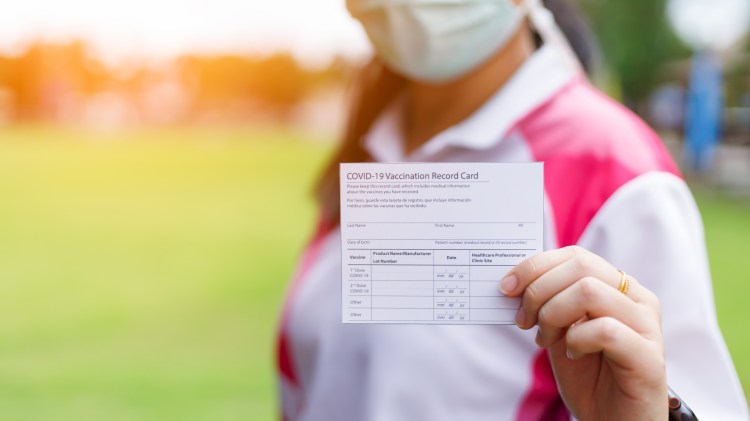
If you haven’t yet submitted your proof of vaccination for verification, make sure you do so as soon as you receive your final vaccination. In order to be fully vaccinated by the deadline, you must receive your second dose of the Pfizer or Moderna vaccines or your only dose of the Johnson & Johnson/Janssen vaccine by Monday, Oct. 4. Please report your vaccination status immediately after receiving your final dose to avoid receiving notices of the job separation process.
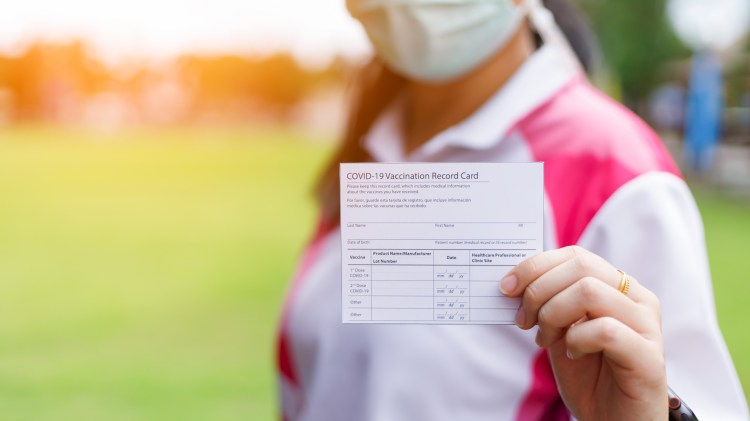
There are a couple of ways to provide proof of vaccination:
- Initiating the COVID-19 Vaccination Declaration process through your NEOGOV Dashboard (click on Dashboard > Forms > COVID-19 Vaccination Declaration) and attaching a copy of an official document (see list below), OR
- Showing one of the following to an HR professional or other designated department representative:
- your actual vaccination card, or a photo or a copy of it,
- a copy of your state vaccine record, or
- a verified medical record.
If you’ve lost or destroyed your vaccine card, you can find out how to replace it here.
Please note, employees will need to get both doses of a two-shot vaccine (Pfizer or Moderna), or a single dose of Johnson & Johnson/Janssen before completing the vaccine verification. Employees can receive their vaccine at several pop-up vaccine clinics hosted by King County, or go to www.kingcounty.gov/vaccine to find a pharmacy, clinic, or community vaccination event nearby. After completing a vaccination series at a King County-sponsored worksite clinic, employees still need to submit verification.
Departments will not keep copies of vaccination cards, state vaccine records, or vaccine medical records; however, they will document that the employee has been vaccinated, which vaccination was received (Pfizer, Moderna, or Johnson & Johnson), and the last date of the vaccination.
If you have any questions, please contact your department’s HR Manager.
Share this:

Don’t wait to get vaccination verified

The Oct. 18 deadline for getting your vaccination status verified is approaching fast, so make sure you’ve submitted your proof of vaccination before the deadline.
There are a couple of ways to provide proof of vaccination:
- Initiating the COVID-19 Vaccination Declaration process through your NEOGOV Dashboard (click on Dashboard > Forms > COVID-19 Vaccination Declaration) and attaching a copy of an official document (see list below), OR
- Showing one of the following to an HR professional or other designated department representative:
- your actual vaccination card, or a photo or a copy of it,
- a copy of your state vaccine record, or
- a verified medical record.
Please note, employees will need to get both doses of a 2-shot vaccine (Pfizer or Moderna), or a single dose of Johnson & Johnson before completing the vaccine verification. Employees can receive their vaccine at several pop-up vaccine clinics hosted by King County, or go to www.kingcounty.gov/vaccine to find a pharmacy, clinic, or community vaccination event nearby. After completing a vaccination series at a King County-sponsored worksite clinic, employees still need to submit verification.
Departments will not keep copies of vaccination cards, state vaccine records, or vaccine medical records; however, they will document that the employee has been vaccinated, which vaccination was received (Pfizer, Moderna, or Johnson & Johnson), and the last date of the vaccination.
If you have any questions, please contact your department’s HR Manager.
Share this:

Innovation Award for Sustainability
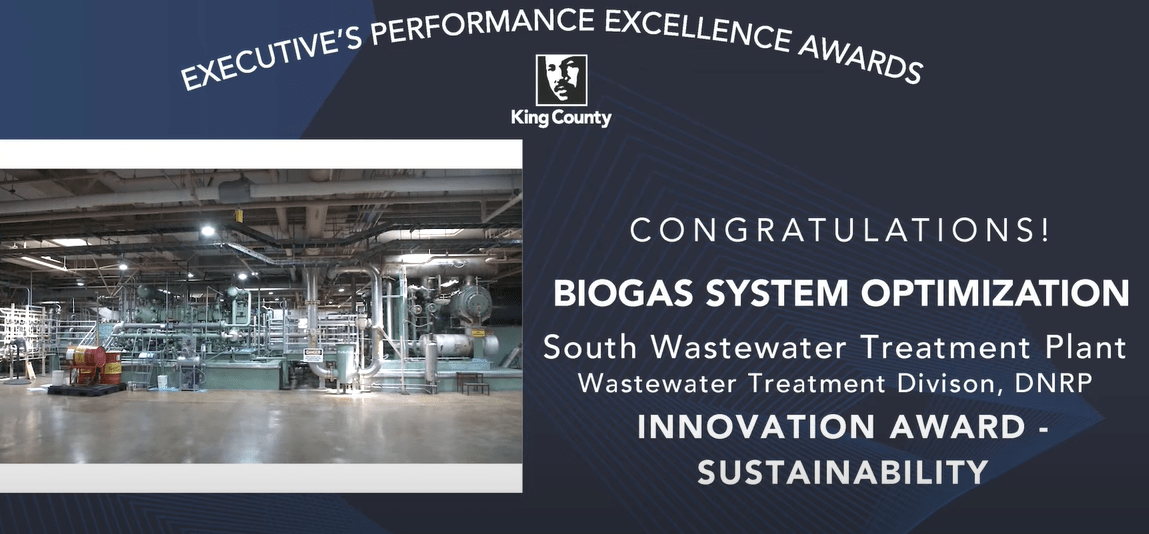
The King County Innovation Awards – part of the Executive’s Performance Excellence Awards – seek to honor employees and teams whose projects, improvements, and ingenuity deliver exceptional, measurable results. These honorees have considered challenges within their delivery of services to King County residents, and developed solutions that address an important need. They also met each challenge in a creative and forward-thinking manner that reflects our True North values.
The Innovation Award for Sustainability went to the Biogas Optimization Team at the South Wastewater Treatment Plant. The team strategically allocated limited resources to increase the life and capacity of a system that produces biogas.

Biogas is a waste byproduct of wastewater treatment, and the South Plant has been converting biogas to renewable natural gas and injecting it into the local natural gas pipeline for more than 30 years. Renewable natural gas is less expensive and less polluting than fossil-fuel natural gas.
The South Plant converts biogas to renewable natural gas through a process called scrubbing. The plant’s biogas scrubbing system is aging, and parts of it needed urgent repairs. According to Rachel Brombaugh, Director of Climate and Energy Initiatives, “It is the longest-operating system for converting wastewater biogas to pipeline-quality renewable natural gas in the country.” The County looked at replacing the system but found it would cost tens of millions of dollars.
With the support of the Wastewater Treatment Division capital team, staff at the South Plant identified cost-effective improvements that focused on repairing the scrubbing tower and re-building gas-compression equipment. “These improvements were made at a fraction of the cost of a new scrubbing system, and they increased gas production and revenues,” Brombaugh stated.
Due to pandemic restrictions, awards this year were presented virtually. Watch this video to see the award presentation and learn how South Plant and associated staff found cost-effective ways to repair an aging scrubbing system.
Executive’s Performance Excellence Awards series
The Innovation Awards are part of the Executive’s Performance Excellence Awards series, honoring employees and workgroups at King County for their exceptional contributions to performance, leadership, and innovation.
“As we build a best-run government at King County, these awards recognize individuals and teams who have gone above and beyond to look at how they can do things differently to better serve our customers and employees,” said King County Executive Dow Constantine.
Learn more about the King County Performance Excellence Awards.
Share this:

KCLx 2021 art contest celebrates Latinx/Hispanic Heritage Month
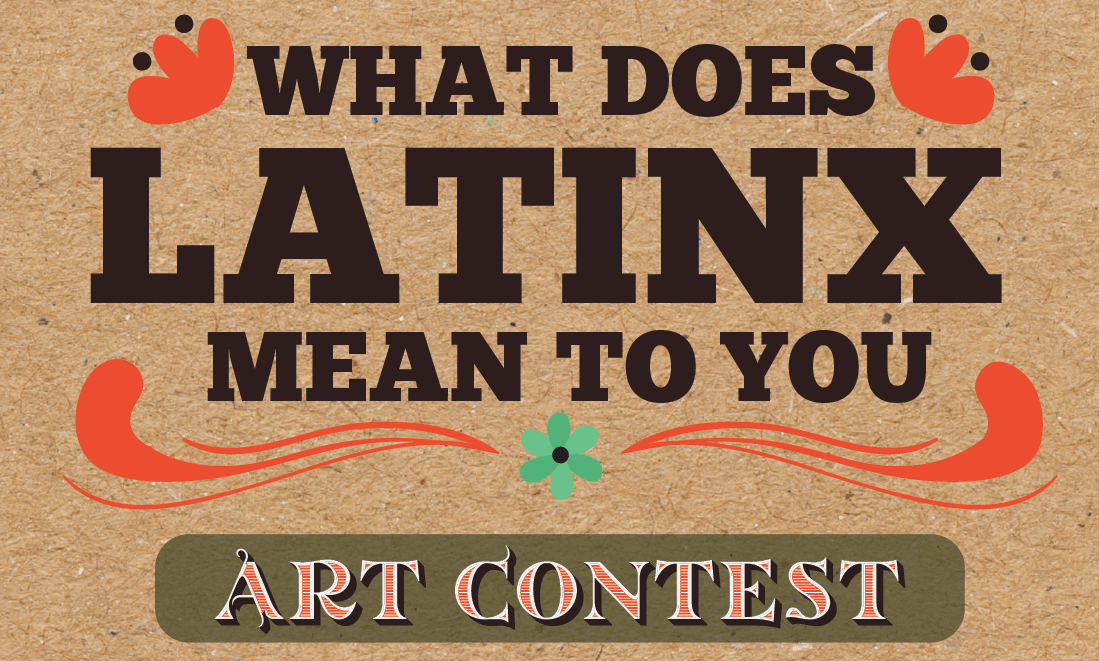
The King County Latinx Affinity Group (KCLx) is excited to kick off a variety of events and discussions that celebrate the colorful and eclectic heritage of Latinx identity. KCLx is curious to ask the Latinx community, “What does this identity mean to you?”
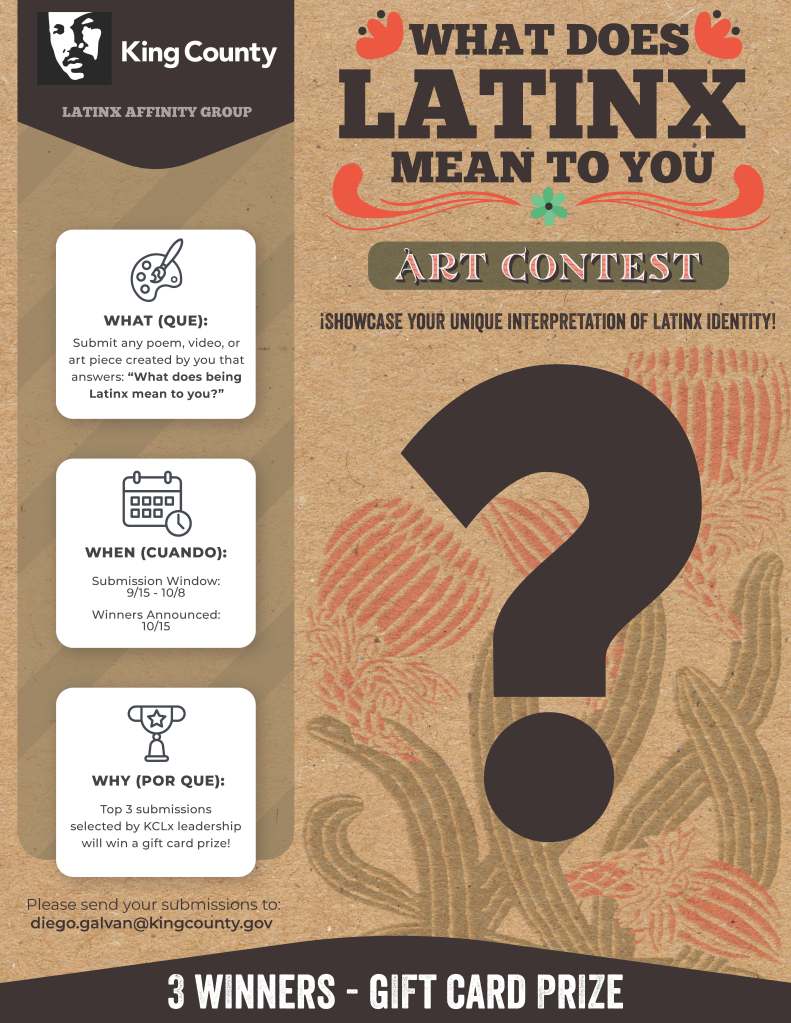
To answer this question, KCLx is launching the “What does LATINX mean to you?” Art Contest. This contest is an opportunity for participants to showcase their unique interpretation of Latinx/o, Chicanx/o, and Hispanic identity. KCLx wants participants to answer the question “We all share common stories, such as culture, heritage, traditions, etc., but how is your story read?”
Art contest submissions will be accepted from Wednesday, Sept. 15 through Friday, Oct. 8. Voting will be conducted by the KCLx Leadership Committee from Oct. 11-15. Winners will be announced Oct. 15.
Guidelines
- Submit a created poem, video, or art piece that answers the question: “What does being Latinx mean to you?” Contest submissions will be accepted via email to Diego Galvan, diego.galvan@kingcounty.gov. Art contest submissions will be placed on display in the virtual KCLx Art Gallery.
- The contest is open to any King County resident who self-identifies as Latinx, Chicanx, and/or Hispanic. Participants are encouraged to share information and spread the word about this opportunity.
Acknowledging and respecting diversity within our common heritage is what allows the Latinx community to flourish and thrive. This contest will also reward the top 3 winners, selected by the KCLx Leadership Committee, with a gift card prize. Grand prize will be $75, while second and third place will be $50 and $25.
KCLx looks forward to admiring each artistic interpretation of Latinx identity. For questions or concerns, contact KCLx via Margarita Aguado at maguado@kingcounty.gov, or Diego Galvan at diego.galvan@kingcounty.gov.
Share this:

Recognizing King County CFJC food service employees
In celebration of National Food Service Employee Day on Sept. 25, the Children’s and Family Justice Center (CFJC) would like to recognize the food services team.
The team provides CFJC youth all their nutritional needs and operate under the National School Lunch Program guidelines. They are being recognized for all their outstanding efforts during COVID-19, the winter snow in March, and for working diligently with minimal staffing levels, particularly throughout this year. Every challenge has been met with professionalism and pride, a desire for continuous improvement, and a passion to build on already excellent food services. For the first time, the CFJC would like to recognize the food service team for the value they bring to the youth served every day.
Currently, the CFJC food service team includes four staff: Luc Ta, Diosdado Dato, Joe Gorham, and Guru Sigdel.
The food services team is quite skilled, with a combined 160 plus years in the food service industry. This expertise is shown in how most food is prepared from scratch, and the ways in which the team regularly provide many special diets and meals for other CFJC staff and events. During a regular seven-day period, the team utilizes utilize approximately 145 pounds of fresh produce and 160 pounds of protein, both animal and plant.
The team comes from a wide variety of interests and backgrounds, but together are proud of the opportunity to serve youth and colleagues at the CFJC. One team member owns and operates a family restaurant, two are dedicated cat owners, and one is a garage afficionado who enjoys working on cars. Combined, the group has language abilities in Chinese, Italian, Spanish, Nepali, and two dialects of Filipino. The team ranges in age from 27 to 70 “years young,” and all enjoy cooking and providing three delicious meals a day, plus two snacks. The team can make everything from curries and casseroles, to burgers, and of course, pizza. Whipping up special event and holiday meals are also enjoyed by the youth, and as they look forward to mealtime, it is their positive responses and feedback which give great value to what the CFJC food services team do.
Join us in recognizing and thanking the CFJC food services team, and all food service employees, on Saturday, Sept. 25.
Share this:

Take our survey to help us improve on-demand, wheelchair accessible, for-hire transportation in Seattle and King County

The City of Seattle and King County are working to improve on-demand, wheelchair accessible for-hire transportation, which includes taxicab, flat-rate/for-hire, and transportation network company (or TNC, e.g., Uber and lift) services.
The City and County are exploring ways to make it easier for those who use wheelchairs and other mobility devices to find and request on-demand trips, as part of a broader effort to make the local transportation system more equitable and accessible for all.
Before implementing any program improvements or changes, we are conducting a survey of individuals who use wheelchairs or other mobility devices, and their family members, caregivers, and service providers. The results from the survey will help us understand how we can improve wheelchair accessible for-hire transportation to better meet the needs of communities across Seattle and King County.
Take the survey here in English, or follow the links below to take the survey in one of eight other languages.
- Amharic / አማርኛ: https://www.surveymonkey.com/r/YSPXNGP?lang=am
- Chinese / 英語: https://www.surveymonkey.com/r/YSPXNGP?lang=zh
- Korean / 한국인: https://www.surveymonkey.com/r/YSPXNGP?lang=ko
- Somali / Soomaali: https://www.surveymonkey.com/r/YSPXNGP?lang=so
- Spanish / Español: https://www.surveymonkey.com/r/YSPXNGP?lang=es
- Tagalog / tagalog: https://www.surveymonkey.com/r/YSPXNGP?lang=fil
- Vietnamese / Tiếng Việt: https://www.surveymonkey.com/r/YSPXNGP?lang=vi
Share this:

Agreement between King County and unions over employee vaccine mandate
King County and the Coalition of Unions, Technical Employees Association, the International Brotherhood of Electrical Workers, Local 77 the King County Corrections Guild, and the King County Juvenile Detention Guild, reached an agreement over the COVID-19 vaccine mandate that affects all King County employees in the Executive Branch.
On August 10, 2021, King County Executive Dow Constantine issued an order that all Executive Branch employees must be fully vaccinated by October 18, 2021. Since then, the Office of Labor Relations (OLR) has been in negotiations with labor unions on what will be considered full compliance and how the mandate will be implemented in King County. OLR has reached agreement with the with these unions. The conditions of the Agreement also apply to non-represented employees.
Negotiations also established some additional procedures for compliance. Under compliance processes in the agreement, those who have not yet shown proof of full vaccination by October 18 can avoid separation from the county provided they have begun the process for being fully vaccinated and can complete that process by December 2.
Under the agreement, an employee who has vaccination side-effects or who contracts COVID-19 has access to some additional COVID leave.
You can read all the details in the Agreement here. If you haven’t already been vaccinated, you can find out where to get your vaccine and find answers to your questions at www.kingcounty.gov/vaccine. If you haven’t had your vaccination status verified, find out how here. If you have any questions, please contact your department’s HR Manager (SharePoint link).
Share this:

Executive proclamation for 2021 Latinx/Hispanic Heritage Month and events

King County Executive Dow Constantine has proclaimed the month beginning Sept. 15 “Latinx/Hispanic Heritage Month” in King County. View the official proclamation here.
National Latinx and Hispanic Heritage Month is observed Sept. 15-Oct. 15 in the United States, Canada, and Latin America. This month is an opportunity to recognize and celebrate the long, important presence and contributions of Hispanic and Latino and Latina (Latinx) Americans. More than 62 million people of Latinx ancestry live in the United States, with almost 220,000 calling King County home.
To commemorate the celebration, the King County Latinx Affinity Group (KCLx) in collaboration with Sound Transit Latinx in Transportation and Seattle Department of Transportation Latinx Caucus for Latinx/Hispanic Heritage Month has provided a list of events. It includes a few public community events. For more information, view the detailed list here.
Upcoming 2021 Latinx/Hispanic Heritage Month events
“What does LATINX mean to you?” Art Contest
Sept. 15 – Oct. 15
To kickoff Latinx/Hispanic Heritage Month, KCLx is launching this contest event to showcase your unique interpretations of Latinx/o, Chicanx/o, and Hispanic identity. We all share common stories (culture, heritage, traditions, etc.) but how is your story read? Submit your art pieces to Diego Galvan at diego.galvan@kingcounty.gov. Art contest submissions will be accepted from Sept. 15-Oct. 8, and will be placed on display in the virtual KCLx Art Gallery. The top 3 submissions/winners, selected by the KCLx Leadership Committee, will be announced on Oct. 15, and win a gift card prize. See flyer for more details. This showcase is organized by King County. Contact: Diego Galvan, diego.galvan@kingcounty.gov or Margarita Aguado, maguado@kingcounty.gov
Sea Mar Virtual Fiestas Patrias
Friday, Sept. 18 at noon
Check out the digital premiere of Sea Mar’s 2021 Celebration Video with presentations from Chile, El Salvador, Guatemala, Mexico, Peru, and Chicano Culture. Hosted by Sea Mar Community Health Centers.
Filantropía para la Justicia Social – Social Justice Giving
Wednesday, Sept. 22 from 6-8 p.m.
Join the Latino Community Fund and Social Justice Fund for an interactive, cross-class workshop held in Spanish for people who identify as Black, Indigenous, people of color and/or immigrant and refugee. They will dive into how many of us already give, what strategic social justice giving is, and outline a framework that uncovers how our communities have and continue to resource ourselves. Hosted by the Latino Community Fund and Social Justice Fund. Register here.
A Discussion with Hispanic Women Leaders
Thursday, Sept. 23 from 5-6:15 p.m.
Please join the Center for Women and Democracy (CWD) for a conversation on how to harness the power of women across Washington State to create a just and equal future for all women. For the September event they will discuss the needs and concerns of Hispanic women and how their issues impact us all. Hosted by CWD. Register here.
Virtual Tour: Sea Mar Museum of Chicano/a Latino/a Culture
Thursday, Sept. 30 from noon to 1 p.m.
Celebrate Latinx Heritage Month with the KCLx Affinity Group by joining us for a virtual tour of the Sea Mar Museum of Chicano/a/Latino/a Culture. Opened in October 2019 in the South Park neighborhood of Seattle, the museum showcases the rich history of Chicano/as and Latino/as from the 1940s to present time. Dr. Jerry Garcia, Vice President of Educational Services for Sea Mar, will lead the tour. Hosted by King County. Contact: Margarita Aguado maguado@kingcounty.gov or Sabrina Torres, satorres@kingcounty.gov. Join via Zoom. Use passcode: 883797.
KCLx Cafecito
Monday, Oct. 4 from noon to 1 p.m.
King County employees who self-identify as Latinx, please join us for our bi-monthly virtual cafecitos! These casual meetings are meant to be a time to catch up with or get to know each other, share some virtual café y pan dulce, and have a little break during our hectic workdays. Contact Margarita Aguado or Sabrina Torres to receive the calendar series hold. Hosted by King County. Contact: Margarita Aguado, maguado@kingcounty.gov or Sabrina Torres, satorres@kingcounty.gov.
Q3 POCA/ERG Meeting hosted by Seattle Department of Transportation (SDOT) Latinx Caucus
Tuesday, Oct. 5 from noon to 1:30 p.m.
As part of Hispanic Month celebration (Sept/Oct), Latinx caucus will be hosting the Q3 meeting for People of Color Advancement (POCA)/employee resource group (ERG). This event includes guest speaker, Barbie-Danielle DeCarlo and a Jeopardy game! Hosted by SDOT. Contact: Lorena Ware, Lorena.Ware@seattle.gov.
La Importancia de los Programas de Acceso al Lenguaje y el Bilingüismo
Thursday, Oct. 7 from noon to 1:30 p.m.
Join KCLx and the King County’s Department of Public Health for this interactive informational about our COVID-19 Language Access Team. This event will be an opportunity to have a relevant conversation about the importance of language access equity and the celebration of bilingualism in the communities we serve. Hosted by King County.
Contact: Margarita Aguado, maguado@kingcounty.gov or Sabrina Torres, satorres@kingcounty.gov.
For more events, please visit the KCLx website at www.kingcounty.gov/latinx.






 Employee News