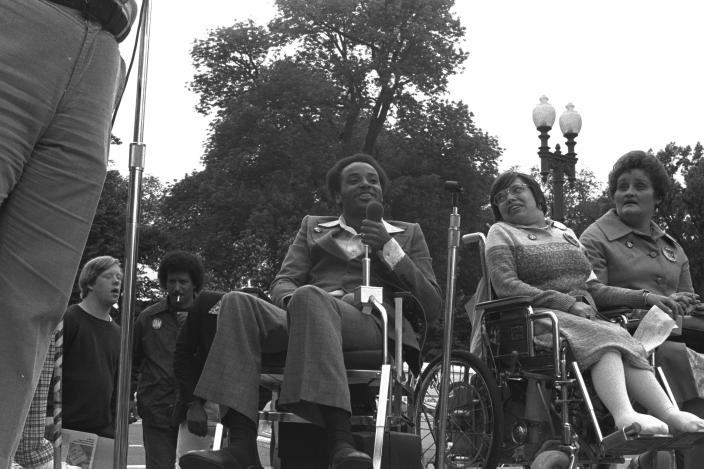
$2 million for King County departments, agencies to increase language access services
We know language access and providing King County communities with accurate information in a language they understand is more important than ever. When people can receive information and services in the language and format that is accessible, it leads to more equitable and healthier outcomes

King County has $2 million in federal funding to distribute to departments, agencies and divisions to increase language access as part of our pandemic response and recovery efforts. The Office of Equity and Social Justice (OESJ), in partnership with the Office of Performance, Strategy and Budget (PSB), will be allocating these resources. Applications will open soon.
This program is meant to improve Language Access Supports, including limited English proficiency, English Language Learners, American Sign Language users, and individuals with communication barriers and disabilities, especially as it pertains to COVID-19 and COVID-19 impacts. Applicable uses include, but are not limited to:
- Contracting translation or interpretation services for live services or translating documents
- Disseminating translated materials to all media, such as ethnic media or social media
- Purchasing software or equipment to facilitate language access
- Responding to disability-related accommodation requests
OESJ will host two informational sessions for agencies interested in applying:
Informational Session #1
Thursday, December 9, 2021 11:00 AM-12:00 PM
Zoom Webinar Link: https://kingcounty.zoom.us/j/89864608633
Webinar ID: 898 6460 8633
Call by phone: (253) 215-8782
Informational Session #2
Monday, December 13, 2021 1:00 PM-2:00 PM
Zoom Webinar Link: https://kingcounty.zoom.us/j/84197669972
Webinar ID: 841 9766 9972
Call by phone: (253) 215-8782
If you have additional questions, reach out to the Office of Equity and Social Justice by emailing oesjgrants@kingcounty.gov or KClanguages@kingcounty.gov.
Connecting to VPN? You’ll need to verify your identity
King County’s AnyConnect VPN software will get MFA (Multi-Factor Authentication) security starting on December 1, 2021.
What does this mean for you? Each time you connect to VPN you must provide your username (username@kingcounty.gov) and password, and verify your identity on a separate device such as a cell phone or digital fob – just like when you access your Microsoft account. For employees currently enrolled in MFA, no additional action is necessary. Simply respond to the MFA security requests on your enrolled device, as described below.
If you are not enrolled in MFA, please do so immediately to maintain access to VPN. You can check to make sure you’re enrolled and set your MFA preferences at My Account (microsoft.com) on the Security Info page. For assistance, Executive branch employees should contact the KCIT Helpdesk. Employees in separately-elected agencies can contact their department IT support.
1. Preview of the new AnyConnect VPN login process: Select your department and click Connect to start VPN. Note: The current “KingCountyVPN” option will be removed shortly – please select your department. If you don’t see your department in the dropdown list, choose KingCountyVPN-KC.

2. Enter your King County username (username@kingcounty.gov) and password.

3. A notification will ask you to verify your identity on a separate device.

4. Approve the MFA challenge using your enrolled device (your cell phone or fob). Remember: Never approve an unexpected MFA challenge; it could be someone attempting to access your account.
Employees accessing VPN must select their agency from the drop-down list in their desktop client, or use an agency-specific URL to log in (see list below). If your agency is not listed here, you should use https://remote.kingcounty.gov/kc
- https://remote.kingcounty.gov/asr
- https://remote.kingcounty.gov/dajd
- https://remote.kingcounty.gov/dc
- https://remote.kingcounty.gov/dchs
- https://remote.kingcounty.gov/des
- https://remote.kingcounty.gov/dja
- https://remote.kingcounty.gov/dnrp
- https://remote.kingcounty.gov/dot
- https://remote.kingcounty.gov/dper
- https://remote.kingcounty.gov/kcra
- https://remote.kingcounty.gov/kcso
- https://remote.kingcounty.gov/pao
- https://remote.kingcounty.gov/ph
- https://remote.kingcounty.gov/sc
Changes coming to PeopleSoft – new login and security requirements

Starting Monday, Nov. 22, you will be prompted to log in to PeopleSoft using your King County network username and password. This streamlined login experience gives you one less password to manage and better protects your PeopleSoft account from cyber attacks using Multi-Factor Authentication (MFA) security, also called “two-step verification.”
For employees currently enrolled in MFA, no additional action is necessary. If you are not currently enrolled in MFA, you should do so immediately to maintain access to PeopleSoft. Executive branch employees should contact the KCIT Helpdesk. Employees in other branches of county government may contact their agency’s IT support.
Review this quick reference guide for more information about logging in to PeopleSoft with King County’s single sign on and MFA.
How Multi-Factor Authentication (MFA) safeguards your information
Ninety-nine percent of organizations that experience cyber security issues don’t use Multi-Factor Authentication, also called “two-step verification.” That’s why King County requires MFA when you log in to Microsoft apps such as Outlook or Teams, and is expanding this important security measure to other web-based apps. In addition to your regular username and password, you must also verify your identity by responding to an MFA security challenge sent to a separate device, such a cell phone or digital fob. Your information is safer because thieves would need to steal both your password and your phone or fob, making it harder for bad guys to log in as if they were you.
For assistance, Executive branch employees should contact the KCIT Helpdesk. Employees not in the Executive branch can contact their department IT support.
Thank you for keeping King County safe from cyber attacks.
New Gender Identity in the Workplace policy
By Whitney Abrams, Chief People Officer
This week, as we celebrate Transgender Awareness Week, we are launching a new King County policy: Gender Identity in the Workplace: Policies for Supporting Transgender, Non-Binary and Gender Diverse Employees.

This policy sets out guidelines to address the workplace needs of transgender, non-binary, and gender diverse employees and helps us create a safe, inclusive, and productive workplace that is free of harassment and discrimination in accordance with the county’s Non-Discrimination, Anti-Harassment and Inappropriate Conduct Policy.
Our True North – Making King County a welcoming community where all people can thrive – applies just as much to the workplace culture we are building at King County as it does to our community. We all play a crucial role in Leading the Way and helping to provide a welcoming, inclusive workplace.
I encourage you to review the policy and become familiar with your role in supporting the needs of our transgender, non-binary, and gender diverse colleagues and helping us create a safe, supportive, and respectful workplace culture where every employee can thrive.
Thank you for everything you do for our residents and your colleagues, and for helping to ensure everyone feels welcome, respected, and supported at work.
Key elements of the policy
- King County employees have the right to be addressed by the name and pronoun that correspond to their gender identity, and managers and supervisors shall support their employees in the workplace by modeling and enforcing the use of the name and pronoun corresponding to each employee’s gender identity.
- The repeated and deliberate refusal to respect an employee’s gender identity (for example, deliberately referring to the employee by a name or pronoun that does not correspond to the employee’s gender identity) can constitute harassment and is a violation of the county’s Non-Discrimination, Anti-Harassment & Inappropriate Conduct Policy. If an employee is unsure what pronouns a coworker uses, it is appropriate to politely ask that coworker how they would like to be addressed.
- The County will update items used in the workplace during everyday interactions, such as email accounts, employee directories, business cards, name tags, and all similar items that do not pose legal or security implications, to ensure the employee’s name and gender expression are represented according to the employee’s gender identity.
- The photograph or name on an employee identification badge may be updated at any time to reflect the employee’s gender presentation. Fees for a new county-issued badge shall be waived in these cases.
- Transgender, non-binary, and gender diverse employees have the right to comply with county dress codes in a manner consistent with their gender identity or gender expression. Within county gender-segregated job assignments, all employees will be classified and assigned in a manner consistent with their gender identity, not their sex assigned at birth.
- Employees shall have access to the restroom and/or comfort stations corresponding to their gender identity. That is, transgender women must be permitted to use the women’s restroom, and transgender men must be permitted to use the men’s restroom. Any employee who has a need or desire for increased privacy, regardless of the underlying reason, will be provided access to a gender-neutral, single-stall restroom, when available. No employee, however, shall be required to use such a restroom.
- The policy also sets out processes to support employees transitioning in the workplace, as well as processes for reporting conduct in violation of the policy.
Taking action on September pulse survey responses
The most recent employee engagement pulse survey found that Engagement, Well-being, and Belonging indices are all trending upwards since the previous survey, and that a sense of belonging among teams can help reduce stress and increase well-being.
The pulse survey, conducted in September 2021, took a deeper dive into belonging to better understand how our public service work benefits when employees have a strong sense of belonging and well-being.
Key findings included:
- Well-being, engagement, and belonging are all trending up for most demographics, except 51 and older where belonging and engagement have decreased.
- There were significant increases in employee concerns about contracting COVID-19, mental health, and emotional demands of work.
- At King County, a strong sense of belonging is associated with:
- Much lower levels of workplace stress:
- Only 23% of employees with a high sense of belonging report regularly feeling excessive stress at work compared to 52% of employees with a low sense of belonging.
- Employees with a low sense of belonging are more likely to experience stress related to conflict with co-workers, uncertainty about their role/work, a lack of control over their work, or a poor relationship with their manager.
- Much greater willingness to stay at the organization if offered a similar job at another company:
- 84% of employees with a high sense of belonging are willing to stay at the organization compared to only 38% of employees with a low sense of belonging.
- Much greater enthusiasm for work:
- 94% of employees with a high sense of belonging are enthusiastic about their work compared to only 67% of employees with a low sense of belonging.
- Much lower levels of workplace stress:
At the same time, more than three-quarters (76%) of expected action plans have been entered. Of those, almost half (44%) are focused specifically on improving employees’ sense of belonging.

Popular actions include:
- Team activities to build belonging
- 3 things that have most shaped people
- “I am, but I am not”
- Rose and thorn
- Regular practices to promote connection
- Ice breakers at the beginning of meetings
- 1-5 check ins
- Recognizing people for effort and growth
- Creating opportunities for collective problem solving
- Engaging people in decisions impacting them
- Make it a practice to ask team for input and incorporate what is shared.
Summary of key findings and recommended responses
| Finding | Recommendation |
| Engagement, Well-being, and Belonging indices are all trending upwards since the June 2021 survey. | Continue to execute action plans focused on belonging and well-being. |
| Employees feel that they have the resources to manage their health but mental health concerns and concerns about contracting COVID-19 are increasing. | Leaders and managers should continue to show support for employee health and well-being especially around issues of mental health. |
| A sense of belonging among teams can help reduce stress and increase well-being. Leaders and managers play a critical role in creating this sense of belonging. | Leaders and managers can help build a culture of belonging and well-being by shifting away from trauma holding crisis management and toward a healing, relational culture. Specifically, leaders and managers should be intentional about including employees in decision making, showing appreciation, and creating safe spaces for listening/sharing different perspectives. Senior and department leadership can help this by demonstrating behaviors that model vulnerability, empathy, and inclusion. |
| On-site workers are less familiar with important Office of Equity and Social Justice (OESJ) communication topics compared to remote workers. | OESJ topics should be communicated using channels that are inclusive of on-site workers that may not work at a computer with regular access to email. |
The survey was a random sample of Executive Branch employees, conducted via email and QR code invitation. A total of 877 responses were collected between Sept. 8 – 27, 2021.
Let us hear your stories of hope, MLK Committee seeks employee testimonials
Posted by the King County Martin Luther King Day Committee
Since COVID-19’s emergence, our community has been rocked by despair, tests and trials, grief, and struggle. In the midst of what some may deem the greatest turmoil we have ever experienced, we still fight and work towards solutions that bring our community together, ever better.

Every year the King County MLK Day committee chooses a theme that honors Dr. Martin Luther King Jr. and that guides the tone of the event and the recognition.
This year, the committee chose to focus on stories of hope and these words from author and activist James Baldwin:
“Not everything that is faced can be changed, but nothing can be changed until it is faced.”
With this in mind, the MLK committee would like to hear from you, our beloved King County employees, and asks that you share with us your stories of hope, strength, resilience, compassion, and determination in the wake of the COVID-19 crisis. King County employees have faced this crisis head on, among other challenges, and show tremendous determination to deliver needed services to our communities. Employees have continued working to make our King County community better and stronger. The MLK Committee wants to hear your story of hope, strength, and resilience, so please consider sharing.
If you have a story you would like to share, we ask that you email it to Brooke McConnaughey at BMcConnaughey@kingcounty.gov with the subject line “Story of Hope.” We kindly ask that submissions be 500 words or less. We will be collecting and featuring selections throughout the month of January and featuring six selections for the Dr. Martin Luther King, Jr. annual memorial event on Jan. 13.
We look forward to sharing in your journey and building up hope through your words.
Supporting human and civil rights organizations through the 2021 Annual Giving Drive
As part of the 2021 Annual Giving Drive, we are highlighting nonprofits whose work supports organizations committed to human and civil rights issues. These and hundreds of nonprofits are participating in this year’s Annual Giving Drive.
- Businesses Endling Slavery and Trafficking (10972) – Provides training, education and awareness to prevent human trafficking and help to identify trafficking victims, prevent exploitation and provide safe employment to survivors.
- Northwest Justice Project (9739) – Free civil legal services ensure that low-income persons in WA can pursue justice when faced with eviction, foreclosure, domestic violence, loss of income, consumer fraud and more.
- Project HOPE (3513) – Working with health care workers and their communities, addressing the greatest public health challenges enabling people to live their best lives.
You can go online or use a paper form by Friday, Nov. 19, to make a pledge to your favorite Employee Giving Program nonprofits by:
- Payroll donation: One-time, once–per-month, or twice-per-month.
- Time donation: Eligible vacation or comp time. See your department Lead Ambassador for details in your office.
- Check or credit card: Made out directly to the nonprofit.
- Volunteering: Up to three sick days per calendar year at a nonprofit in the EGP (for non-represented and employees whose union has approved this benefit, including those covered by the Master Labor Agreement).
For more information, contact your Employee Giving Program Ambassador, visit www.kingcounty.gov/giving, email EmployeeGiving@KingCounty.gov, call 206-263-9372, or attend an online Nonprofit Expo.
Powering regional recovery by inclusion
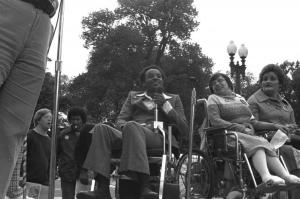
Every October, King County recognizes Disability Employment Awareness Month, celebrating the many contributions of people with disabilities to our communities, workforce, and country.
In 2021, the Disability Awareness Month Committee gathered stories about King County employees working to improve accessibility, provide services, and engage people with disabilities.
Employees get airport ready for snow

The National Weather Service is predicting a double-dip La Niña winter, similar to last winter. This weather pattern typically results in colder, wetter conditions in our region – including more snow. The teams at King County International Airport-Boeing Field are ready for whatever Old Man Winter brings. At a recent discussion, the Operations and Maintenance teams detailed their winter weather preparations:
- For 2021-22, the airport will use a new Priority surface clearing map, including taxiways A and B as Priority I.
- Thanks to some new hires, Operations now has 24-hour coverage. Both Operations and Maintenance will go into 24-hour coverage during any snow event.
- 27,000 gallons of liquid E-36 de-icer (airside) and 31,000 pounds of NAAC solid de-icer (landside) are available for use. Three additional E36 tanks are being installed in mid-November and will add 27,000 more gallons of capacity, for a total capacity of 54,000 gallons of liquid de-icer.
- Operations, Maintenance and Fleet Services will do practice snow removal runs in early November. These allow the team to ensure the equipment is in perfect working condition and give the drivers hands-on practice for navigating the airfield as a team.
- A request for new snow and ice removal equipment is under review for FAA funding, but won’t be here in time for this winter season. KCIA is requesting Multi-tasking Equipment (MTE) units – single operator units that include a snow plow and a snow broom.
Join the Walking Bus pilot program
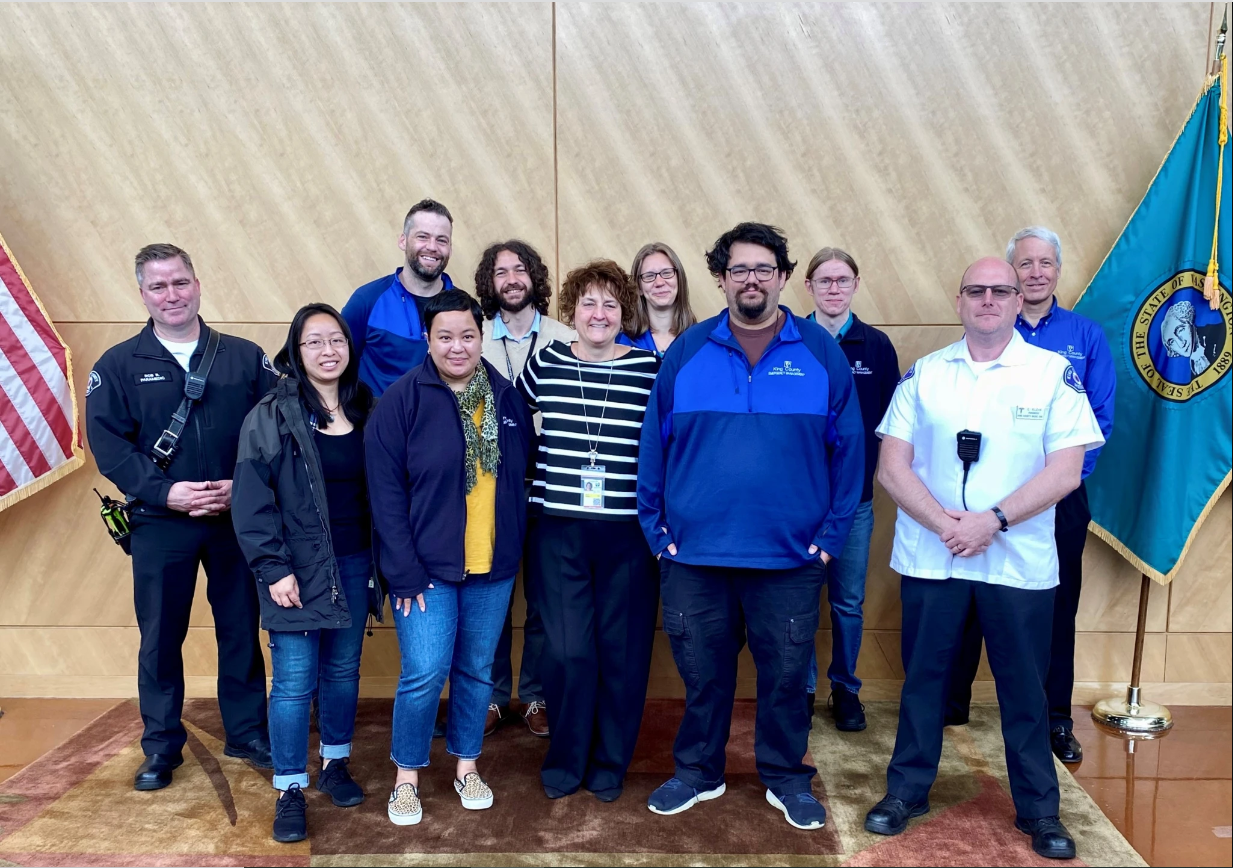
King County has launched a “Walking Bus” pilot program where county employees can join their colleagues and a Facilities Management Division (FMD) Security Escort each evening walking to the King Street Station and the Colman Dock from the downtown campus.

In this initial pilot phase, two dedicated security escorts will depart daily, Monday-Friday, from the King County Courthouse: one to the King Street Station and one to the Colman Dock ferry terminal:
Meet Location: King County Courthouse, 4th Avenue Entrance
Walking Time to King Street Station: 5-10 minutes
Walking Time to Colman Dock: 12-20 minutes
- To King Street Station – Depart 4th Avenue Entrance at 4:40 p.m.
- 4:55 p.m. train (southbound)
- To Colman Dock – Depart 4th Avenue Entrance at 5:05 p.m.
- 5:30 p.m. sailing to Bremerton (car)
- 5:30 p.m. sailing to Vashon Island (foot ferry)
- 5:40 p.m. sailing to Bremerton (foot ferry)
- 5:45 p.m. sailing to Bainbridge Island (car).
For additional information, please contact the FMD Security emergency dispatch center at 206-296-5000 or FMD.Security@kingcounty.gov.
The Walking Bus pilot program is in addition to security escorts offered by FMD Security Officers, who can escort you for several blocks from the building you work in, from downtown buildings to Goat Hill Garage or immediate vicinity bus stops. Please contact the FMD Security emergency dispatch center at 206-296-5000 or FMD.Security@kingcounty.gov to arrange for a security escort whether coming in to work or leaving work. Advance notice for a Security Escort is appreciated. You can learn about the many employee transportation and safety programs on the Future of Work Personal Safety site (employee access only).