Supporting working parents as schools return to in-person learning

Many school districts in our region have either restarted in-person learning or announced plans to restart in-person learning.  Seattle School District middle and high school students are returning to in-person classes April 19.

The return to in-person learning may create additional challenges for working parents and employees may need additional schedule flexibility or need to take leave during this learning transition.

We have provided some options below to support employees with school-aged children. Please work with your supervisor and seek approval when pursuing these options, and consult your HR Manager for more details. Supervisors are encouraged to be supportive and flexible with employees’ requests whenever possible.

  1. Request an adjustment to your work schedule. If you need to provide care or learning support for children during your usual workday, talk with your supervisor about whether an adjustment to your schedule could meet both your needs and the business needs of the county. Where permitted, an employee may adjust the time period in which they complete each day’s required work hours to help them better manage the competing demands on their time.

    For example, instead of a standard 8 a.m. to 5 p.m. work schedule, an employee may be permitted to adjust their schedule to 6 a.m. to 10:30 a.m. and 3:30 p.m. to 7 p.m. five days a week. Employees may also be permitted to adjust their schedule to work a different number of hours on each day of the week as long as they complete their regular 35- or 40- hour work week. It is recommended that you create a consistent schedule to allow for some predictability for both your home and work life.

    This option will not be appropriate for every employee or every function and will require the approval of an employee’s supervisor. Any change to the schedule of an employee represented by a labor organization must be consistent with the relevant collective bargaining agreement. If an employee would like to adjust their hours, they are encouraged to have a discussion with their supervisor.

    A Pandemic Alternative Work Schedule form must be completed and approved by the employee’s supervisor prior to beginning an adjusted schedule. After an employee begins an adjusted schedule, supervisors should conduct periodic reviews with the employee to evaluate the success of the arrangement. 

    ***Supervisors:  Consider how you can support a schedule change and consult with your department’s HR Manager if you have questions or concerns.
  2. Request to use your own accruals for time off. You can request to use your leave balances (vacation, BTO, comp. time, executive leave, etc.). For hourly employees this could mean taking two hours of vacation time and then logging six hours of work time. Currently FSLA exempt employees are not approved to use their own accruals in partial day absences. 

    ***Supervisors:  Consider how you can support your employee’s request and consult with HR if you have questions or concerns.
  3. Request an Unpaid Leave of Absence. Ask your HR representative about the possibility of taking an unpaid leave of absence. Employees should also discuss potential impacts to employee benefits (for example, retirement credits, healthcare benefits, leave accruals, etc.) with HR. 

You will also find more on leave options, telecommuting, and COVID-19 protocols in our Temporary COVID-19 Personnel Policy.

Metro Transit has also provided some useful tips to help students and families get ready for using transit for their school commute. Learn more here.

How to schedule a COVID-19 vaccine appointment

COVID-19 vaccine eligibility is currently open to those who qualify under Phases 1A and 1B Tiers 1-4, but starting Thursday, April 15, all Washington residents age 16 and up will be eligible to receive a COVID-19 vaccination.

Whether you are eligible now or will be on April 15, it is important to remember that there are several ways you can make an appointment for the vaccine:

  • Go to vaccinelocator.doh.wa.gov to search for COVID-19 vaccine appointments near you by zip code.
  • Call your doctor’s office or health care provider to see if they have available vaccination appointments. 
  • Whether you’re a Kaiser Permanente member or not, King County employees can follow these steps to get a COVID-19 vaccine with Kaiser Permanente.
  • For language interpretation, call the Washington state COVID-19 Assistance Hotline: Dial 1-800-525-0127 or 1-888-856-5816, then press #. Available Monday 6 a.m. to 10 p.m., and Tuesday to Sunday and observed state holidays 6 a.m. to 6 p.m. For language interpretation, state your preferred language when you are connected. Phone support is also available from the Public Health COVID-19 Call Center at 206-477-3977, 8 a.m. to 7 p.m.
  • WA COVID Vaccine Finder is a volunteer-driven effort to help Washingtonians find appointments for the COVID-19 vaccine: covidwa.com
  • Preregister with the City of Seattle’s vaccination appointment notification list at the four city-affiliated vaccination clinics. You can also call 206-684-2489 between 8 a.m. and 5 p.m. for sign-up assistance. The sites are Lumen Field Event Center (330 South Royal Brougham Way), North Seattle College Community Vaccination Hub (9600 College Way North), Rainier Beach Community Vaccination Hub, 8702 Seward Park Ave. S., and West Seattle Community Vaccination Hub (2801 S.W. Thistle St).

Leave time: If your COVID-19 vaccine appointment occurs during a time you are scheduled to work, please follow regular procedures for requesting leave. Sick leave and COVID-19 Paid Administrative Leave may be used for COVID-19 vaccine appointments as well as recovering from side effects.

After COVID-19 vaccination: Thank you for getting vaccinated and helping our communities get one step closer to overcoming this pandemic. After vaccination, it’s important to continue COVID-19 precautions to protect co-workers, friends, and family. Please follow Public Health’s guidance at www.kingcounty.gov/vaccine.Employee webpage: Visit out one-stop employee COVID-19 vaccines webpage where you can learn how to find out when you are eligible, how to schedule a vaccine, your leave options, and much more. 

School-to-Work Transition Fairs go virtual in 2021

Since 2005, in response to community need, the King County School-to-Work Program (S2W) has partnered across numerous organizations to help students with developmental disabilities seek and gain employment before they leave their high school programs.

This year, S2W is excited to present its Annual Transition Fair exclusively online. As in previous years, the highly anticipated event is offered to the entire community – families, teachers, local agencies, and potential employers. The Transition Fair is designed to help students with developmental disabilities find employment before leaving their high school programs.

Register now

Participants can access online content anytime through May 31. There are a wide variety of resources, featuring new videos on the School-to-Work program, what it is and how to participate. These testimonials by students, families, schools and other community partners share how it is key to focus on employment early, what success looks like, advice for families, and how services have adapted and remain important during COVID-19.

There will be two virtual Exhibitor Expos with more than 40 community partners, including supported employment agencies for students before they leave school. Representatives will be available in virtual rooms for real-time conversations.

Like past events, attendees can learn about a wide range of services and resources, including Washington’s adult employment services system, Social Security, housing, recreation, guardianships, wills and trusts, as well as other critical information to successfully transition students to adult living.

  • Tuesday, April 20 from 9:30 a.m. ‑1 p.m.
  • Saturday, May 1 from 9:30 a.m. ‑1 p.m. 

Open Doors for Multicultural Families will be offering both support and interpreter services for the live presentations.

Open Doors provides culturally and linguistically relevant information, services, and programming to families of persons with developmental and intellectual disabilities.

Registration gives you access to additional live presentations like the School-to-Work Program Orientation, and both Washington’s Developmental Disabilities Administration and Division of Vocational Rehabilitation on eligibility, services for youth, and their partnership with the School-to-Work Program.

  • King County School-to-Work Program: Wednesday, April 21from 3:00‑4:30 p.m.
  • Division of Vocational Rehabilitation Transition Services and School-to-Work: Tuesday, April 27 from 1‑2 p.m.
  • Developmental Disabilities Administration Eligibility and Services: Wednesday, April 28 from 9‑10 a.m. 

King County has been a national leader for over 20 years in promoting and supporting people with developmental disabilities to gain and maintain employment. Starting early, the School-to-Work program has supported hundreds of students to obtain employment upon leaving high school, becoming highly valued members of the workforce in hundreds of businesses in our region.

Please share with all who may be interested and Register here!


Celebrating our 911 staff National Public Safety Telecommunicators Week

This week we are recognizing King County’s 911 Communications Center employees and the KCIT employees who support the 911 system during National Public Safety Telecommunicators Week, Sunday, April 11 through Saturday, April 17.

911 Communications Center

911 Communications Center employees are the primary link between people who desperately need help and people who provide it. The King County Sheriff’s Office handles 911 calls from unincorporated King County, 12 cities, Metro Transit Police, King County Airport Police, and Regional Animal Services of King County.

More than half a million people rely on the County’s call receivers, dispatchers, and other personnel who answer and dispatch calls for police services, take police reports by phone, research “tape” requests, support the computer aided dispatch (CAD) and E-911 systems, and manage a host of special projects and functions.

The E-911 Program Office is within KCIT and is responsible for ensuring correct routing of a 911 call to the appropriate Public Safety Answering Points (PSAP), which provide 911 call answering and dispatch services for local jurisdictions

If you ever need to make a 911 call, you can find crucial information on what to do when you call 911 on the Enhanced 911 website and the Sheriff’s 911 Communications Center website.

New King County eLearning platform “Learn” is launched

from Whitney Abrams, Chief People Officer

Whitney Abrams,
Chief People Officer

King County is launching a new platform to power King County eLearning, our online learning system, called NEOGOV Learn.

King County eLearning offers thousands of courses and with NEOGOV Learn now powering it, you will be better able to customize and track your learning, access courses that have been assigned to you, and get credit for your attendance at classes and webinars.

There are a couple of ways you can log in:

  • If you have a @kingcounty.gov email address:
    • Login through single sign here.
    • Open the new NEOGOV icon on your computer’s desktop.
  • If you don’t have a @kingcounty.gov email address:
    • Submit a HelpDesk ticket to set up a free account. Use the following path to expedite your request: “I want something new” > “Human Resources (DHR) – Shared Services”

Once you have logged in, click on “Training” to show your “Overview,” “My Courses,” “Course Catalog,” and “Training Activity Report.” For more information on using the new King County eLearning, go to kingcounty.gov/kcelearning for FAQs and more, and watch our Introduction to Learn video and How to navigate King County eLearning video.

I encourage you to think about your development and career goals and talk to your supervisor about how King County eLearning can help you reach them. If you are in a position that is eligible for overtime pay and you would like to take a course or video that is directly related to your current job on paid time, you must first obtain your supervisor’s approval. If a course or video is not directly related to your current job, you may take it without your supervisor’s approval, but you will not be compensated for the time you spend taking the training, and you must take it outside your regular work hours or at a time you and your supervisor agree upon.

I hope you find the new King County eLearning a useful tool that helps you learn, grow, and reach your personal and professional goals at King County.

Refer your favorite nonprofit for the Employee Giving Program

During these times of acute social change, our community’s nonprofit organizations have dealt with extreme shifts in patronage and support. The arts and entertainment went virtually dark for most of the year, education programs moved 100% online, and food banks saw their lines multiply.  

Enrollment deadline is May 11 

Through it all, the King County Employee Giving Program has helped keep employees connected to the organizations and causes they are most passionate about. In the true spirit of giving and service, employees donated over $2 million through the Giving Program in 2020. 

Nonprofit enrollment in the Employee Giving Program deadline is May 11

Each year, King County employees support nonprofits through the Annual Giving Drive, volunteering and more. Employees are encouraged to invite their favorite nonprofit to enroll to be included this year’s program.  Enrollment for nonprofits to participate is now underway through May 11. 

Click here to invite your favorite nonprofit to participate.   

During the Annual Giving Drive, employees are encouraged to share their passion about their favorite nonprofit during team meetings and via social media, and, of course, pledge to the organization.  

All nonprofits that apply and meet eligibility requirements annually will be in the upcoming Annual Giving Drive.  

Any King County employee can refer a nonprofit to participate in the Annual Giving Drive. Some examples of the employee referred nonprofits this year include: 

  • Community Passageways 
  • Renton Regional Community Foundation 
  • Choose 180 
  • Seattle Music Partners   

If you have questions, please email employeegiving@kingcounty.gov 

Equipping employees to advance equity and social justice

King County is helping employees build their equity and social justice (ESJ) skills and knowledge by offering a new and updated suite of ESJ learning opportunities.

The Department of Human Resources’ Learning & Development (L&D) team is offering foundational ESJ learning opportunities throughout this year. In early 2020, the L&D team took on this important set of ESJ education work initiated by the Office of Equity and Social Justice (OESJ). With the onset of the pandemic, the team was able to quickly redesign and adapt ESJ curricula for online delivery to continue making learning accessible for both onsite and remote employees.

“During the last year, Learning and Development’s work has had to be agile and responsive to the changing landscape in terms of workforce needs and delivery of our learning resources,” said Ariana Bostian-Kentes, Learning & Development Manager. “Our team has done a great job of transforming our approach and adapting quickly to move our learning from the classroom environment to the virtual space, as well as creating new ways to continuously center equity and social justice learning in everything we do.”

The ESJ learning portfolio now includes Equity and Social Justice Fundamentals, Race: The Power of an Illusion, and  Building Gender Inclusive Spacesan additional formal training which focuses on the intersectionality of race and LGBTQ identities. All are offered once a quarter.

The team has also been hard at work developing new curriculum to be launched this year aimed at people leaders, and an ESJ facilitation training program to build this important capacity at the County.

Tynishia Walker and Keith Clarke, Equity and Social Justice educators
from Learning and Development

Leading that work is Tynishia Walker, former Equity and Social Justice Program Manager at OESJ and now one of the L&D team’s ESJ Educators. Informed by her experience leading ESJ learning at OESJ, Tynishia and the L&D team collaborated to design a strategy to support and sustain ESJ education across King County.

The ESJ Educators are also supporting and consulting on other areas of Learning and Development work. “Because of the ways in which race and racial disproportionalities are showing up in our community now and always, part of the work is ensuring that no matter the topic, our team is developing curriculum for, or facilitating an eye towards racial justice is woven throughout,” Tynishia said.

Keith Clarke joined the L&D team as the second ESJ Educator at the end of 2020. Most recently he worked as the ESJ Veteran Fellow in King County Information Technology (KCIT). Keith’s experience and long history of ESJ work with various organizations has made him a dynamic and valuable addition to the team. With the successful hiring of these two full time ESJ Educators, the L&D team will be able to help offer ESJ learning more readily and consistently to the County’s workforce.

You can learn more and sign up to attend these classes and other upcoming training opportunities on the Learning and Development trainings webpage or email KCTraining@kingcounty.gov. For other ESJ information and resources, check out the Office of Equity and Social Justice website.

Understand your options for scheduling a COVID-19 vaccine appointment

COVID-19 vaccine eligibility is currently open to those who qualify under Phases 1A and 1B Tiers 1-4, but starting Thursday, April 15, all Washington residents age 16 and up will be eligible to receive a COVID-19 vaccination.

Under Phases 1A and 1B Tiers 1-4, those currently eligible includes all people age 60 and older, people 16 years or older with two or more co-morbidities or underlying conditions, people, staff and volunteers in certain congregate living settings, and additional high-risk critical workers in certain congregate settings.

Whether you are eligible now or want to learn how you can schedule an appointment once eligibility expands on April 15, find out how you can get the COVID-19 vaccine:

  • Go to vaccinelocator.doh.wa.gov to search for COVID-19 vaccine appointments near you by zip code.
  • Call your doctor’s office or health care provider to see if they have available vaccination appointments. 
  • Whether you’re a Kaiser Permanente member or not, King County employees can follow these steps to get a COVID-19 vaccine with Kaiser Permanente.
  • For language interpretation, call the Washington state COVID-19 Assistance Hotline: Dial 1-800-525-0127 or 1-888-856-5816, then press #. Available Monday 6 a.m. to 10 p.m., and Tuesday to Sunday and observed state holidays 6 a.m. to 6 p.m. For language interpretation, state your preferred language when you are connected. Phone support is also available from the Public Health COVID-19 Call Center at 206-477-3977, 8 a.m. to 7 p.m.
  • WA COVID Vaccine Finder is a volunteer-driven effort to help Washingtonians find appointments for the COVID-19 vaccine: covidwa.com
  • Preregister with the City of Seattle’s vaccination appointment notification list at the four city-affiliated vaccination clinics. You can also call 206-684-2489 between 8 a.m. and 5 p.m. for sign-up assistance. The sites are Lumen Field Event Center (330 South Royal Brougham Way), North Seattle College Community Vaccination Hub (9600 College Way North), Rainier Beach Community Vaccination Hub, 8702 Seward Park Ave. S., and West Seattle Community Vaccination Hub (2801 S.W. Thistle St).

Leave time: If your COVID-19 vaccine appointment occurs during a time you are scheduled to work, please follow regular procedures for requesting leave. Sick leave and COVID-19 Paid Administrative Leave may be used for COVID-19 vaccine appointments as well as recovering from side effects.

After COVID-19 vaccination: Thank you for getting vaccinated and helping our communities get one step closer to overcoming this pandemic. After vaccination, it’s important to continue COVID-19 precautions to protect co-workers, friends, and family. Please follow Public Health’s guidance at www.kingcounty.gov/vaccine.

Employee webpage: Visit out one-stop employee COVID-19 vaccines webpage where you can learn how to find out when you are eligible, how to schedule a vaccine, your leave options, and much more. 

Executive Constantine recognizes Public Health staff in National Public Health Week

King County Executive Dow Constantine recorded a short video thanking Public Health – Seattle & King County employees for all of their work amid the COVID-19 pandemic in recognition of National Public Health Week, April 5-11, 2021.

“I’d like to take a moment to thank all of our staff at Public Health – Seattle & King County for the incredible work you’ve been doing for the past 13 months and more as we confront this once in a century pandemic,” Executive Constantine said in the video. “You’ve saved thousands of lives. You’ve worked around the clock seven days a week. It has been remarkable.”

Executive Constantine also issued a Proclamation proclaiming the week of April 5 to 11, 2021 to be Public Health Week in King County.

You can watch the video and read the Proclamation below.

Thank you for your participation

from Whitney Abrams, Chief People Officer

Dear fellow King County employee,

Whitney Abrams,
Chief People Officer

I sincerely want to thank you for taking the time to participate in the 2021 Employee Survey. Following a year like no other, your feedback will be more important than ever in helping us build a truly inclusive, respectful, and supportive workplace.

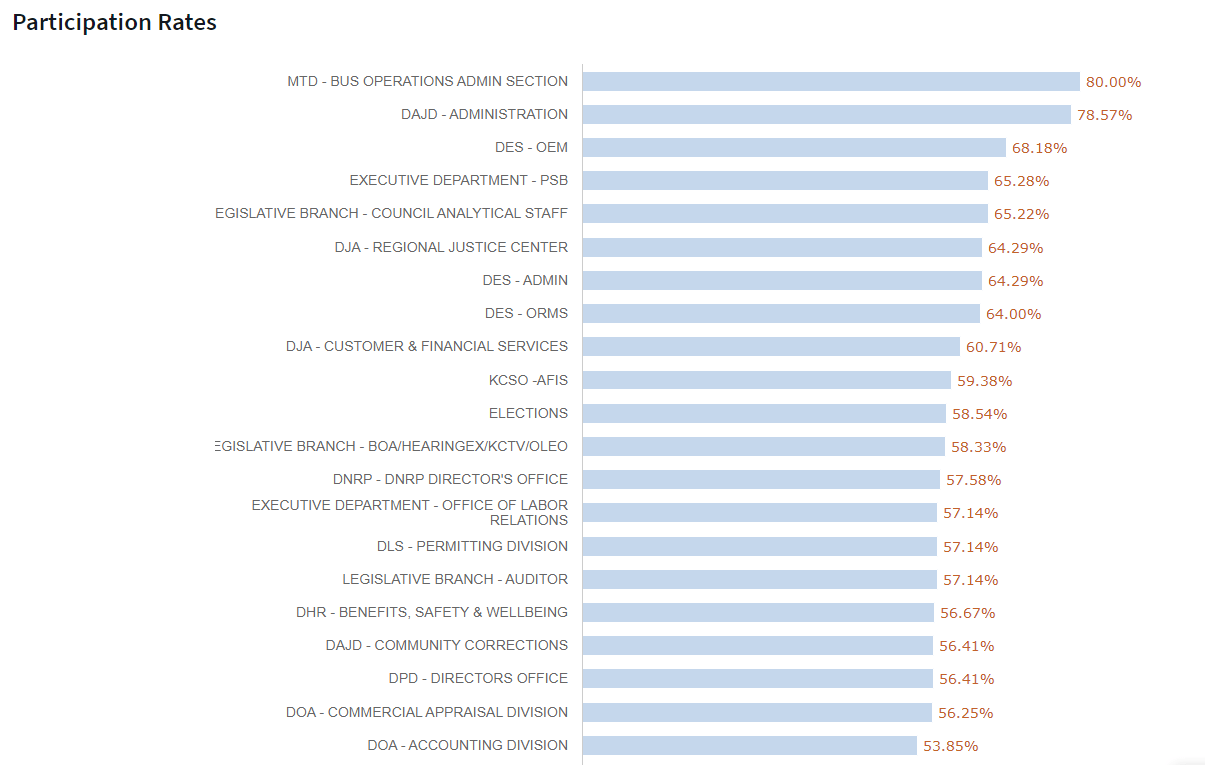
This year more than 66% of eligible employees had their say in the survey. Your feedback and comments are being compiled and analyzed, and we will share the results with you in May. These results will guide us as we move forward into the future of work for King County, from what will the ‘new normal’ for many employees to the long-term planning in all our services. 

Our goal of having a highly engaged, inclusive, and culturally responsive workforce remains paramount. Your input is one of the most important tools for us to achieve this and we’re committed to being responsive to your contributions.

Thank you for your participation and for all you do to make King County a great place to live and work. 

Best regards, Whitney