
King County launches SoundGuardian to join emergency Puget Sound orca recovery effort
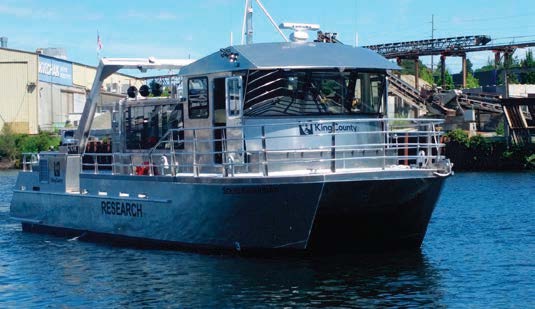
On the morning of Aug. 5, King County’s research vessel, SoundGuardian, departed its Seattle homeport on its way to northern Puget Sound to take part in an emergency effort to save ailing members of the endangered resident orca population.
King County research vessel SoundGuardian.
“Orcas are the Salish Sea’s most iconic residents, and we all share the responsibility of protecting these beloved animals,” said King County Executive Dow Constantine. “We are doing whatever we can to help the orca now, and fulfill long-term goals to improve the health of local waterways and the Salish Sea.”
Operating with a crew of three, SoundGuardian left its dock at the King County Environmental Laboratory in Fremont early Sunday morning, Aug. 5, charting a course to dock at Squalicum Harbor in Bellingham later that day.
SoundGuardian will operate with other vessels under the authority of National Oceanic and Atmospheric Administration officials who are coordinating emergency recovery actions.
Launched in 2016, SoundGuardian is King County’s primary marine research vessel and is used by scientists to collect samples, assist in monitoring buoy maintenance, and other work. The 48-foot, twin-hulled vessel provides workers with a swift and stable platform for a variety of open-water tasks.
SoundGuardian is an essential component of Executive Constantine’s Clean Water and Healthy Habitat Agenda that includes removing salmon-blocking culverts to improve fish populations, habitat restoration, and continuing investments in wastewater and stormwater systems.
Read more in the official press release.
Share this:

Metro earns top award – best in North America

In a message to Metro’s employees, General Manager Rob Gannon shared the fantastic news that the American Public Transportation Association has recognized King County Metro as Outstanding Public Transportation System of the Year!

Dear Metro colleagues,

King County Metro General Manager Rob Gannon
I have wonderful news to share with you: Metro has been named Outstanding Public Transportation System of the year—the best among the largest transit agencies in North America.
All of you—our 4,800 employees—earned this honor through your hard work, exceptional customer service, and innovations in service and technology. I am immensely proud to be part of this agency, where so many people with different skills, backgrounds, thinking and experiences work together to deliver excellent service to the public.
This prestigious award, bestowed by the American Public Transportation Association (APTA), recognizes Metro’s impressive achievements over the past three years, including:
- Efficient, effective operations
- A 15 percent expansion of service and record-high ridership
- Leadership in adopting new electric trolleys and battery buses as we move toward a zero-emission fleet
- Enhancement of our safety program
- Our ORCA LIFT reduced fare that’s making transportation more affordable for 70,000 people with low incomes
- New mobility solutions to meet local community needs, such as community shuttles
- Our long-term plan, METRO CONNECTS, that lays out our vision for doubling transit service over the next 25 years and offering more frequent, innovative, and interconnected mobility options all day long across King County.
The scope of these accomplishments, and the fact that many were made under intense time pressure, makes them especially remarkable.
A community honor
Our successes stem not only from our internal efforts, but also from steadfast community support. We are fortunate to have elected leaders who strongly back transit, cities and transit agencies that partner with us to create services that work, voters who have approved transit funding, and hundreds of thousands of riders who choose Metro buses, vanpools, and other mobility options every day. The APTA award is truly a community honor—we got there together.
What’s ahead
While the award recognizes what we’ve done, it also positions Metro to be a leader in the future. APTA has more than 300 transit agency members in the U.S., Canada and around the world. At a time when many of these agencies are experiencing declining ridership, competition from other transportation providers, and rapid technological change, they’ll be turning to us as a model for surviving and thriving. This is a great opportunity for us to continue being innovators and leaders.
There is still much work ahead as we continue to grow our system. A hallmark of our agency is our relentless drive to improve. Our goal is sustained excellence: we work every day to serve our customers—and each other—even better.
The Outstanding Public Transportation System Achievement Award will be formally presented at APTA’s annual meeting in September. We’ll be celebrating and highlighting this honor in various ways throughout the year ahead.
Take care of each other and be safe—and proud!
Rob Gannon, General Manager
King County Metro
Share this:

Trauma-informed fitness leads to skill building for youth
Crossposted from Zero Youth Detention
“Our job is to listen.”
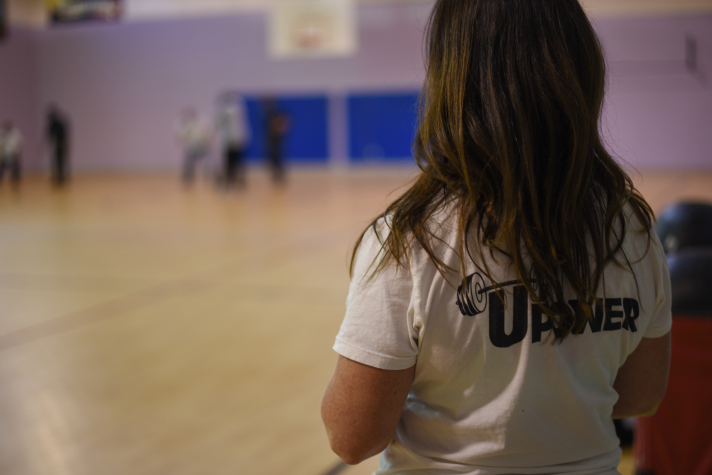
That is how Upower coaches describe their role in offering fitness classes at the King County Juvenile Detention Center.
Upower offers trauma-informed fitness and wellness classes at no cost to underserved teens in King County. Their classes are fun, safe and open to all fitness levels. Upower’s sensitive approach to trauma-informed fitness means that they advocate for physical fitness and social-emotional well-being for every teen served.
Upower coaches get teens moving through activities such as cardiovascular conditioning, strength training, flexibility and fun fitness games. Equally important are the regular check-ins that help teens build trust with peers and coaches, develop social skills and pro-social connections, increase self-awareness and regulation of emotions as well as encourage leadership skills. Together these activities are a therapeutic outlet that helps teens practice coping skills, focus on the future and become positive members of society.
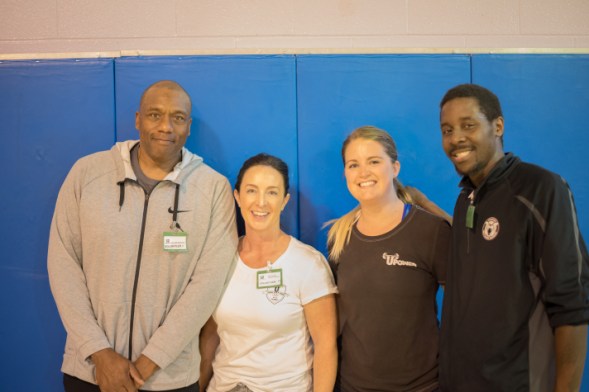
Stafford Mays, Kate Holman, Leighla Webb, and Zo Jackson–some of the many Upower coaches and staff who provide fitness classes at the King County Juvenile Detention Center.
Upower brought their trauma-informed programming to the King County Juvenile Detention Center through their relationship with Interagency Schools–the alternative school for Seattle Public Schools, which is present within the Juvenile Detention Center. The average number of Adverse Childhood Experiences (ACEs) for kids in interagency schools is seven out of a list of 10 recognized ACEs. It is likely higher for kids in the interagency school in Juvenile Detention. These are very high numbers that speak to a lot of past trauma and place these kids at high risk for negative long-term effects. Therefore a trauma-informed approach is necessary across all Juvenile Detention programming and partnerships.
What does an Upower class look like in Juvenile Detention?
Upower classes are structured but with a lot of flexibility to be responsive to the youth. The coaches describe it as “meeting kids where they are at and determining a workout based on energy levels.” This can look like a yoga and stretching class, or an intense game of basketball. Whatever the format, the youth walk away feeling good after class.
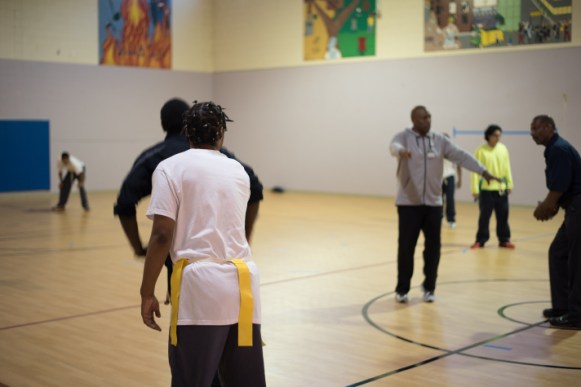
This was a high energy class so the coaches led a full hour of flag football!
The value of Upower fitness classes for youth in Juvenile Detention
Upower’s fitness programming supports youth in building a number of skills including coping skills when faced with triggers and stress. Physiological responses are similar to working out and it’s not always a bad thing–youth learn you can experience a physiological response and it can be okay.
Youth learn to regulate emotions
Emotion regulation is a social skill. When youth feel the same adrenaline and stress responses in a fitness class that they may feel in other stressful situations, they can learn coping skills that will benefit them when they leave Juvenile Detention. Coaches are trained in de-escalation and model the skills they want the youth to build. In tense situations, coaches ask consistent and calming questions, while being authentic and 100% genuine. As one coach said, “Kids are a good judge of character–they see through you!”
With consistency and care, comes trust as the youth learn that the Upower classes are a safe place. Another coach shared, “They [the youth] don’t perceive us as a threat. The kids feel loved by us.” Because the coaches are good listeners, youth often open up to the coaches and sometimes share things they don’t share with others. The physical and the emotional are connected.
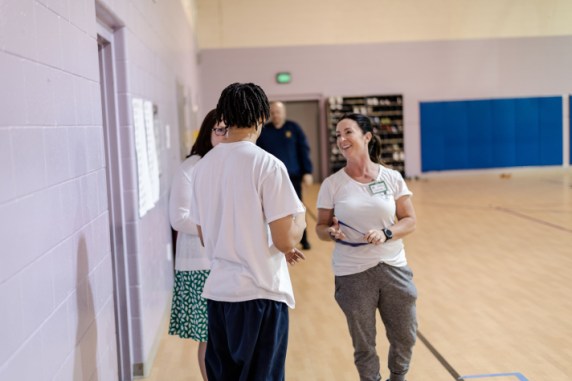
A youth hangs out on the sidelines, talking with a Upower coach and King County program staff.
Not only do youth make personal connections with the coaches as mentors, but they make personal connections with their peers. While running and bonding during a team sport, kids can be physically affectionate with one another, which may not happen often otherwise. In doing so, they are building accountability to each other and learning to regulate emotions in a healthy way.

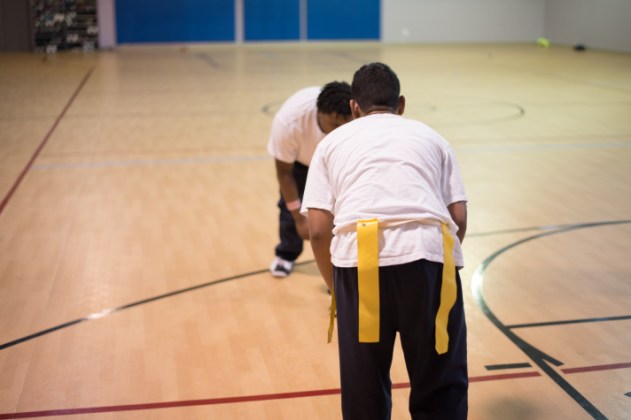
A moment of encouragement during a flag football game.
Youth learn to problem solve
Upower fitness classes create a safe environment for kids to learn and sometimes fail. Coaches describe an environment in which kids don’t get to pick their “teams” the same way they would on the “outside.” In order to make things work, the youth have to figure it out and the coaches are there to help facilitate problem solving.
These problem solving skills follow them when the youth leave the Detention Center and they model these skills (and others) with their community outside Detention. In fact, many of the youth that participate in Upower classes inside Detention continue to be involved with Upower on the “outside” and even recruit many of their friends to participate as well!
Connections to relationships and resources
The Upower coaches build relationships with the youth who attend their classes and are a positive adult mentor in the kids’ lives. These relationships matter when the youth transition out of the Detention Center back into community. The coaches offer connections to resources and other positive relationships on the “outside,” and will ask the youth, “Who can we connect you with to help you?”
Trauma-Informed Approach
Trauma and toxic stress negatively impact the health of communities. Public Health-Seattle & King County promotes resilience and protective factors to reduce the negative impacts of trauma on our community’s health. Public Health’s goal is to promote integration of core concepts of trauma informed practice by creating a shared culture and common language, beginning with staff and programming. With Public Health now overseeing Juvenile Detention programming, programs that are trauma-informed like Upower’s fitness classes are excellent examples of existing partnerships that the County hopes to expand upon.
Stay tuned to the blog for future stories on other trauma-informed programs taking place in the Juvenile Detention Center.
Share this:

Now recruiting Ambassador teams
Crossposted from Employee Giving Program
By Junelle Kroontje
Build your resume AND make a difference? Yes, you can have it all.
Join our rock star Ambassador team for our 30th Anniversary year!
Ambassadors are the most important element of our Employee Giving Program team. You will be the key to making sure that every King County employee has a quality opportunity to support a cause they care about through the program; literally bringing transformative moments of meaning to your colleagues.
You get to:
- Meet new people,
- Advocate for your favorite cause, and
- Build rock star skills.
Check our top 5 reasons to get involved here.
Average commitment:
- 4-6 hours of training and prep
- 1-2 hours per week during Annual Giving Drive
- Done at work-site in your current position
Get your supervisor’s approval and then sign-up for training here:
Sept. 4 | 12pm-4pm @ Chinook
Sept. 11 | 9am-1pm @ Elections in Renton
Sept. 12 | 9am-1pm @ King Street Center
What is the impact?
When the experience is supported and voluntary, this is the average Ambassador outcome:
- 20% participation and $8,000 in pledges (This can plant 8,000 trees or provide 20,000 meals)
- Put it on your Resume! Top four skills developed:
- Organization and multitasking
2. Communications and marketing
3. Cooperatively working with employees at all levels of the organization
4. Patience
- More engagement at work! Ambassadors and those who help at their work sites are 22% more engaged than employees who do not use the program. Contribute to teamwork, morale, gratitude, pride, and productivity!
- Provide powerful – possibly life-changing – moments of meaning to co-workers.
How awesome is that?! Join here
Share this:

King County represents at Reebok RAGNAR Northwest Passage ‘200-ish’ mile relay
By Al Dams, Chief Deputy Assessor
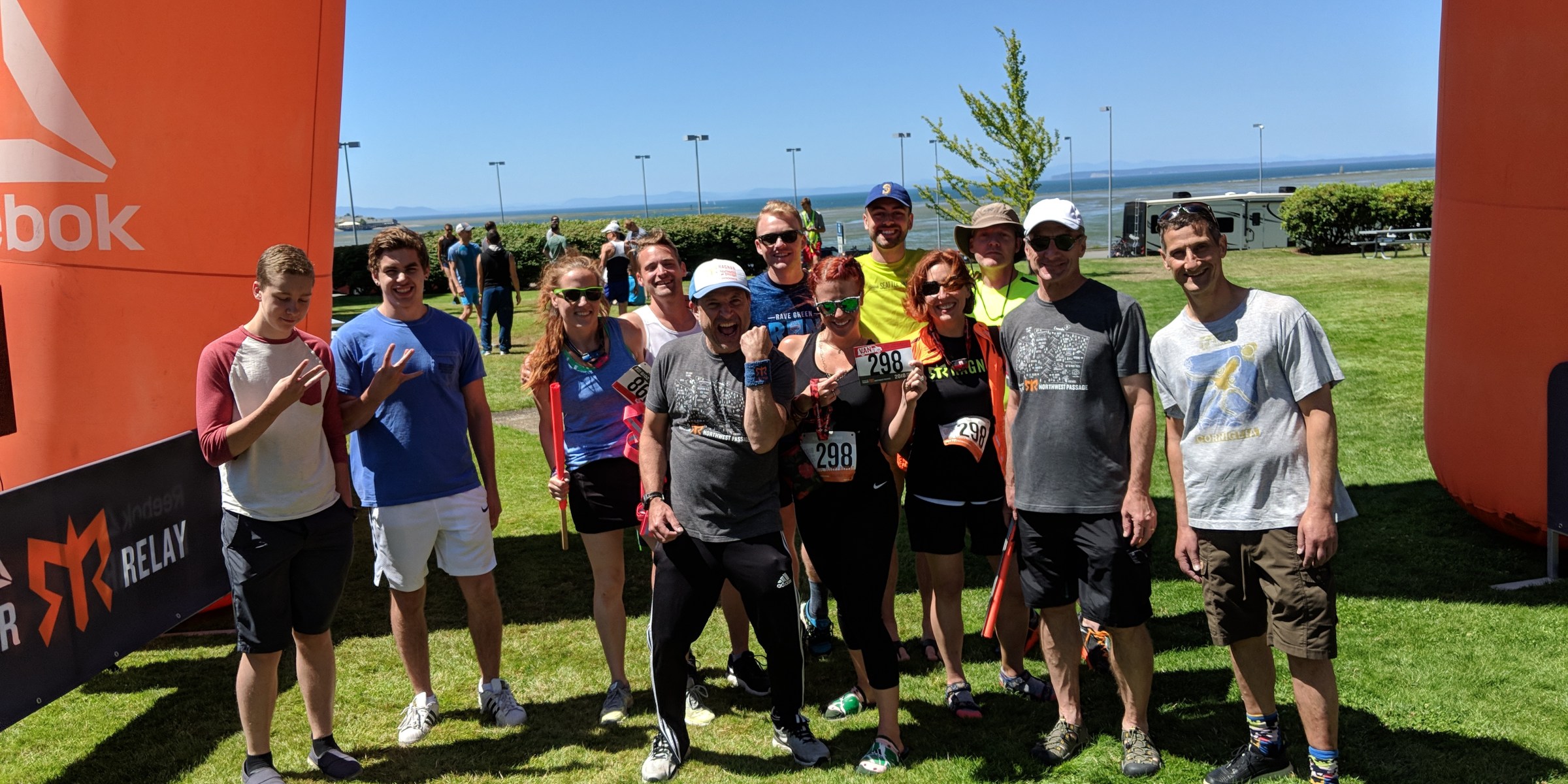
The 2018 King County Bureaufasts Ragnar Relay team at the race start line. From left to right: Simon Fraser, Vincent Dams, Ellie Letterman, Matthew Browning, Al Dams, Garrett Lee, Ashley Wilson, Adam Vance, Annie Kolb-Nelson, Seth Watson, Ken Guy and Brendan Camarda.
The King County Bureaufasts completed their third Ragnar Relay this month, coming in fifth place overall in the Corporate Division. The 200-mile relay race is always a test of determination for your King County runners, but this year proved to be even tougher than usual as the team faced very hot temperatures, an injury during the race, and other challenges. Nonetheless, the Bureaufasts endured and still managed a respectable time and a good number of “road kills” for passing other teams on the course that winds from the Peace Arch in Blaine to Whidbey Island. The team is already looking forward to next year’s race! Are you? Let me know if you’re interested in joining us.
Read about the Bureaufasts’ first and second Ragnar Relay adventures on our blog!
Share this:

Kudos! to Maleng Regional Justice Center in Kent
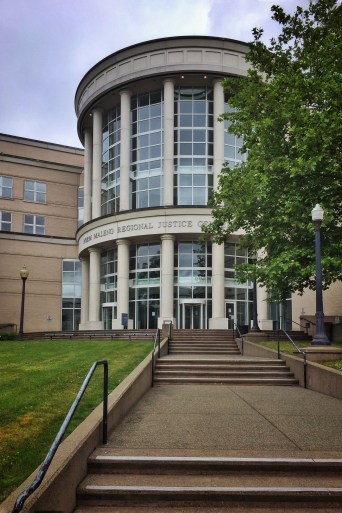 The U.S. Census Bureau returned to MRJC last month to conduct a Community Survey of sampled inmates. The Department of Adult and Juvenile Detention facilities are periodically selected for the surveys, and DAJD makes special efforts to facilitate. DAJD received this written Thank You from the interviewer, a field representative from the Los Angeles Regional Office of the American Community Survey:
Thank you for all your help in accomplishing the American Community Survey at MRJC today. It is always a pleasure to deal with your community of dedicated and efficient professionals. Your efforts on behalf of the Census goals are greatly appreciated.
Best regards,
Jan
Kudos, MRJC and DAJD!
Share this:

Announcing Community-Designed Home-Based Programs and Practices Awards
Crossposted from the Best Starts for Kids Blog
We’re thrilled to announce ten awardees for the prenatal-to-5 Community-Designed Home-Based Programs & Practices funding opportunity. With a total investment of $5,825,000 million over 2.5 years, these awards to community-based organizations will expand the availability of home-based services that draw upon local community knowledge and practice to develop approaches that are designed for and valued by specific communities, and/or addressing populations not well-served by other programs.
Congratulation to our new partners:
- United Indians of All Tribes
- East African Community Services
- Atlantic Street Center
- Centro Rendu @St. Vincent DePaul
- Iraqi Community Center
- Open Arms Perinatal Services
- El Centro de la Raza
- Somali Health Board
- Coalition for Refugees from Burma
- Open Doors for Multicultural Families
Best Starts has made significant investments in evidence-based and evidence informed home-based programs and we are now so excited to invest in community-based expertise—such as experience, knowledge, and local client data—that embraces the concept that “practitioners in the field, families, communities, and diverse cultures serve a vital role” in identifying optimum programs and practices. This is the first significant public investment in community-designed programming for home visiting in King County.
For a full list of awardees and their projects, go to the Best Starts for Kids awards database and filter by the Home-Based Services: Community-Designed strategy. (information will be available soon if not available already)
During the program development phase, Best Starts is supporting awarded partners by providing capacity building through the Capacity Building RFP that was also recently awarded. Stay tuned to the blog to soon meet those awarded community partners!
“This funding will address barriers faced by our focus community; immigrants and refugees from Burma, Iraq, Somalia, Latinx countries, and other new arrival communities living in South King County, by connecting parents to a trusted leader from their own communities in the form of a home visitor. All discussions and early learning/kindergarten readiness information are delivered in the native language of the parent, in a culturally relevant way. Learning toy delivery and interaction modeling will encourage parents to increase the quality and quantity of interactions with their child, which will in turn influence that child’s future success in school,” said Mona T. Han, Executive Director of Coalition for Refugees from Burma. Their Leadership, Education, and Access Program (LEAP) serves low-income, limited English-speaking people of color and based on the theory that refugees and immigrants rely on a community-based system of knowledge acquisition.

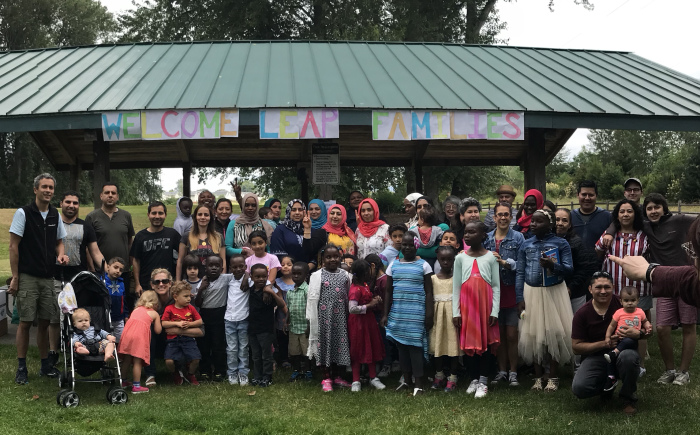
LEAP families and their community leaders (home visitors) served by the Coalition of Refugees from Burma in the past year.
As one of the Coalition for Refugees from Burma home visitors shared, “Our presence in the homes of the families is really special, especially the demonstration of playing with the children and providing examples to parents. The parents are so thankful to us for sharing creative ideas on how to play with their children. Having the same home language and cultural reference points are unique features of CRB’s LEAP program, and parents seem really interested to build their children’s skills while building their cultural identities.”
Equity Embedded in Program and Practice
The foundational principle behind the community-designed home-based services investment is that equity must be embedded in all programs and practices. Best Starts awarded organizations that are reflective of and embedded in the communities they serve, and recognize and address the disparities and disproportionality that exist in our communities.
For example, the Somali Health Board will use their awarded funding to develop and implement their home-based services program, Somali Centering Motherhood Program. Their project incorporates elements of the evidence-based models called CenteringPregnancy® and CenteringParenting® that the Centering Healthcare Institute developed in the 1990s. The Somali Health Board will adapt the model to include culturally relevant practices for the Somali community and relationship-based home visits. All services will be provided in Somali by Somalis.
“The Somali Health Board is excited to receive this award to implement Somali Centering Motherhood project which facilitates prenatal and postnatal care groups for expectant mothers- A new approach to care and an attempt to innovatively address significant maternal and child health disparities in our Somali-American population in King County. The Somali Health Board will leverage its strengths as a Somali-led organization to develop a culturally- and linguistically-responsive program that meets the needs of our community and our ultimate goal is to develop a robust set of best practices for this type of work to be duplicated in other immigrant communities,” said Ahmed Ali, Executive Director of the Somali Health Board.
East African Community Services (EACS) and Culturally Appropriate and Responsive Education Center (CARE Center) will partner to establish a pilot Somali Home Visit & Literacy Program called Sheeko, Sheeko, Sheeko Xariira (meaning “story story, what’s the story” in Somali). Serving 30 Somali families who are experiencing poverty, the pilot program is named after the oral storytelling activity of Sheeko Sheeko, which is a cultural activity that connects very well to dialogic reading. In Sheeko Sheeko, the mother starts the exchange with her child by saying, “sheeko sheeko” (story story). The child responds, “sheeko xariir” (what’s the story?). The mother and child go back and forth and build a story made up of Somali rhymes. The pilot program will build upon this existing cultural tradition to encourage mothers and family members to increase their child’s language exposure through singing lullabies and sharing stories. The pilot program includes weekly home visits from practitioners and establishes network of families. By hiring staff that are culturally and linguistically matched to families, the pilot program fills a critical need in the Somali community for culturally competent home-visits and support for parents and families of young children.
Amir “Noir” Soulkin from East African Community Services said, “Youth exposed to reading and literacy at the earliest moments of life, have a significant advantage over less-prepared youth. This funding allows EACS to intervene far earlier in the brain development of our youth. Thus, Sheeko, Sheeko is a culturally sound tool in our ongoing evolutionary journey towards stronger individuals and stronger families.”
Other projects include:
- Centro Rendu of St. Vincent de Paul and Catholic Community Services Pregnancy and Parenting Support (PrePS) will engage with low-income Latinx families to design and implement a home visitation program that meets their unique needs. Centro Rendu is fully embedded in the South King County Hispanic/Latinx community, with an all-Latinx staff and an ongoing process for incorporating community feedback into program design. Centro Rendu is trusted as a “go-to” resource for the community. Jackie Lloyd-Evans, from The Society of St. Vincent de Paul shared, “Best Starts funding will enable The Society of St. Vincent de Paul and Catholic Community Services to unite the strengths of each agency on the ground, face to face in a more effective response to the growing needs of Latinx families across South King County.”
- The Iraqi Community Center of Washington (IRCCW) is a community-based organization primarily serving the Iraqi and Arabic speaking refugee communities within South King County. IRCCW will provide culturally and linguistically competent, one-on-one home visiting services to low-income, Iraqi refugee families. Home visits will provide support and education to new and expecting mothers and families. Services will include case management, direct needs assessment, parent early-learning education, resource connection, community development and creating a larger support network of other parents. There will be an additional focus for parents with young children with disabilities.
- The United Indians of All Tribes will support the development and provision of culturally-based birth doula services for the AI/AN/NH/PI community in King County, called Daybreak Star Doulas. These free-of-cost birth doula services will be available to individuals who identify (themselves or their child) as AI/AN/NH/PI. Services will include provision of pre-birth information and birth coaching; birth, breastfeeding, and infant attachment observation and coaching; and therapeutic supports to reduce the risk of postpartum depression.
The Community-Designed Programs and Practices for Home-Based Services investment is part of the larger Best Starts Home-Based Services funding strategy. Best Starts for Kids understands that families need a range of different home visiting services to best meet their needs and leverage community resources and expertise, with many different types of evidence to show what works—from randomized control trials to community-defined and practice-based evidence. We are proud to support building a system that meets the needs of all families in King County.
Share this:

Biosolids and digesters and sludge, oh my! Summer interns tour South Plant
Crossposted from Clean Water Stories
By Isabelle Trujillo, WTD intern
What do brisk walking, new facts, and interesting sites all have in common? They are all part of the South Treatment Plant tour! As a summer intern at WTD, many options are given to us to get to know the different facilities in the regional system. One of them being a tour of the South Treatment Plant located in Renton. Expanding over 80 acres and covered in patches of trees, the South Plant facility gave similar first impressions to some of the interns.
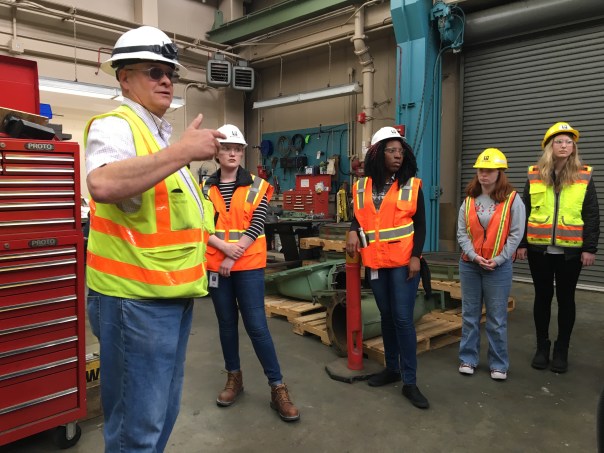
Process Analyst Jim Pitts leads the tour.
“It was a lot bigger than I was expecting it to be. And I also thought that the grounds were very nice and well taken care of,” states Alex Cole, a project management intern. “It didn’t look like how a waste water treatment facility would look in my mind – or maybe my pre-WTD mind.”
Jyoti Bodas, an industrial waste intern, had the same thoughts.
“It was a lot bigger than I thought it was. They have a standard set of processes but they’re spanned out over quite a large area and different buildings and such.”
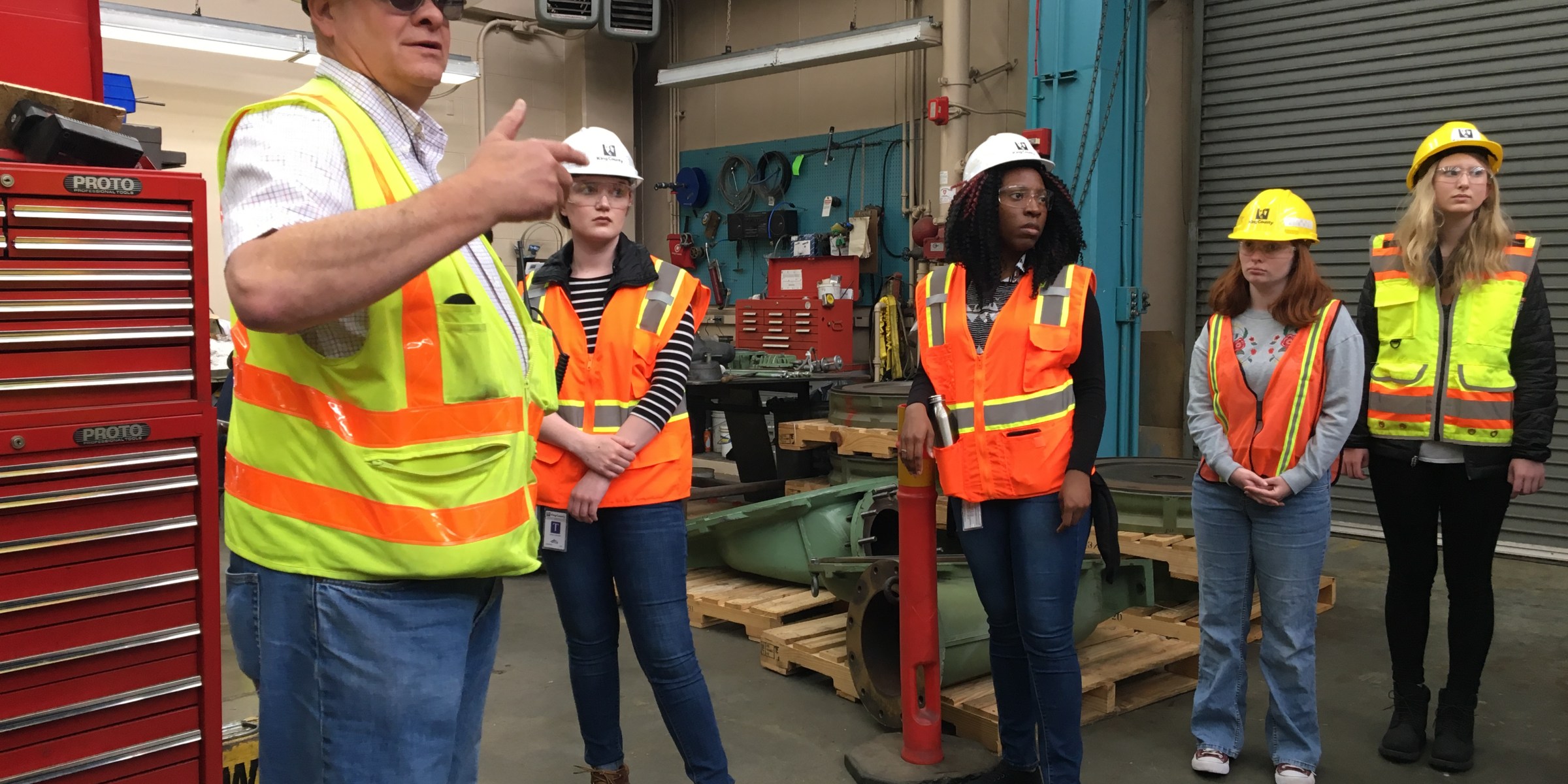
At these tours, you’re given an educational, up close, and personal view of the treatment process done at these facilities. The other interns and I, led by tour guides Jim Pitts and Katelyn Hunt, were taken step by step through the process and given a view of what goes on above and below the treatment plant.
When asked what her favorite thing was that she saw on the tour, Jyoti responded with the Bio-digesters. In high school, she had worked on a small scale project revolving anaerobic digestion and thought it was interesting to see it on a larger scale.
“To see a large one, spanning a room… was kind of cool. Just to see how it would be built on an industrial level.”
As someone who was not very knowledgeable about the wastewater treatment process at these plants prior to becoming a WTD intern, there was a vast expanse of information to learn and ground to cover. Our tour guides were helpful and informative and led the tour in a way that kept all of the interns engaged and eager to soak in more information.
Not only does this facility treat wastewater, but located on site is 1.5 acres of land dedicated to the CitySoil Farm. Once an unused part of the treatment plant’s grounds, it has been transformed into an urban agriculture that is dedicated to environmental education and sustainable farming. While we didn’t get to tour the CitySoil Farm on this trip, another opportunity has been given to the interns to learn more about CitySoil through a separate tour later on in the summer.
Being able to go on a tour like this allowed me to see all that the South Treatment does to treat the wastewater before King County returns it to the environment.
Share this:

Aw shucks! It’s pretty risky to eat raw and under-cooked oysters

Crossposted from Public Health Insider
By Lindsay Bosslet
 As waters warm up, shellfish beds become breeding grounds for bacteria, including Vibrio parahaemolyticus or “Vibrio,” one of the most common causes of illness related to raw oyster consumption.
And this year, we’re setting records. Why are so many people getting sick?
We sat down with Vance Kawakami, our communicable disease epidemiologist, to better understand the risk of eating raw and under-cooked oysters.
Vance, is there any safe way to eat raw oysters? Will Tabasco sauce or vodka kill the bacteria? Please say yes.
No, there is no safe way to eat raw oysters, and no amount of alcohol, hot sauce or other condiment will kill the bacteria. The only way to avoid getting a Vibrio infection is to make sure the oysters are thoroughly cooked to an internal temperature of at least 145 degrees Fahrenheit for 15 seconds.
I only eat oysters at King County’s finest restaurants. They’re probably safer than other oysters, right?
Wrong. Even the fanciest restaurants can’t eliminate Vibrio from their shellfish suppliers’ shellfish beds, and they probably won’t know if their latest batch is extra risky until it’s too late. Of course, restaurants still have a role in reducing risk by keeping raw shellfish at the proper temperature, preventing cross-contamination, and reporting illness when it happens.
Okay, maybe I’ll just start harvesting them myself. Then I can pay close attention to the beds and only harvest disease-free oysters.
Oysters that contain Vibrio don’t look, smell, or even taste different from oysters without Vibrio. With the exception of closed beach signage, you will have no way of knowing if oysters are free of bacteria. If you want to harvest your own oysters I suggest:
- Checking for beach closures and advisories or call 1-800-562-5632 before you plan to harvest
- Harvesting as soon as possible after the tide goes out
- Don’t harvest oysters that have been exposed to direct sunlight for more than two hours
- Refrigerating or icing oysters immediately after harvesting (keep at less than 41 degrees Fahrenheit)
I eat raw oysters all the time, and I haven’t gotten sick. Maybe I’m immune? Sorry! Anyone eating raw or under-cooked shellfish should consider themselves at risk for infections from Vibrio. Certain health conditions put people at greater risk of illness. People with weakened immune systems and chronic liver disease are at greater risk of becoming ill, but even otherwise healthy persons who take antacids might also be at greater risk of getting sick and should avoid raw and under-cooked oysters.
What’s up with that? Why are we hearing about so many people becoming sick with Vibrio after eating raw and under-cooked oysters this year?
We don’t know for sure. Vibrio growth is favored by warmer water temperatures. Salinity, water depth, and post-harvest handling may also influence Vibrio levels. Studies are underway that we hope will help us better understand Vibrio and prevent illness. In addition, it is likely that greater public awareness of Vibrio associated with raw and under-cooked shellfish and recent increases in the use of more sensitive diagnostic tests to diagnose Vibrio are contributing to the increase in reports. What we do know is that eating raw and under-cooked oysters is risky business anytime of the year.
Share this:

Featured Job: Transit Administrative Support Specialist III – FMLA Support (four TLT or SDA positions)

Closing: 08/13/18 11:59 PM (GMT -8:00)
Salary: $26.04 – $31.48 Hourly
Location: King Street Center, Seattle, WA
Job Type: Special Duty Assignment or Term Limited Temporary
Department: Transportation – Transit Division
Job Number: 2018EM08420
Metro Transit is seeking four talented administrative specialists to join our Operations team on a temporary, six-month-pilot basis to support the processing of FMLA/KCFML and Workers Comp FMLA. These fully benefited positions may be filled either as Term-Limited Temporary or by providing a Special Duty Assignment to an existing King County career service employee who has completed their initial King County probation. The positions will report to the Superintendent of Planning and Technical Support in the Operations Section and be located in King Street Center. Accurate attention to detail and maintenance of a high level of confidentiality are critical in these positions.
Contact: For more information, contact HR Analyst Elisha Mackey at 206-477-0193 or Elisha.Mackey@KingCounty.gov.
Learn more about this position or all available jobs.






 Employee News