
King County: #RiseWithUs

Welcome 2018 Special Olympics USA Games!
Let me win. But, if I cannot win, let me be brave in the attempt.
– Special Olympics Athlete Oath

The #2018USAGames medals. Photo courtesy @2018USAGames
During the July 1-6 Seattle- and King County-hosted games, more than 4,000 athletes and coaches representing each state and the District of Columbia will compete in 14 team and individual sports “in the best sports facilities in the greater Seattle region including the University of Washington, Seattle University, Seattle Pacific University, King County Parks’ Weyerhaeuser King County Aquatic Center, Willows Run Golf Club, Celebration Park, Angle Lake and Kenmore Lanes,” according to the games’ official website. All sporting events are free and open to the public.
King County joins the State of Washington and the City of Federal Way as a Public Partner of the 2018 Special Olympics USA Games, and King County Metro has joined Sound Transit, Alaska Airlines, REI Co-op and others as a Bronze Medal Partner. In a joint effort with Sound Transit, King County Metro is an Official Transportation Sponsor of the 2018 USA Games. “We’re honored to do our part for the Games, and invite the athletes, families and volunteers to ride and enjoy our frequent and reliable transit services,” said King County Metro General Manager Rob Gannon. “We’re inspired by both the competitive spirit and sense of community the Games are bringing here, and hope everyone enjoys our region’s unique sights and wonderful culture during their stay.”
“Athletes, coaches and fans from across the nation will gather in Seattle for the 2018 USA Games, and for many, this will be their first visit to our region. We couldn’t ask for a better welcoming committee than our partners at the Port of Seattle, King County Metro and Sound Transit,” said Beth Knox, president and CEO of the 2018 Special Olympics USA Games.
According to the official press release, King County Metro and Sound Transit will provide a total of 4,000 pre-paid ORCA Passport cards, which will enable athletes and their families to travel by bus, water taxi, and light rail throughout King County, including to and from Sea-Tac Airport and between USA Games venues.

Jonathan Leckband with his job coach, Employment Consultant Meghan Spellman.
In addition to being a public partner of the games, King County is proud to have employees participating! Jonathan Leckband, office assistant with the Department of Transportation, and Rama ‘RJT’ Tall, parks specialist with the Department of Natural Resources and Parks, are two employee athletes who will be competing in the 2018 USA Games. I’m looking forward to the chance to show how good our team is,” said Leckband, a soccer player and teammate of RJT. “This will also be a chance to demonstrate sportsmanship, and maybe make new friends.”
The mission of the USA Games is much like our own King County goal of seeing both our employees and those we serve have the opportunity to fulfill their potential. “Over the last 3 years, King County’s Supported Employment Program has recruited for 12 positions, which is the largest increase of new positions within the program since the 1990’s early 2000’s,” said Christina Davidson, King County Supported Employment Program Manager. “It is great to see employees like Jonathan and RJT recognized for their contributions at King County and as an athletes competing in the upcoming games.”
For more information about the King County Supported Employment program, visit the website and contact Christina at 206-477-3372 or Christina.Davidson@KingCounty.gov.
For more information, tickets, schedules and special events details, visit the Special Olympic USA Games website. In addition to event information, there are details on the site about a variety of ways to get involved and opportunities to volunteer. You may also nominate a game changer. If you know a person or a company that exemplifies what it means to be inclusive, the 2018 Special Olympics USA Games wants to hear from you!
Get social with the games!
- @2018USAGames on Twitter
- @SpecialOlympicsUSAGames on Facebook
- SpecialOlympicsUSAGames on Instagram
- 2018 Special Olympics USA Games on YouTube
- #2018USAGames #RiseWithUs #Inclusion #KingCounty

The Weyerhaeuser King County Aquatic Center in Federal Way
Share this:

Tech Tip: Don’t shut down, restart!

ICYMI: We ran a great tip last fall on the importance of restarting your computer rather than just shutting it down. KCIT maintains our computer systems around the clock, even while most of us are sleeping. But, your computer must be on. This is especially important when security patches are being deployed.
So, if you leave your computer in your work area when you depart for the day, hit “Restart” instead of “Turn Off” when you go home. Doing so cleans up your computer and allows KCIT to roll out the necessary upgrades and patches so your device is up-to-date when you return the next day.
Share this:

KCIT deploying new tool to protect data and systems

During the month of July, KCIT will deploy a new security tool that will help protect the entire King County network from cybersecurity attacks. The new tool will operate behind the scenes, helping to protect all of our data and systems from both external and internal cyber threats.
This deployment should affect neither your computer nor your day-to-day business operations. If you are blocked from a work-approved website or application, either submit a Help Desk Ticket to HelpTicket@KingCounty.gov or escalate the issue through your technical support group.
Share this:

Kudos! to EcoConsumer for offering Repair Events – inclusively
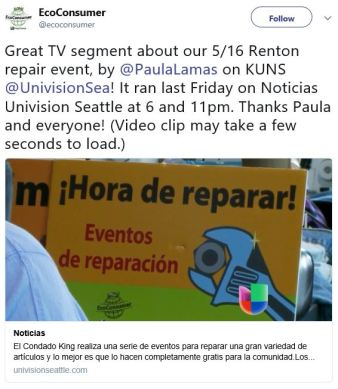 EcoConsumer joined forces with Univision Seattle to get the word out to everyone about our great King County Repair Events! EcoConsumer’s creativity and media outreach continue to impress and serve the residents of King County well.
Thank You, Paula Lamas and Univision Seattle!
Kudos, EcoConsumer!
Share this:

Financial Wellness: Class is in session!

Crossposted from Balanced You
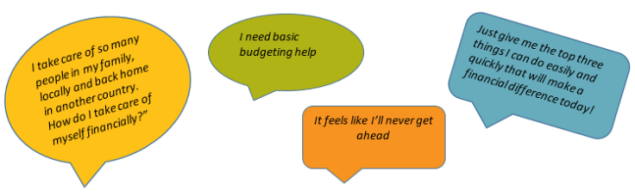 Get a passing grade when it comes to managing your financial wellness
Did you know 46 percent of full-time employed U.S. adults say that financial challenges cause them the most stress in their lives?* Are you one of them? If any of the following sound familiar to you, consider signing up for a My Secure Advantage class for tips and resources to support you in your quest for peace of mind when it comes to managing your finances.
Sign up for a My Secure Advantage onsite class today
As part of our goal of reaching you where you’re at, we’re bringing My Secure Advantage to you. While My Secure Advantage typically provides free telephone-based financial coaching, these special onsite sessions are great for employees who prefer to attend in-person classes. It also gives you a chance to learn more about My Secure Advantage before signing up with a Money Coach.
My Secure Advantage will offer two different classes. Check out the schedule and sign up for a class today.
Financial Wellness Playbook
It’s never too late to learn and start practicing good financial habits! If you want to achieve your long-term goals, attend our presentation to learn how to improve the financial habits listed below.
– How to write and prioritize goals
– Avoid debt, prioritize spending, keep good credit
– Start and never stop saving
– Protect and share your assets, make a difference
Your Debt-Free Game Plan
Avoiding debt is extremely difficult, but reversing the trend and reducing debt can be even more challenging. Good news! We have tips and tricks to help you.
– Recognize spending habits, be willing to change
– Disciplines for saving rather than spending
– Consider and adopt a debt-reduction strategy
– Conquering a life-long challenge
| Date/Time | Location | Class | Sign up |
| Tuesday, June 26
9 a.m. – 9:45 a.m. |
Atlantic/Central Transit Base
1500 6th Ave, Rms 2C and 2B Seattle |
Financial Wellness Playbook | Register for this Class |
| Tues., June 26
11:30 p.m. – 12:30 p.m. |
Chinook Building
401 5th Ave, Rm 123 Seattle |
Financial Wellness Playbook | Register for this Class |
| Tues., June 26
1:00 p.m. – 1:30 p.m. |
Chinook Building
401 5th Ave, Rm 123 Seattle |
Your Debt-Free Game Plan | Register for this Class |
| Tues. June 26
3 p.m. – 3:45 p.m. |
Dexter Horton Building
710 2nd Ave, Rm 103 Seattle |
Financial Wellness Playbook | Register for this Class |
| Tues. June 26
4:15 p.m. – 4:45 p.m. |
Dexter Horton Building
710 2nd Ave, Rm 103 Seattle |
Your Debt-Free Game Plan | Register for this Class |
| Wed., June 27
7:30 a.m. – 8:30 a.m. |
Renton Maintenance Facility
155 Monroe Avenue NE
J-Building Crew Room Renton |
Financial Wellness Playbook | Register for this Class |
| Wed., June 27
9:30 a.m. – 10:30 a.m. |
Elections
919 SW Grady Way First floor, multi-purpose room Renton |
Financial Wellness Playbook | Register for this Class |
| Wed., June 27
1:15 p.m. – 2:00 p.m.
|
Snoqualmie/DPER
35030 SE Douglas St. #210, Snoqualmie |
Financial Wellness Playbook | Register for this Class |
| Wed., June 27
3:30 p.m. – 4:15 p.m. |
East Transit Base
1975 124th Ave., training room A Bellevue |
Financial Wellness Playbook | Register for this Class |
Share this:

What’s a Data Dive?
Crossposted from Best Starts for Kids Blog
Part 2 of our Community Owned Data blog series
Last week, we kicked off our month-long “community owned data” blog series. You can read the first post here. Every other year, Best Starts collects community data that helps guide our funding strategies. To ensure that we are truly partnering with communities and sharing data ownership, Best Starts partnered with specific communities to have conversations about the data from our Best Starts for Kids Health Survey and help us understand it. We learned a lot from this process and want to share our learnings with our larger community here. Today’s post shares more details about how “data dives” happened.
We heard from partners, including the Equal Starts Community Coalition, about how essential it is for communities to own and interpret their own data. Part of the idea behind the data dives is to put the power in the hands of specific communities to shape the narrative of what their data “means,” rather than having people without knowledge of community context and history tell the story. That’s why, rather than having generic community-wide events, we decided to hold community-specific data dives where we shared survey results specific to a community, alongside members of that community.
There are many diverse and overlapping communities in King County. While we’re excited that we got to build relationships with eight groups over the course of this project, we know there are certainly many more communities to partner with in the future. These communities were selected because their voices were underrepresented in the Best Starts for Kids Health Survey results, and existing relationships helped facilitate successful data dives. Five of these gatherings were held in languages other than English, and materials were translated by community partners as necessary.
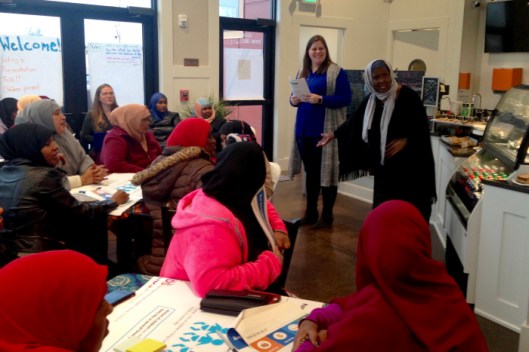
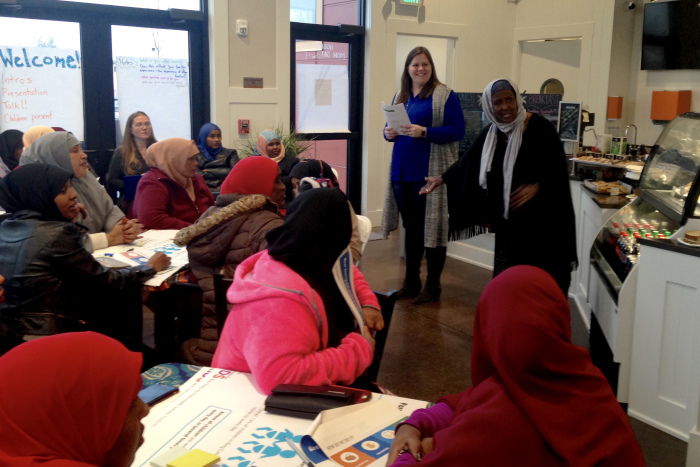
A Data Dive with the Somali community.
One of our lead partners in this work was the team of consultants at the Community Café Collaborative. They have an amazing model for holding conversations that are not just about discussing a topic – they build community leaders, develop relationships, and strengthen families. They work with individual parents and family members to facilitate conversations with their peers, and hold concurrent “kids’ cafes” where children address the topic in a play-based, developmentally appropriate way, and then present their feedback to adults before the evening ends. Community Café Collaborative hosted data dive cafes with Black/African American; Latina/o; lesbian, gay, bisexual, transgender, and two spirit (LGBTQ2S); Samoan; and Somali families.
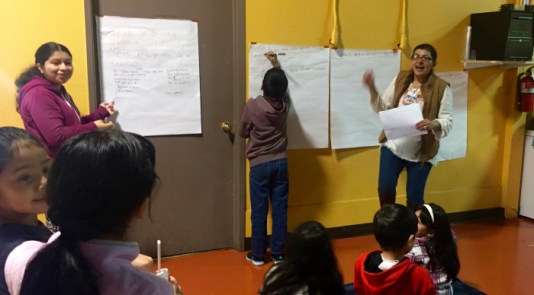
Children contributed their thoughts to the Data Dive, too.
We also partnered with Open Doors for Multicultural Families, a nonprofit that serves diverse families of children with developmental disabilities and special health care needs. They were a key partner when we did outreach about the Best Starts for Kids Health Survey and have received Best Starts funding in a number of areas including out of school time and youth and family homelessness prevention. We were eager to continue working together. They chose focus groups as the appropriate engagement model for the families they work with, and held data dives with Chinese- and Vietnamese-American parents.
Finally, we partnered with United Indians of All Tribes Foundation (UIATF) to hold a talking circle with American Indian/Alaska Native families. UIATF is a partner that has received funding for home visiting and youth and family homelessness prevention programs from Best Starts and holds deep relationships with many native families in King County.
While the format varied a bit across all of these gatherings, a few things were key.
- A budget of $2,000 was provided for each partner to spend as appropriate so that families could attend and feel comfortable, safe, and welcome.
- Each data dive was held in a location familiar and comfortable to the community, in their language, and led by a member of that community.
- Delicious local food and childcare were available, and participants received thank-you gifts to recognize their generosity in sharing their time with us.
- County staff did not control the agenda. At each one, Best Starts staff presented “data placemats” showing the community’s survey results and answered questions about them – but our main purpose was to listen!
When we listened we heard feedback like this:
We are in a developed nation and rich county but we are at the lowest level economically. We don’t understand the system and there is a need for systems understanding for us. Coming to see us like you are doing right now helps us. We need a flow of continuous community. We need a flow of conversations that is coming back and forth not just one visit.
Stay tuned to read more about what we heard, including a guest post from a Community Café facilitator. And if this model interests you, we’d love to hear from you! Let us know in the comments or on social media so we can address them in future posts.
Share this:

Rev Up For Retirement seminar July 11th

You’re not too young to think about retirement! Join us Wednesday, July 11 from 11 a.m. to 1 p.m. for a retirement information seminar featuring guest speaker Jean Cormier, who will discuss your Medicare options.
We’ll also talk about the current retirement climate, projections for the future, and the resources available to you through King County. Representatives from the Washington State Department of Retirement Systems and the Retired Public Employees Council of Washington will be in attendance.
The seminar takes place in King Street Center’s eighth floor conference center, 201 S. Jackson St., Seattle. Registration is required and limited to King County employees. Attendance is voluntary, is on your time, and is non-work related. For more information, contact King County Benefits, Payroll and Retirement Operations at KC.Orientations@KingCounty.gov.
Share this:

Featured Job: Administrative Support Specialist III, Transit

Closing: July 1, 2018, 11:59 p.m. (GMT -8:00)
Salary: $26.04 – $31.48 Hourly
Location: Multiple locations in King County
Job Type: Career Service, Full Time, 40 hrs/week
Department: Department of Transportation – Transit Division
Job Number: 2018EM08230
Description: This career service position located in Metro’s Atlantic Base provides the administrative support required to sustain Transit Operations. The position ensures timely and accurate tracking of employee leave, payroll processing, maintains files, monitors and tracks budget expenditures and maintains spreadsheets and databases.
Contact: For more information, contact Elisha Mackey at 206- 477-0193 or Elisha.Mackey@KingCounty.gov.
Learn more about this position or all available jobs.
Share this:

Social Media Spotlight: King County, WA on Twitter

 America’s 13th-largest county, home to 2.1 million people and 39 cities, and the only jurisdiction in the world named for Dr. Martin Luther King Jr.
Stay current on the happenings in King County by joining @KingCountyWA’s 67.4K followers on Twitter.
Follow King County, WA on Twitter today.
Share this:

Pet of the Week: Domino
Crossposted from Tails from RASKC
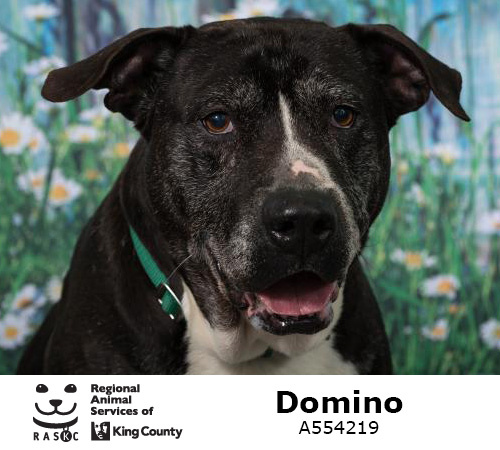
We’re not playing games: Domino is our Pet of the Week!
 This senior pittie mix is black with white spots, just like his namesake. He came to us because his previous owner couldn’t care for him anymore. Domino’s personality color is “Easy Going Green,” meaning he’s an adaptable dog who loves to go with the flow.
This sweet boy is full of love and snuggles! Silly, goofy, and adorable are his middle names. Domino has lived in a home with children, and his previous owner described him as shy, loving, and playful. He’s also a very smart dog and already knows how to “sit” and “come.”
Domino can be a bit shy in new situations, so he would prefer a calm home. Although Domino is an older guy, he doesn’t let that slow him down! He still loves to play, and he is always ready to settle down and cuddle with his favorite people. He also loves car rides and going on walks. While he’s easy-going, Domino doesn’t seem to get along with other dogs or cats, so he would do best as the only pet in his new home.
Domino is neutered, current on vaccinations and microchipped. His adoption fee includes a certificate for a free veterinary exam and 30 days of free pet insurance through Trupanion.
You can see Domino’s profile on our website, kingcounty.gov/AdoptAPet, or visit him in person at the Pet Adoption Center in Kent.






 Employee News