
Two of our firefighters render medical aid on cross-country flight
Crossposted from The Centerline
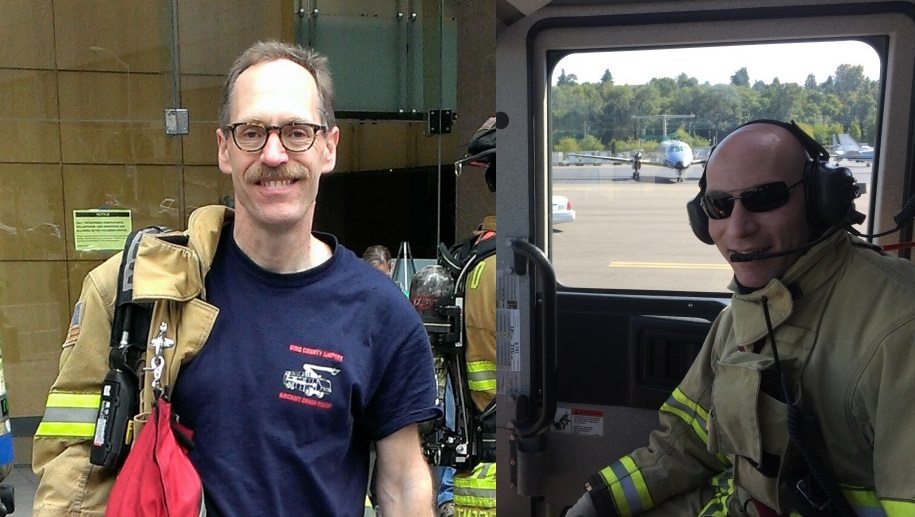
Pictured: From left, Graydon Matheson and Seth Grant.
Our Aircraft Rescue and Firefighting Unit staff members are trained to respond to emergencies on the airfield, but helping with a medical emergency in midair is a different story.
On Sept. 21, King County Sheriff’s Office deputies Seth Grant and Graydon Matheson were returning from a conference in Louisville, Ky., aboard an Alaska Airlines flight from Chicago. A flight attendant asked over the intercom if there were any medically trained passengers aboard.
Grant and Matheson immediately responded, as did an ER doctor who also happened to be aboard. An 81-year-old man had collapsed and stopped breathing in the front of the aircraft. The three provided continuous CPR while the pilot made an emergency landing in Spokane, where medics were waiting at the airport.
Read more at The Centerline
Share this:

County resources help employee find the right job
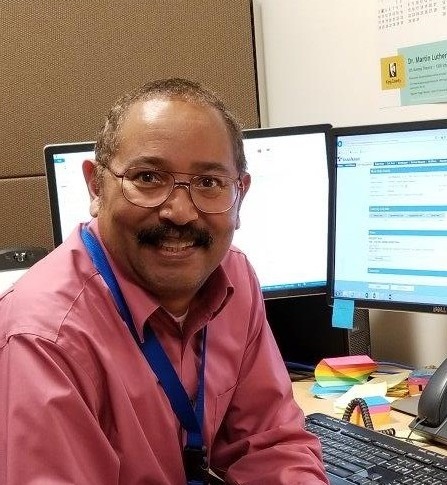
 Sometimes you get a second chance. When Sean Porter started his career at King County, he had a completely different job. For the first eight months, things went well. But then the pressures grew – along with the workplace distractions.
It was soon discovered that Sean had a very treatable medical condition. After working with a trusted supervisor, along with Disability Services, he was able to locate a new job as a Maintenance Planner Scheduler/Transit Administrative Specialist II at Rail. Though it’s never easy to switch jobs, he credits the help of his manager for being open and supportive about what was needed.
In addition to his manager, the assistance of Transit and King County’s Disability Services team was extremely helpful when he had questions about handling organization, expectations and priorities at the new job. At first, there were frequent check-ins and assistance.
Through communication about what would help him perform his job, and a little creativity from everyone involved, Sean has now been working successfully in his current job for over six years. He feels he has found a good fit, with a great team and a great boss.
But sometimes it takes a while to find a job you like that fits with what you need.
Sean has some words of advice for anyone who may be struggling or wondering what to do next. “It’s better to make the first move and get started on the road to healing than to wait until things get out of hand,” he says. “There is no shame in admitting that we need help.”
He points to Employee Assistance Program/Making Life Easier as a good first step if you are not sure what to do.
Employees who have a medical condition may need to explore different reasonable accommodations to perform their current job, or in some cases may end up working in a completely different job through a process called Reassignment Services.
If Disability Services is required as part of the process, you’ll find “a wealth of warmth, support and knowledge to guide you,” he says. And if you realize that you need to be in a different position that fits better for you, make sure you do your best. This helps everyone, including the taxpayers, he says. “Doing your best will make it easier to find something else if this position turns out not to be your dream job.”
Share this:

Employee development through Special Duty Assignments
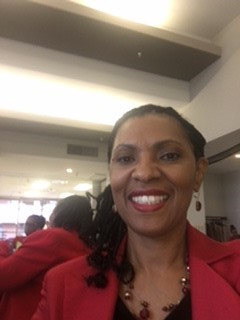
At King County, Special Duty Assignments (SDA) create opportunities for employees who wish to hone their current skills and add new ones to their resume.
Such is the case for one King County employee; Public Health Administrative Specialist Donna Rodgers-Yates has been with King County for more than 20 years, and in June Donna took on a SDA with King County Information Technology as a Human Resources Associate.
“Opportunity for personal and professional growth prompted me to take on a SDA,” Donna said. “After gathering more information about other departments and exploring other areas, I thought about IT; I like that IT supports all of King County, and they work tirelessly to provide excellent customer service.”
Career advancement and skill development are key goals of the County’s Investing in You strategy, and Special Duty Assignments are integral to this work by providing immersive learning opportunities.
For the last few months, Donna has been learning the ropes of working at KCIT in HR, and while she is accustomed to some of the Microsoft programs and software, she admits that there is a learning curve. “HR is a very dynamic area in itself, and a great challenge,” Donna said. “In the Health department we use some of the same systems in Microsoft, but with more of a billing system functionality.”
This dynamic work environment is fostering continuous learning opportunities for Donna that she can apply to her work in any department. “This environment is very fast paced, and I am challenged to sharpen my skills continuously,” Donna said. “I’m still learning – there are so many parts to HR and something new to be learned each day.” In a KCIT, Donna has been enhancing her problem solving skills and decision making abilities.
Donna began exploring the many pathways to career advancement in meetings and employee development training sessions where she became exposed to different areas of work in King County.
“King County has not stopped investing in me,” Donna said. “I owe this opportunity to the Administrative Professional Advisory Committee created by the Executive to foster advancement among Administrative Specialists. I am an Admin Spec. that has worked for the County for more than 20 years, and now I’m on a SDA in KCIT HR as an HR Associate. I hope that I am only the first of many Administrative Specialists in the County who are given the opportunity to advance.”
“Special duty assignments are awesome,” Donna said.
Thank you Donna for your commitment to King County and its residents you serve. Your work does not go unnoticed.
Share this:

Metro Transit celebrates National Hispanic Heritage Month
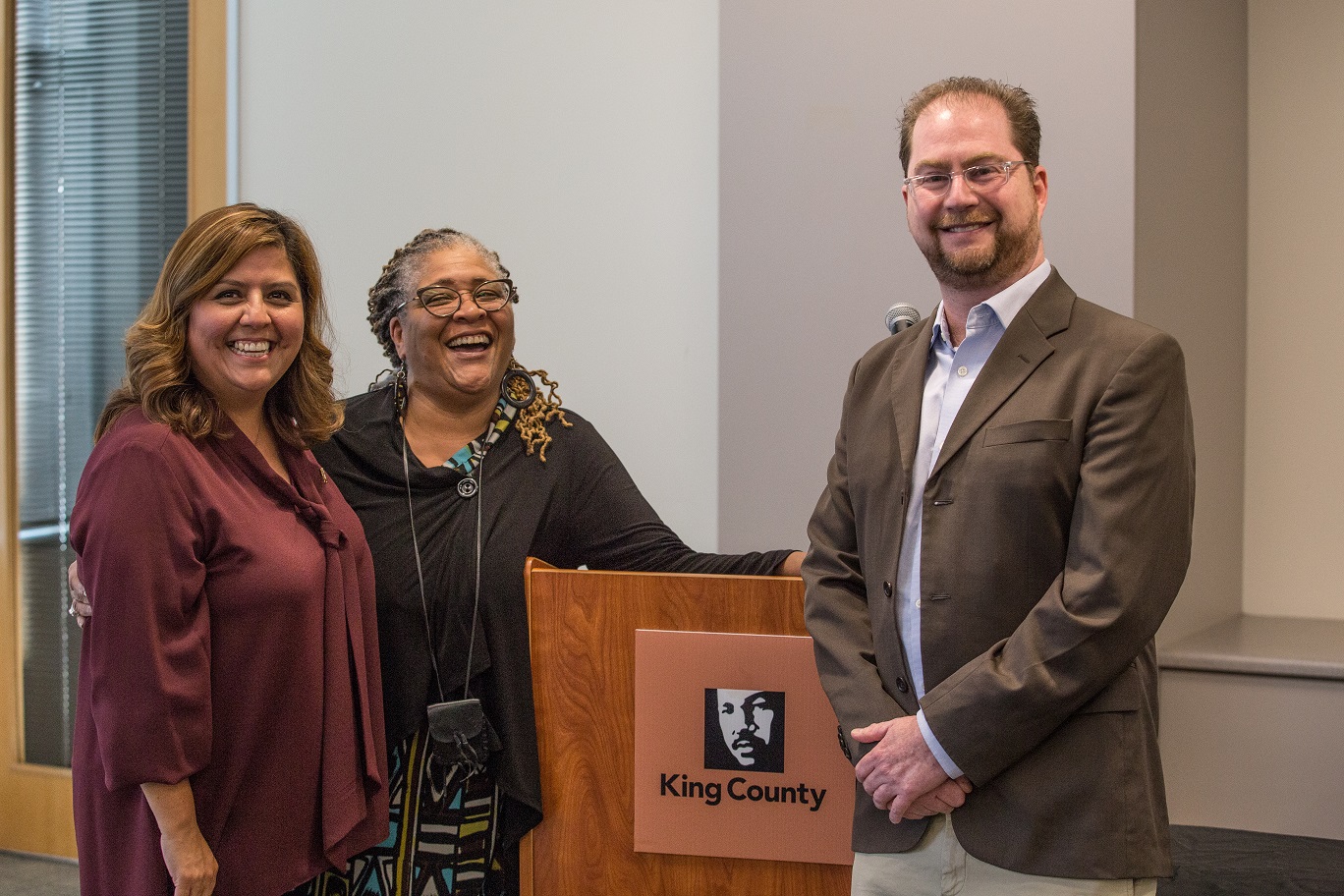
Pictured: From left Transportation Planner Penny Lara, Diversity and Inclusion Manager Anita Whitfield and Dr. Roberto Dondisch-Glowinski.
During National Hispanic Heritage Month (September 15 to October 15), we at King County recognize the important presence of Hispanic and LatinX Americans and the contributions they have made to the United States and King County, and celebrate their heritage and culture. National Hispanic Heritage Month begins each year on September 15, the anniversary of independence of five Latin American countries: Costa Rica, El Salvador, Guatemala, Honduras and Nicaragua. Mexico, Chile and Belize also celebrate their independence days during this period and Dia de la Raza is October 12.
Before Washington was a state, people of Hispanic origin were coming to the region to work on ranches, in mines, and on farms. Today, Mexico is a trading partner and the single biggest importer of Washington apples. People from Mexico and those with Mexican heritage, along with people from other Latin America nations, are part of the fastest growing demographic group in King County. King County residents of Mexican heritage is 9.5%.
Share in our annual tribute by learning about and celebrating the generations of Hispanic and LatinX Americans who have positively influenced and enriched our nation and society. In honor of this month, the Metro Transit Office of Diversity & Inclusion hosted a special Lunch & Learn featuring the Consul of Mexico in Seattle, Dr. Roberto Dondisch-Glowinski, on Wednesday, September 27 at King Street Center.
Dr. Dondisch is the Head Consul of Mexico in Seattle providing services to over 790,000 Mexican nationals in the state of Washington as well as Alaska and seven counties in Idaho. He was previously Director-General for Global Issues within the Ministry of Foreign Affairs, where he served as the Chief Negotiator for Mexico for the post-2015 Development Agenda and the Paris Climate Change Agreement and focal point for the Mexican participation as elected member of the United Nations Security Council. He has a Bachelor’s Degree in International Relations with a Masters in Foreign Service and International Studies and then received his PhD in International Relations (John Hopkins), a Masters of Science in Foreign Service (Georgetown University), and a Bachelors in International Relations (Universidad Iberoamericana). The King County Council presented Dr. Dondisch with a proclamation to celebrate Mexico Week in September.
Dr. Dondisch delivered an informative, inspirational and passionate message to a sizable audience of employees about Climate Change and Social Justice. The employees came from not only Transit but other Sections and Departments. Dr. Dondisch explained the interesting processes of negotiation that led to the Paris Climate Change Agreement. He spoke about the challenges and opportunities of getting nations of the world to reduce their carbon footprint with a goal of significantly slowing the increase in the rise in global temperature and thereby reducing the impacts to our planet. Mexico has its primary focus set on renewable resources and fuels as their way to achieve their goals. There was discussion about the recent earthquake in Mexico City regarding the devastation and relief efforts. Dr. Dondisch’s friendly and engaging style was evident during his question and answer period. Everyone in the room left feeling enriched by the experience.


Share this:

Exec meets with employees to learn how to boost women in trades
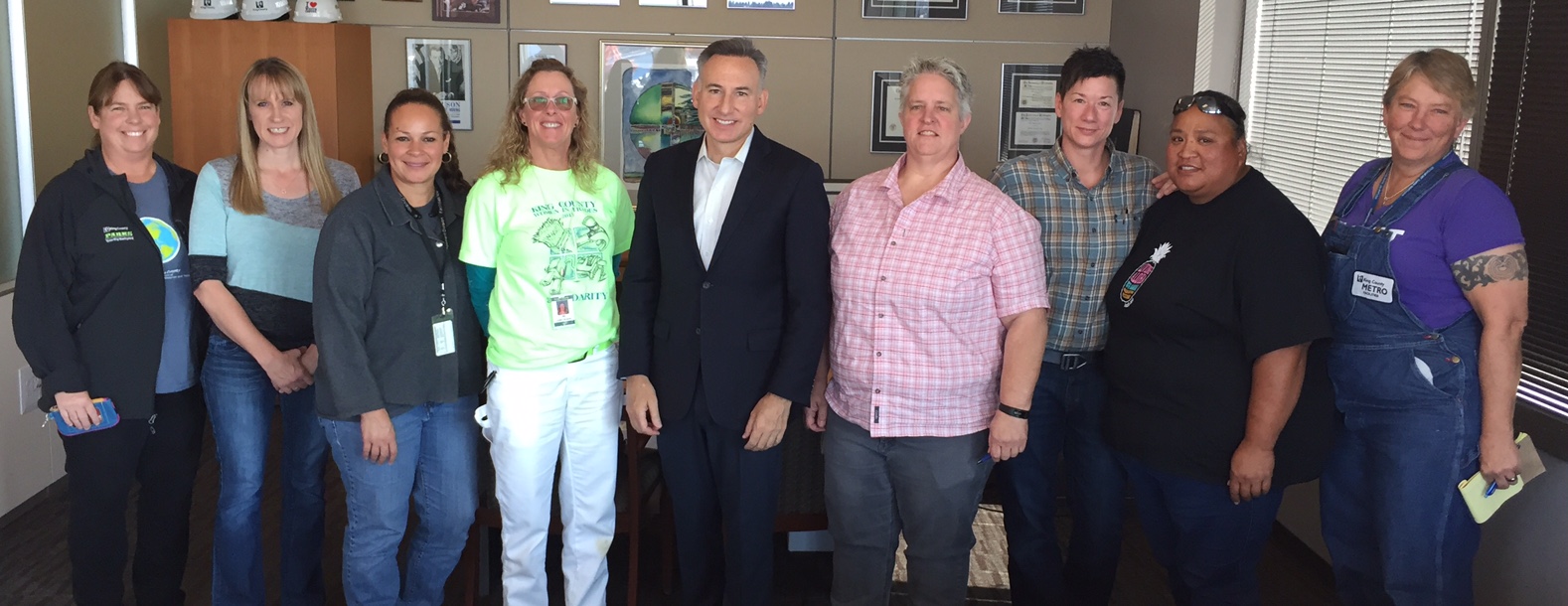
King County Executive Dow Constantine recently hosted an Employee Listening Session on the topic “Women in Trades” to hear from the people in the best position to advise on how we can bring more women into the skilled trades at King County – women working in the trades at King County.
“As women who work in the trades here at King County, I want to get your thoughts on how we can bring more women into skilled trades jobs at the County,” Executive Constantine said to the attendees. “What are the barriers you see or have encountered yourself, and how we can go about removing them?”
At King County just 7% of employees in the skilled crafts are women, whereas women comprise 41% of the total County workforce. Executive Constantine spoke about the need to do more to attract women into County trades careers if we are to be truly representative of the communities we serve at all levels.

The women represented a diverse group of trades, including painting, plumbing, carpentry and electrical, and worked in the Facilities Management Division, Roads Division, Fleet Division, Parks Division, Wastewater Treatment Division and Metro Transit.
The group’s suggestions included looking at how the County can provide more trades jobs so there are more positions to recruit women into (“it’s hard to attract women into jobs that don’t exist” was one comment); an apprenticeship program for garage services; offering more apprenticeships in the north of the county rather than just south King County; and beginning early with education to help girls believe they can do trades work and with boys to show them that girls can excel at this work.
Executive Constantine began hosting quarterly Employee Listening Sessions last December to hear from employees about the issues they are facing in their workplaces, and what the County can do to help them thrive and better serve their customers.
Thank you to the employees who participated in this listening session and providing their unique perspectives and ideas.
Share this:

Resources to help you cope with traumatic events

The horrific mass shooting that took place Sunday night in Las Vegas has deeply affected all of us. This senseless, heartbreaking event may evoke feelings of fear and anxiety, or bring back thoughts associated with other tragedies that have happened closer to home.
King County Making Life Easier is providing several resources to help you and your family cope with your emotional reactions to this tragedy. If you need immediate support, or specific resources, please call the King County Making Life Easier program at 1-888-874-7290.
The following links are curated articles provided as starting points to help you understand and navigate through the emotional impact of this tragedy.
- Common Reactions After Trauma
- Coping With A Traumatic Event
- Helping Children And Adolescents Cope With Violence And Disasters
- Tips For Talking With Children After A Traumatic Event
- Coping With Traumatic Events
When something tragic like this happens, it’s normal to have stress reactions. The severity of your reaction depends on the nature of the situation, your involvement in it, and how you are coping with other stressors in your life at the time of the incident. Most stress reactions resolve within a few weeks, with good self-care and support from friends and family.
Common reactions to an extreme stressor include:
- Physical reactions: tightness in the throat or chest, trouble sleeping, lack of appetite, fatigue, headaches, lower back aches.
- Emotions: sadness, irritability or anger, fear, anxiety, and guilt.
- Thoughts: disbelief, inability to concentrate, confusion, difficulty with decision-making.
- Behaviors: avoiding reminders of the event, withdrawing from others, increased use of alcohol, restlessness.
There are many ways to cope with the aftermath of a traumatic situation. Some that you may find helpful include:
- Accept that the reactions you are experiencing are normal following a traumatic incident.
- Take a break from the news when coverage is making you feel overwhelmed.
- Keep a journal. Writing can be very healing. Write down your thoughts, fears, pain and despair.
- Reach out to your support system. Find people who will listen to you, and comfort you. This could be friends, family, clergy, or a therapist.
- Take care of yourself physically. Get 8 hours of sleep, eat balanced meals, drink plenty of water, and take walks outside.
- Avoid alcohol and drugs not prescribed by your physician.
- Remember to breathe.
If your reactions do not resolve within a few weeks, or if you are experiencing disturbing images or nightmares, call us for a referral to a qualified therapist experienced with trauma.
This tragic event is a reminder that all employees should be aware of their surroundings and potential threats in and around their workplace.
If you see anything or anyone that looks unusual or out of place, please call FMD Security at 206-296-5000. If it’s an emergency, call 9-1-1 first, then call FMD Security when you are able. We have also launched a new online security incident report form to report non-emergency incidents to the FMD Security Unit for possible follow-up. You can report incidents that happen at work or on your commute.
We also have a list of safety tips online. This information from the Seattle Police Department is designed to help you enhance your personal safety and avoid potential trouble. Want a walking buddy to or from work? Check out our Walkpool program.
Our first priority is your safety and security at work and we are continuing our efforts to ensure the safety of all employees and visitors to our facilities.
Share this:

Featured Job: Strategic Planning Manager I

Closing Date/Time: Continuous
Salary: $101,920.00 – $129,188.80 Annually
Job Type: Career Service, Full Time, 40 hrs/week
Location: King Street Center – 201 S Jackson St, Seattle, Washington
Department: Department of Natural Resources & Parks – Solid Waste Division
Description: The Solid Waste Division (SWD) of King County’s Department of Natural Resources and Parks (DNRP) is looking for a dynamic person to lead the division’s public policy, strategic planning, forecasting and rate development efforts. The candidate will lead an interdisciplinary team to plan for future solid waste services, provide technical and policy analysis, and develop solid waste rate proposals. The ideal candidate will be forward thinking with solid waste knowledge, strong supervisory experience and excellent communication and quantitative skills.
Contact: For more information contact Prakash Meloot, Senior Human Resource Analyst at Prakash.meloot@kingcounty.gov.
Learn more about this position, or view all available jobs.
Share this:
Tech Tip: Reset your own password 1-2-3

Tired of calling the IT Customer Support Services HelpDesk everytime you forget your password or get locked out of your computer? You can enroll in the Password Reset program and you’ll (almost) never have to contact KCIT again! This one minute video shows you how.
Share this:

Social Media Spotlight: Public Health – Seattle & King County Facebook

 Your local source for timely and useful health information you can trust — from Public Health – Seattle & King County.
Follow Public Health – Seattle & King County on Facebook today!
Click here to view all King County social media pages.
Share this:

Stop by soon! Flu clinic locations and schedules

Clinics are open to all King County employees and flu shots are provided at no cost to benefits-covered employees. Employees with no health benefits may self-pay for the vaccine at the clinic (flu shots are $30 each).
Flu shots are on a first-come, first-served basis. Check out the calendar below and mark your calendars for the location most convenient for you.
If you’re unable to take advantage of a worksite flu clinic, King County employees can get flu shots at clinics offered by the City of Seattle. Flu shots are also available through your primary care physician and many local pharmacies.
Flu-site coordinators will provide more information before your worksite’s scheduled date.
- Remember to come prepared to the worksite clinics:
- Bring your medical insurance card with you.
- Wear short sleeves, sleeveless shirt or clothing that bears your shoulder easily. This makes for speedy service and short lines!
- If you need a receipt, please tell the clerk when you check in.
For more information regarding influenza, visit the Centers for Disease Control and Prevention’s (CDC) Influenza resource page.
Read more at Healthy Incentives.






 Employee News