
Kudos! Afshin Meratinia, Metro Bus Operator

I wanted to thank this driver for avoiding the freeway backup due to the incident on the freeway, and finding a way to get folks home as fast as he could. He even offered suggestions for people who needed to go directly to Shoreline. I took his advice, and got home 3 hours sooner than I expected given the situation. Since I had worked all day and visited a friend in the hospital before going home, I couldn’t afford to be stuck on the freeway and miss an online test due at midnight. Because of how he handled the situation, I got home, took the test, and got some sleep before heading to work today and my finals later. Thank you for reducing the negative impact of a bad situation!!!
– Jenna Ramirez
Share this:

Tell us about your “other life”

Like radio host Sandy Macdonald, King County employees do lots of interesting things in their “other lives” in addition to the work they do for King County. Do you have another life outside of your King County work that you’d like to share with your colleagues? Email us the details at kcemployees@kingcounty.gov or tweet us with the hashtag #kcotherlives (remember to follow us @kcemployees), and we will feature your stories in upcoming editions of Employee News.
Share this:

SR 99 construction may delay your commute Monday 8/25 & Tuesday 8/26

Employees commuting to/from downtown Seattle for work on Monday and Tuesday, Aug. 25 and 26, should prepare for upcoming transit delays and reroutes on State Route 99 and Aurora Avenue North as the state closes sections of the roadway for construction 10 p.m. Friday, Aug. 22 through 5 a.m. Wednesday, Aug. 27.
Seventeen routes will be directly affected by either delays, reroutes or both during the construction closures. Riders can go online to see reroute information for five Aurora Avenue North bus routes. Riders on another 12 bus routes should prepare for delays as buses travel to and from downtown Seattle on the Alaskan Way Viaduct.
Because of potential widespread traffic delays, most bus riders using transit service into Seattle should prepare for possible weekday commute delays Monday and Tuesday, Aug. 25 and 26, as traffic shifts from SR 99 to Interstate 5 and other city streets.
Metro Transit affected routes:
Share this:

Employee uses Zumba to help employees get in shape
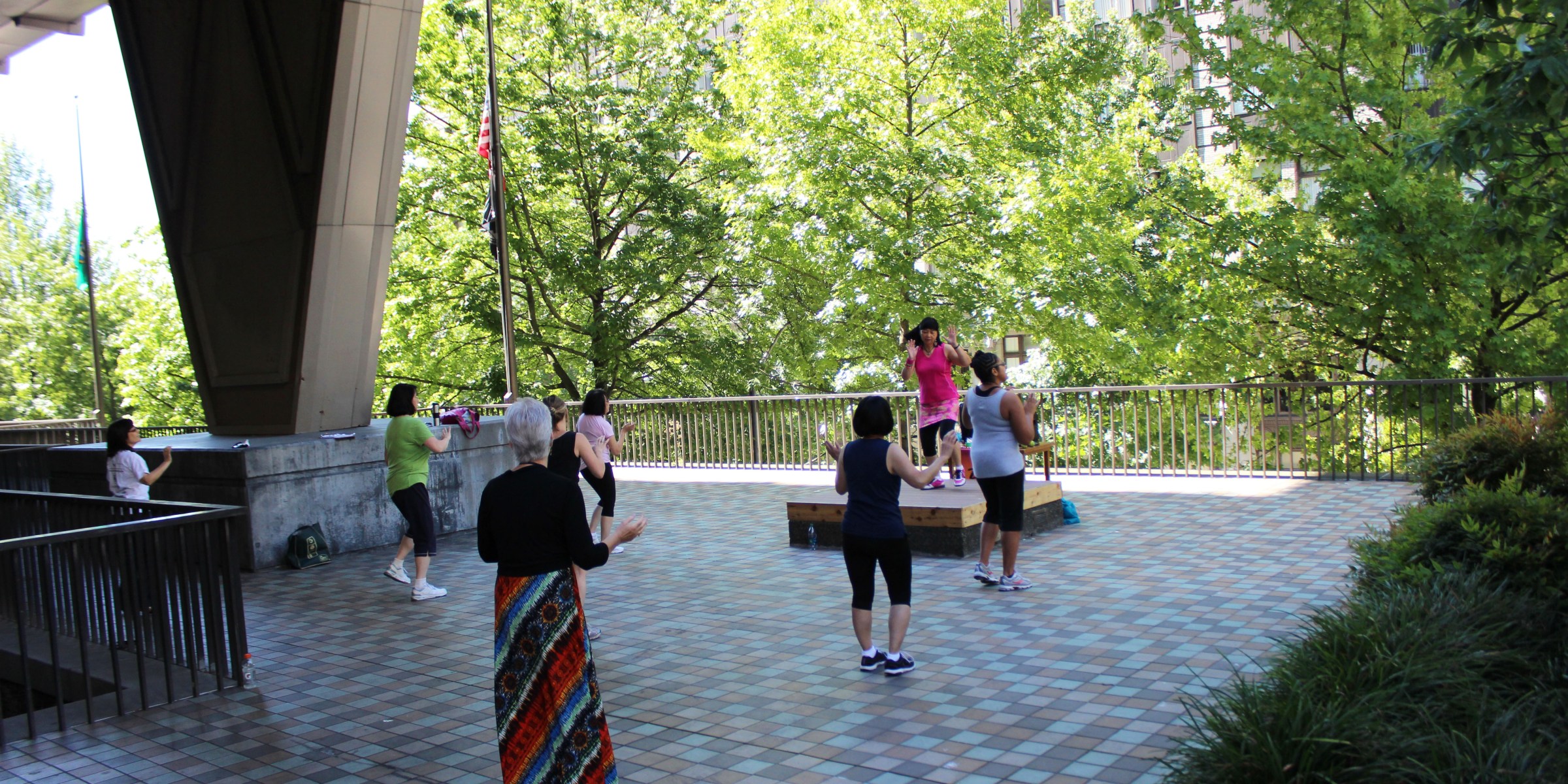
At a Seattle Storm basketball game, 80 Zumba instructors performed for the half time show. Sitting in the crowd, Lilian Yetter thought that might be something she’d want to try.

Lilian Yetter
“They were looking like they had so much fun. One lady I focused on out of the 80 instructors out there had this big smile on her face, and I was watching her thinking, ‘wow, this is really cool,’” Yetter said.
So Yetter joined a local gym to learn Zumba, and was greeted by none other than the Zumba instructor with the big smile. A year later Yetter was out at the Key Arena dancing Zumba at half time.
Yetter, who works at King County as a Fiscal Specialist for the property tax section in the Department of Executive Services, has been a certified Zumba instructor for two years and teaches free Zumba classes for King County employees every Wednesday and Friday during her lunch break.
Share this:

Employees take noxious weed fight to the streets

The employees of King County’s Noxious Weed Program know they can’t stop the spread of invasive plants on their own, so they’re bringing a secret weapon to the fight – local residents and businesses.
“We try to teach people enough so they can do better at controlling these plants. A lot of people want to control noxious weeds and invasive plants, but not everyone knows how. We offer that expertise,” said Sasha Shaw, the noxious weed education specialist.

Garlic Mustard
Throughout the year, staff from the program attend public events to answer questions about what noxious weeds are and how they can be controlled.
“We talk to people who are completely unfamiliar with the concept of invasive plants all the way up to farmers who have been farming for 50 years,” Shaw said.
Share this:

Radio brings out employee’s passion for music

 When Sandy Macdonald isn’t working as a civil rights investigator, he is playing music – as a radio host, producer and in a band.
“I just enjoy playing the music and I enjoy being part of live radio,” Macdonald said.
An 18-year employee with what is now King County’s Office of Civil Rights and Open Government, Sandy gets in the radio booth every second and fourth Sunday of the month to host 91.3 KBCS’s show, “Sunday Folks” from 9 a.m. to noon. The show describes itself as “A morning mix of traditional and contemporary folk in all its undefined states.”
Macdonald has hosted shows at the public radio station for 23 years. He originally got into radio in college, graduating with a degree in radio, television and film.
Share this:

PAO’s Annual Food Frenzy Drive Raises $11,600 for Food Lifeline
The Prosecuting Attorney’s Office (PAO) completed its annual two-week fundraising project in July called Food Frenzy, which raised $11,600 for Food Lifeline which equals last year’s total. The money will provide 46,400 meals for hungry children. Food Frenzy is a “friendly” competition between law, accounting and engineering firms with the goal of feeding children during the summer months when food bank shelves aren’t well stocked and school lunch programs aren’t running.
The PAO again won the competition in the Public Sector category for 2014 and has won in that category for the past nine years.
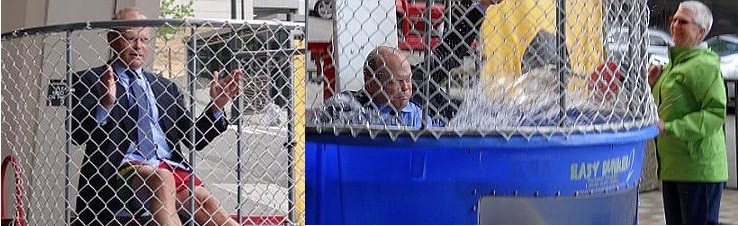
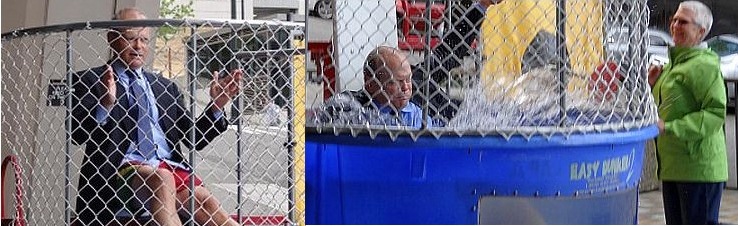
Employees participate in many fundraising projects including cooking & bake sales, softball and bowling tournaments, a pie baking contest, a silent auction for gift baskets, a spaghetti luncheon, raffles and Dress Down for a Cause. The Food Frenzy competition fielded a new event this year, a dunk tank event called “Make a Splash to Fight Hunger.” Employees could vote for co-workers and have them dunked into a lot of cold water.
Share this:

Lync Awareness Event at King Street Center
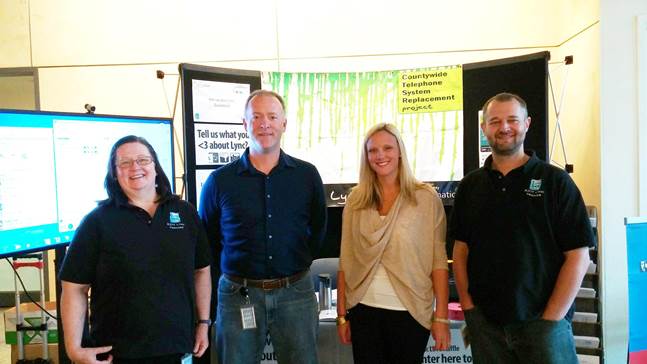
More than 175 employees stopped by the KCIT Lync Team’s booth on July 23 and 24 to learn more about Lync.
Some of the questions we heard were focused on:
- What’s changed in Lync 2013 compared to 2010
- Update on the Outlook contact phone numbers in Lync issue
- How to get your picture in Lync
- How to get more information and training.

Share this:

Lunch and Learn highlights County’s efforts to end human trafficking

According to Kelly Mangiaracina, King County’s Task Force Coordinator for Commercially Sexually Exploited Children (CSEC), an estimated 300-500 children are forced into prostitution in Seattle every year.
When the CSEC Task Force was convened by Juvenile Court Judge Barbara A. Mack in 2013, it hoped to change that.
“King County was very fortunate to realize this is an issue. We’re very fortunate to have great organizations in the area that want to do something about it,” Mangiaracina said at the Equity and Social Justice “Stopping Human Trafficking” Lunch and Learn held on June 30.
Share this:

Five Questions with Judy Garcia, Director of Probation Services, District Court

 1. What was your first role at King County and how did you progress to Director of Probation Services? I began as a Volunteer for the Federal Way District Court Probation Department in 1982, while working for the Weyerhaeuser Company. During my time as a volunteer, I enjoyed interviewing defendants about life problems and writing pre-sentence reports much more than I enjoyed talking with sawmill managers about log inventories, and writing competitor analysis reports. I found working in the criminal justice system, rather than in the timber industry, to be highly interesting and very satisfying. I instantly knew the work was a perfect fit for my personality and skill set and my commitment hasn’t wavered in my 30 years on the job. My employment with Weyerhaeuser was terminated during a major round of timber industry layoffs, and with a severance, I was able to continue the volunteer work until I was hired in the summer of 1983 to job share the half time Volunteer Coordinator position. I became a Probation Officer II (a supervisor with a full caseload) when a full-service probation branch office was opened in Federal Way in 1986 and continued in that capacity for Federal Way and other locations for approximately 20 years. I became the Probation Services Director in May of 2009, after serving 18 months as Acting Director in two non-consecutive stints.
2. What do you do as Director of Probation Services for District Court? Probation provides pre- and post-sentence investigations, to include in-custody interviews and monitors compliance with conditions of sentencing for misdemeanant offenders, primarily high-impact and repeat DUI offenders, those convicted of violent offenses, and those in need of drug, alcohol and/or mental health treatment. Services are provided for state cases in unincorporated areas of King County as well as the King County Domestic Violence Court, Regional Mental Health Court, Regional Veteran’s Court, and 12 cities that contract for the full array of District Court Services. Currently we have four probation mental health specialists and 12 probation officers in five courthouse locations, supervised by two management positions, including me. As the Probation Director, I am responsible for all program and staff activity and supervise and train new officers and supervisory staff. My responsibility also involves evaluation of departmental activity, community trends for use in short and long-range planning, being a liaison with treatment agencies, coordinating public relations efforts, and representing Probation and/or the Court on agency, county, and state committees and task forces.






 Employee News