
Public records request submitted to Washington State Department of Retirement Services
The Washington State Department of Retirement Systems (DRS) has received a public records request that seeks information about all members of the state’s retirement systems, including all retirees and members, for the period of July 1, 2020, to June 30, 2021.
DRS intends to release information, per the state’s public records act, to the requesting organization, the Seattle Times, on Aug. 15, 2022. Read the DRS notice for details, including a list of the information items that will be released.
If you are the subject of this public records request, no action is required of you. For additional information, contact DRS at 844-704-6780 or drs.pdrnotice@drs.wa.gov.
Share this:

KING 5 spends the day with DNRP Swim Beach Monitoring Team

KING 5 reporter Erica Zucco spent the day with the Water and Land Resources Division’s team that monitors water quality at 27 lake beaches in King County. Wildlife, people, and pets all contribute to bacteria levels.
The story highlights the important service this team provides to keep local beachgoers and swimmers safe. Watch the video.
Share this:

New approach to increasing access to free vegetarian meals
Cross-posted from Keeping King County Green
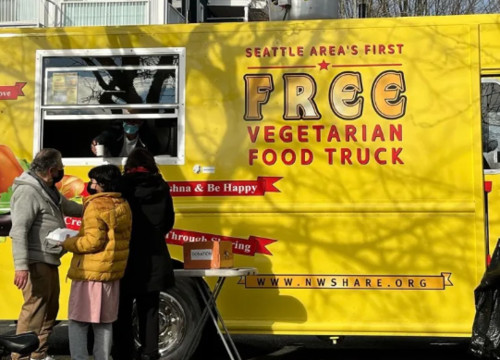
Nearly one-third of households in Washington reported they were food insecure in 2021, according to the Washington State Food Security Survey. Hunger relief organizations such as NorthWest Share work to address this ongoing issue.
Harry Terhanian, founder of NorthWest Share, recently discussed how food trucks serving free meals came about, and the importance of providing free vegetarian meals via food trucks. Read more.
Share this:

Public advisory committee and reorganization for King County Sheriff’s Office under new plan
Executive Dow Constantine and King County Sheriff Patti Cole-Tindall announced new plans and updates for the vision, structure, and community engagement of the King County Sheriff’s Office, including the creation of a community advisory board. Read more.
Share this:

WW (Weight Watchers Reimagined)

Are you ready to kickstart your journey to better overall health and wellness? Whether you want to learn about nutrition, ways to improve your sleep, or new workout techniques, WW has you covered.
During July, King County employees and your benefits-covered spouses or state-registered domestic partners who register as new WW members receive a $25 WW Shop credit!
Visit WW.com/us/Kingcounty to sign up.
Share this:

How a beaver boom is reshaping floods and fire

Jen Vanderhoof, a senior ecologist with the Water and Land Resources Division of the Department of Natural Resources and Parks, was recently interviewed for a story on beavers. The video was produced by Grist, a non-profit, independent media organization focused on covering climate solutions.
The piece highlights how beavers may offer real protection against climate impacts like flooding and wildfires, if people can learn to live with them. Watch the video.
Share this:

Office of Equity and Social Justice Community Compensation Project
King County is working to become an anti-racist and pro-equity government, and is looking toward community engagement and co-creation to reach those most affected by inequality. One way shown to improve on this inequity is to compensate those in the community who participate in developing county programs.

The Office of Equity and Social Justice (OESJ) is partnering with Root Cause Equity Consulting to connect King County departments doing this work with these community members. The goal is to establish consistent standards for compensating community members who work with our government through volunteer advisory groups.
Providing expertise and experience in a meaningful and ongoing way to county programs is a significant time commitment for residents. Community expertise is invaluable and compensating people fairly for their time and commitment helps to remove barriers to participation.
How staff are involved
OESJ recently completed an Inventory of Existing Projects with the involvement of twelve departments. Data and samples were collected from agencies on current and past compensation practices. This information helps to establish a baseline for future policies by identifying common themes, strategies, and structures.
Following this phase will be a Staff Engagement component. This phase will include listening sessions to get deeper insights into successes, challenges, and barriers.
How you can help: Spread the news
This project is currently recruiting for the Community Engagement phase. This involves paid listening sessions to better understand the experience of residents who take part in advisory groups. OESJ will also connect with people who have barriers to participation that prevented them from working on projects in the past.
Do you know someone?
If you know someone in the community who might be interested in providing input, have them complete a quick Interest Form, and OESJ will follow up with the details. Meetings will be held online via Zoom. The session dates are as follows:
- Wednesday, July 13 from 5:30 – 7:30 p.m.
- Saturday, July 16 from 10 a.m. – 12 p.m.
- Monday, July 18 from 5:30 – 7:30 p.m.
Need a different way to provide input?
People can share their thoughts through the Public Input Engagement Hub. Comment on one or all the questions. All insights will help shape the final recommendations. Translations are available in ten languages.
Follow this project
Visit KingCounty.gov/CommunityCompensation to learn more about the OESJ Community Engagement and Co-Creation team and their work. For questions or comments, please reach out to CECteam@kingcounty.gov.
Share this:

The intern experience at King County International Airport

Originally posted in Plane Talk
Getting an internship at King County International Airport (KCIA) provides a unique opportunity for high school, college, and graduate students. Key Brewer, Landin Reibram, Chloe Sow, Inayah Farooqi, Elijah Jones, Vaibhavi Lakshmi, Sierra Sellers, and Rares Neagu have joined the team this year to add valuable on-the-job experience to their educations, as well as some fun.
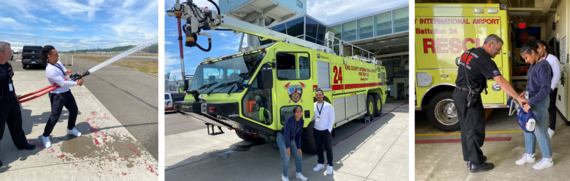
One of the benefits of an internship at KCIA is getting to tour the Aircraft Rescue and Firefighting (ARFF) station and get some hands-on experience. Above, at left, Elijah Jones gets to practice with a fire hose. Center, Inayah Farooqi and Jones with an ARFF rig. At right, Sergeant Clint Herman shows Farooqi a drill tool that can tear through many types of material so that fire fighters can get access.
Staff recruit future interns at American Association of Airport Executives career fair
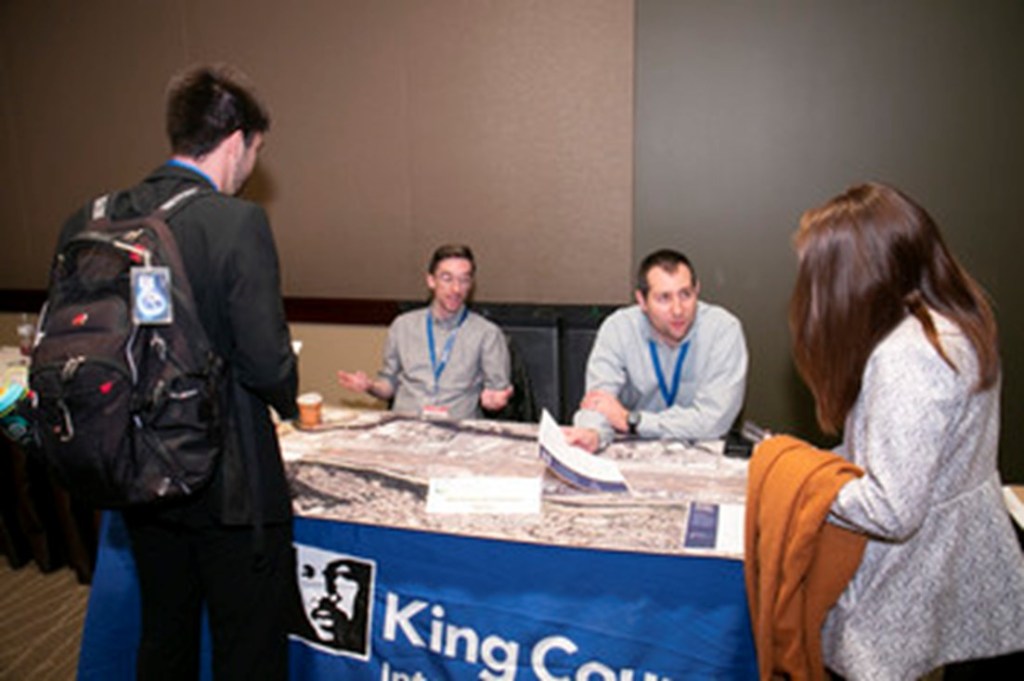
KCIA internships are highly sought-after positions. Finding the right people for these roles is a mixture of public relations and recruiting. Airport employees recently talked with about 75 students at the American Association of Airport Executives student career fair. This event gave KCIA the chance to tell prospective interns about KCIA’s internship program, discuss what type of work is done at the airport, as well as review students’ resumes and gave tips for improvement.
Share this:

Celebrating Disability Pride and people with disabilities
Dear fellow King County employee,
July is Disability Pride Month, a time to celebrate the pride people with disabilities have in themselves and their many successes and contributions to our workforce and community.
Disability Pride Month coincides with the anniversary of the passing of the Americans with Disabilities Act of 1990, better known as the ADA. The ADA has created civil rights protections and better access for people with disabilities. Disability Pride builds upon the legacy of the ADA with the demand for visibility, acknowledgement, and acceptance from society.
Disability spans all races, genders, ages, socioeconomic status, religions, and geographic regions, and Disability Pride Month is also an opportunity to celebrate people’s disabilities and their overlapping identities.
In our work to become a pro-equity and anti-racist government, it is important to value the diversity and unique skills and experiences that every person brings to this region, and everything that they do to make King County a more welcoming, inclusive, and successful community.
King County’s Disability Awareness Committee is hosting a couple of events during Disability Pride Month, and I encourage you to learn more and join in the celebrations at these events:
Film Viewing and Discussion | Monday, July 11, 1-2:30 p.m.
The King County Disability Equity Network and the Disability Awareness Month Committee, co-hosted by Superior Court, will watch and discuss the Sundance Festival award-winning documentary “Crip Camp: A Disability Revolution.” Please register in advance for this event.
Disability Pride Day | Tuesday, July 26, 12-1 p.m.
Join Anita Whitfield, King County’s Chief Equity and Inclusion Officer, and King County employees in celebrating disability pride as we honor and recognize the contributions of persons with disabilities through the lens of equity. All King County employees are welcome and encouraged to participate in Disability Pride Month events. This event is co-sponsored by the King County Disability Equity Network, King County Disability Awareness Month Committee, and the Office of Equity and Social Justice. Please register through NEOGOV Learn in advance for this event (get login help here).
Happy Disability Pride Month.
Sincerely,

Dow Constantine (he/him/his)
King County Executive
Share this:

White House Evidence Team highlights King County’s Priority Hire Program
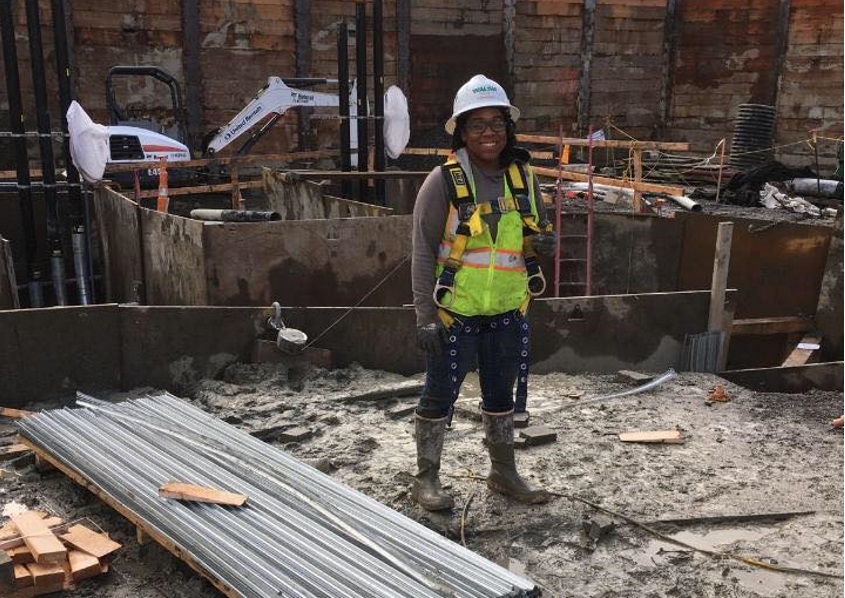
King County’s Priority Hire program has been featured by the White House as one of six examples from across the country to share how evidence can inform practices and policies.
“When we use evidence to inform our practices and policies everyone benefits,” said Sandy Hanks. Manager, Business Development and Contract Compliance in the Department of Executive Services.
The White House’s recent Year of Evidence for Action Summit highlighted leading practices from Federal Agencies to generate and use research-backed knowledge to advance better, more equitable outcomes for all of America. As a lead up to the Summit, the White House Evidence Team solicited examples of evidence in action from invitees.

King County submitted 15 examples of our equity- and evidence-driven work to the White House. These 15 examples are just a few highlights of the equity- and evidence-driven work King County employees do every day.
“King County has a strong commitment to equity- and data-informed decisions, and to using and building evidence about how our actions, processes, and investments contribute to better outcomes for the people and communities we serve,” said Carrie S. Cihak, King County Evidence and Impact Officer.
King County’s Priority Hire Program is a workforce and economic development strategy providing training and family wage employment opportunities in the construction industry on King County public works construction projects of $5 million or more. The Priority Hire program provides access for people interested in pursuing career opportunities in the construction industry who reside in economically distressed areas of the King County region. With the goal of championing greater workforce diversity in the trades, King County’s Priority Hire Program has addressed a widening gap between the demand for construction labor and the supply of skilled trade workers in our regional labor market.
Evidence has been foundational to the development and implementation of the Priority Hire Program.

“The Priority Hire Program is an example of how the county used research-based evidence to identify zip codes and prioritize individuals from vulnerable and underserved populations for paid training and family wage employment opportunities on County construction projects,” Hanks said.
In addition, the Priority Hire Program is an important component of King County’s Equity and Social Justice Strategic Plan and supports a more diverse and trained workforce that is necessary for the region to continue to prosper. From the most recent data available, 2018-2021, the Priority Hire Program has exceeded its goals for the proportion of labor hours from workers in targeted zip codes: nearly one-third of the labor hours were performed by participants who reside in Priority Hire communities. In 2021, the Priority Hire Program saw the following impressive results:
- $4.4 million in wages earned by Priority Hire workers
- 305,583 total Washington State labor hours on projects with Priority Hire requirements
- 93,875 Priority Hire labor hours
- 45% Priority Hire apprentice participation rate, exceeding the required rate of 19%
- 27% Priority Hire journey worker participation rate, exceeding the required rate of 16%
- 577 Priority Hire workers, including 482 journey workers and 95 apprentices.
Additionally, the Priority Hire Program is clearly reaching more people every year and fulfilling its goals of increasing entry and diversity in the building trades: 45% of Priority Hire workers identify as people of color as compared to 24% people of color in the King County construction industry overall. While the proportion of women participating in Priority Hire (13% in 2021) is higher than women represented in the nationwide construction industry (11% in 2021), more work is needed to open additional opportunities for women.
The Priority Hire Program is currently implemented through a Master Community Workforce Agreement (MCWA), which is a pre-hire collective bargaining agreement between King County and 18 construction labor unions that sets the basic terms and conditions of employment on covered public works projects. The MCWA strengthens the collaborative relationship with our labor partners and is an efficient contracting business practice that sets clear expectations on all construction projects above specified dollar thresholds.






 Employee News