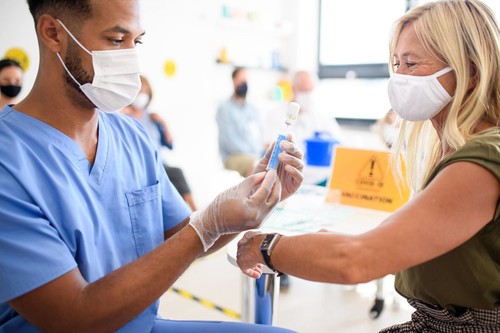
Reduce your risk, sign up for a COVID-19 booster shot
With the highly infectious Omicron variant now circulating rapidly in our region, it is more important than ever to take steps to reduce your risk – including getting a booster dose if you are eligible. If it has been at least six months since your second dose of the Pfizer or Moderna vaccine, or at least two months since your single dose of the Johnson & Johnson vaccine, you are eligible for a booster shot.
To schedule a COVID-19 vaccine booster, visit www.kingcounty.gov/vaccine or use the Washington State Department of Health’s vaccine locator to check out your options. And to help meet the demand for boosters, the Federal Emergency Management Agency (FEMA) is sending its Mobile Community Vaccination Center to Federal Way and Auburn in December and January. This Community Vaccination Center will be providing free COVID-19 vaccinations and boosters to everyone ages five and older. To get more information and register for an appointment with the Mobile Clinic visit https://bit.ly/kc-comm-vax.
The Centers for Disease Control and Prevention (CDC) recommend everyone currently eligible should get a COVID-19 vaccine booster to maximize protection. CDC recommends the Pfizer or Moderna vaccines over the Johnson & Johnson for both initial and booster vaccinations.
N95 masks for employees working onsite
King County is making N95 masks available to employees who are required to be onsite for voluntary use as we continue to monitor the rise of the Omicron variant of COVID-19.
All King County department and division leaders have been provided with information on ordering N95 masks, and these masks will be available soon for onsite employees to request.
If you would like to request a N95 mask for voluntary onsite use, please contact your supervisor.
Before using a N95 mask, please ensure that you read the information below on voluntary use of respirators (N95/KN95).
Information for Employees Who Voluntarily Use Respirators (N95/KN95 masks)
When providing these N95s for voluntary use by on-site employees, each must be provided with the following information:
- Wearing an N95 may put additional stress on your heart and lungs; respirators should be worn with caution, and you might want to get advice from your personal physician or a medical professional prior to wearing one. If you have any trouble breathing or other related symptoms, you should stop wearing this type of respiratory protection and wear a disposable facemask or cloth face covering instead.
- Important information about masks can be found at this Public Health Insider blog post: It’s time to refresh your mask supply (publichealthinsider.com)
- Regardless of the type of mask worn, follow these guidelines:
- To protect yourself, wear face coverings properly.
- Your mask should cover your nose and mouth at all times.
- Always wash your hands with soap and water or use an alcohol-based hand sanitizer before you put on a face covering and after removing it.
- Change your face covering when it gets moist.
- Wash your face covering after each use.
- Snug-fitting masks provide excellent protection.
- Make sure masks fit snugly against your face. Gaps can let air with respiratory droplets leak in and around the edges of the mask.
- Use a cloth mask with multiple layers of fabric, or wear a disposable mask underneath a cloth mask.
- Choose masks with a nose wire or mask fitter
- For visuals of these tips, visit the CDC’s guidance for improved mask use.
- The Washington Administrative Code requires that this table be provided to employees who voluntarily wear respirators, including N95s:

Additional COVID-specific information from the WA Department of Labor & Industries can be found at: Coronavirus/COVID-19 Workplace Safety & Health (wa.gov).
Update on in-person operations in January
By Dow Constantine, King County Executive
Many of you have been asking about Future of Work (return-to-office) plans in the new year, and the impacts of the Omicron variant to our timelines. Our Future of Work plans are created to be nimble and responsive to health and safety, operations, and the needs of our employees.
We have not set a firm return-to-office date for those employees who are currently teleworking. At this point, due to the changing environment around the Omicron COVID-19 variant, and the expectation that the spread of the variant will rapidly increase in King County for the next several weeks, teleworking employees will not be asked to return to the office in January. Please continue to hold meetings remotely when possible and do not go into the office unless necessary and approved by your supervisor. With the exercise of reasonable caution, we can help slow the spread of this variant and protect our coworkers whose jobs necessitate they be on-site.
This direction is for King County Executive branch employees, including Assessments, Elections, and Sheriff Office. Employees in other branches of County government may receive additional guidance from their leaders.
While the severity of illness associated with Omicron is not clear at this time, the good news is that most fully vaccinated people – particularly those who have received booster shots – should be protected from severe infection. Thanks to the success of our employee vaccination mandate almost all of our workforce is fully vaccinated. However, we do expect to see many more serious cases in unvaccinated people, as well as many milder breakthrough infections among the vaccinated.
We already have several measures in place to stop the virus and are augmenting these with additional actions where appropriate:
- Operations that require employees to be onsite will have KN95 or N95 masks available for all employees. Find out more about using these masks in this Public Health article on improving the quality and fit of your mask.
- Non-essential in-person gatherings should be canceled until further notice. Please also work with your supervisors and use good judgment about which meetings should continue to be conducted in person and limit the number of people present where possible. Conduct meetings using Teams, Zoom or teleconferencing where practical.
- In-person customer services that are currently suspended will remain so, except where there is an operational need to shift to in-person service.
- All employees and visitors must continue to wear masks indoors regardless of vaccination status.
I also urge you to make an appointment for a booster shot as soon as you are eligible. Booster shots have been shown to greatly improve protection against COVID-19, including the Omicron and Delta variants. To schedule a COVID-19 vaccine booster, visit www.kingcounty.gov/vaccine or use the Washington State Department of Health’s vaccine locator to check out your options and get on a waitlist.
I know that the emergence of this variant is something none of us wanted to see, particularly right before the holidays. As we enter the holiday season, there are many things you can do to protect yourself and your loved ones, including:
- Limit the number and size of gatherings. If possible, get a test before the gathering. Rapid tests are less accurate but still useful
- Gatherings will be safer in well-ventilated spaces. Open windows for fresh air
- Postpone travel where possible
- Now is the time to refresh your mask if needed. Make sure it is well-fitting and high-quality. Everyone ages 5 and older, regardless of vaccination status, are required to wear masks in all indoor public settings and at outdoor events with 500 or more people. Masks are also recommended for everyone in crowded outdoor settings
- Visit Washington DOH’s Vaccine Locator to get a booster appointment
- Take extra precautions for higher risk people in your life, including those who are unable to get vaccinated.
I encourage you to take reasonable precautions this holiday season and do everything you can to stay safe and reduce the impact of this virus on family and friends, on healthcare and other emergency workers, and on our entire King County community.
We thank you, our employee audience
Our top stories and videos for 2021
This past year, the twice weekly Employee News newsletter shared employee accomplishments and events, COVID-19 resources and vaccine updates, training and career development information, and other relevant employee news. The Department of Human Resources Employee Communications Team also featured these items on the KC Employee News blog, the King County Employees YouTube channel, the KCEmployees Twitter account, and the King County, WA LinkedIn account.
We would like to thank you, our employee audience, for interacting with this information, sharing it with colleagues, and helping us provide timely news and information that is relevant to your career, your family, and your community.
2021 has been an equally challenging year, and we are grateful to have your support. If you have any story ideas, suggestions, or recommendations, please email us KCEmployees@kingcounty.gov.
The 10 most-clicked Employee News newsletter stories for 2021 were:
10. Walking Bus pilot program launches Nov. 15 – 2,269 clicks
9. How to make sure you are fully vaccinated by Oct. 18 – 2,269 clicks
8. Juneteenth and Indigenous Peoples’ Day to be observed holidays beginning in 2022 – 2,640 clicks
7. King County to require all employees to be fully vaccinated by Oct. 18, 2021 – 3,037 clicks
6. How to get your vaccination status verified – 3,849 clicks
5. Planning for the future of work for employees of King County – 4,138 clicks
4. FAQs and updates to mask requirements for King County employees – 4,494 clicks
3. How to provide verification of vaccine status – 5,255 clicks
2. Want to opt out of Washington’s long-term care program? – 11,536 clicks
1. School-to-Work Transition Fairs go virtual in 2021 – 15,391 clicks
The 10 most-watched videos for 2021 were:
10. Introducing King County eLearning, powered by NEOGOV – 256 views
9. How to navigate King County eLearning – 274 views
8. King County Employee Performance Awards for 2020 – 308 views
7. EAP or MLE: Which program is right for my situation? – 314 views
6. Four Pro-Equity Actions: A Conversation Between the Executive’s Senior Leadership Team. – 322 views
5. DAJD Employee Recognition Video – 363 views
4. King County Vaccine Deadlines for Employees – 373 views
3. KingCare Select Requires County Employees to Choose Their PCP – 471 views
2. Multi-factor Authentication for KC – 643 views
1. King County Employee Engagement Survey – Key Findings – 728 views
Is it time to schedule your COVID-19 booster?
If it has been at least six months since your second dose of the Pfizer or Moderna vaccine, or at least two months since your single dose of the Johnson & Johnson vaccine, you are eligible for a booster shot.

The Centers for Disease Control and Prevention (CDC) recommend everyone currently eligible should get a COVID-19 vaccine booster to maximize protection.
To schedule a COVID-19 vaccine booster, visit www.kingcounty.gov/vaccine or use the Washington State Department of Health’s vaccine locator to check out your options and get on a waitlist.
With the Omicron variant now circulating, it is more important than ever to get a booster dose, wear a high-quality and well-fitting face mask, avoid crowded indoor spaces, and get tested if you have symptoms. Thank you for all you are doing to help keep yourself, your family, our workplaces, and our community healthy and safe.
Supported employee takes pride in his work, shares joy with community
The Supported Employment Program (SEP) provides employment opportunities within King County government to people with disabilities. With an assigned job coach, and supportive supervisors and team members, participants are encouraged to fulfill their potential, pursue career goals, and thrive in a helpful environment.
One employee within the Supported Employment Program who enjoys his work and the chance to make a difference is Naveed Labib, an Office Assistant in the Transit Facilities Division of the Metro Transit Department. Naveed has been with King County since January 2018. While some of his duties include working on payroll, completing time sheets, utility billing, and filing, they have recently expanded. He now also helps other groups beyond his specific team within the Division.
“It feels good to go beyond, and be proven to be reliable and independent,” Naveed shares. “I love being productive and love working hard.”
Naveed also credits his supervisor, Jake Jacobovitch, for being a supportive and caring manager. Jake is a superintendent within the Transit Facilities Division and has been with King County overall for 36 years, and with Metro Transit the last nine years. He oversees the environmental compliance group, his division’s equity and social justice program, the safety program, and Naveed.
“Wherever Naveed goes, I go with him,” Jake explains. “I’m proud I hired Naveed. He’s developed into a wonderful person and employee.”
“Jake is an amazing superintendent,” said Naveed. “He is so supportive.”
Naveed likes completing his duties and takes satisfaction from knowing it is important, meaningful work. He explains how he’s proud to earn his keep and be on top of things, especially with his favorite task, the time sheets.
“I enjoy doing time sheets, I like to help out everybody,” he said. “Time sheets, utility billing – I enjoy working with numbers, and something I also really enjoy is knowing how others can rely on me and being dependable.”
“I tell myself each day, if I finish what I’ve needed to do and proven to others it’s another day that they can depend on me, then I feel good.”
“Naveed is very reliable. He is precise in his duties and tasks. So much so that the accuracy of his work is recognized,” added Jake.
The Supported Employment Program provides job coaches and additional support for each employee. Naveed shares how in his King County position, he has been able to gain some independence, while still knowing he has a team of supportive people in his corner.
“Initially when I started, I had support from two job coaches, and we were meeting weekly, but currently I just have one. He calls me monthly, and we talk about any issues,” he said.
Naveed has transitioned to remote work, as has the rest of the administrative team during the pandemic, and he continues to produce accurate and timely work. During this transition, he has become more independent and requires even less job coaching support.
Jake shares how he worked closely with the Supported Employment Program Manager, Christina Davidson, to recruit a full-time employee (FTE) that met the division’s business needs and ensured that both Naveed and the overall workgroup were successful.
“In 2017 leaders said we had a SEP program, and that it was a priority within Metro Transit to participate, so we identified a body of work and completed interviews with different candidates, then chose Naveed,” he said.
“There was a big emphasis to make it a success, so we worked with SEP staff and Naveed’s job coach to ensure we would be successful.”
Naveed explains his journey to getting his role at King County. He first got involved with supported employment about 12 years ago through the King County School-to-Work Transition Program, where young adults with disabilities are connected with jobs based on their interests and skills.
“I worked at a library, Trader Joes, and other places, but out of all of those jobs I enjoy working at King County the most,” said Naveed. “I enjoy working with people the most, and I have an amazing superintendent who is always looking out for my best interests.”
In addition to his work at King County, Naveed also stays busy in his free time. He has received his Associates and Bachelor’s degrees, regularly completes adventurous, long-range walks, holds a part-time job, and also works at Bellevue’s Snowflake Lane during the holiday season.
“I recently started working part time at CVS Health as a retail associate, working the cash register, stocking items, and checking out customers,” he said. “And also, during the holidays I work at Snowflake Lane in Bellevue as a reindeer. It’s a beautiful job and it keeps me happy.
“I get to dress up and walk down the streets every evening, waving at the audience, and have pictures taken. I love it.”
The Supported Employment Program has been a rewarding experience for Naveed and Jake, one that they both strongly recommend other workgroups consider, and are grateful King County has made the effort to develop it.
“It’s important that people with a disability are given paid opportunities to develop their skills and interests,” said Naveed. “It’s important to broaden their knowledge about different positions they could do as well as expand their communication skills through work experiences with their fellow employees. I feel like this helps each person understand more about themselves.”
Jake adds the Program is a great way to help adults with disabilities find a workplace that suits them and is willing to work with them.
“There are many people with disabilities that can do the work, but they can’t navigate through the system. Not just at King County but everywhere,” Jake said. “This initiative is a good one to give opportunities to individuals who may need help in applying to ensure it’s a good fit and to be successful.”
Jake and Naveed hope that by sharing about their positive experiences with the Supported Employment Program at King County, they can inspire others with disabilities to know that there is a place for them, with supportive, caring colleagues and dedicated support staff.
“It’s important for the general public to know about this program, to find the resources they need and help young adults with disabilities to find a job and see their options,” Naveed said. “We want to encourage more people to come work for King County.”
To learn more, visit the Supported Employment Program website, or contact Program Manager Christina Davidson at Christina.Davidson@kingcounty.gov to find out how to take advantage of this program.
Vanpool and Vanshare program requirements lowered from five riders to three
Starting Jan. 1, 2022, King County employees may start a King County Metro Vanpool or Vanshare with only three or more participants and the cost will be covered 100% by the Employee Transportation Program (ETP). This reduced ridership minimum from five participants to three or more participants is being offered after the recent survey of employee safety programs highlighted employee interest in more shared ride options for commuting into downtown Seattle. As a result of the survey and support from ETP, the Executive’s Office approved continuing the 100% subsidy for employees commuting in a Metro Commuter Van through the end of 2022.

The Metro Commuter Van program is ideal for groups of consistent commuters who have a common route to work and are willing to share the driving and bookkeeping roles in the van. The program includes everything for your shared ride to work – the van, fuel, maintenance, insurance, roadside assistance, and the Home Free Guarantee program. There are nearly 30 existing Metro Commuter Vans from various King County departments traveling to worksites throughout the county, some able to accommodate up to 15 passengers. In addition, for commuters traveling to Seattle’s downtown core, parking costs for vans may also be covered.
Metro Vanpool is your direct commute to work where the van is parked overnight at the assigned driver’s home. The driver picks up passengers at pickup locations and then travels to the worksite. The vanpool can travel in HOV lanes and pass for FREE through WSDOT toll facilities, and is a great way to reduce stress and save money.
For commuters riding the train, ferry or bus, Metro Vanshare can provide the first connection to the terminal or station, or link the last couple miles from the terminal or station to your worksite.
To find an existing Metro Vanpool or Vanshare, or find others to start a new group, create your commute profile at www.RideshareOnline.com. If you would like to start a new group with at least two other participants who share a similar commute, start here and submit information about your group to start the process.
Please know that any transportation benefit amount in excess of the IRS limit for the year, $270.00 for 2021 is taxable income and will show in your W-2.
For more information about this commute option or your ETP program, please visit www.Kingcounty.gov/ETP or ask Hossein, the ETP Manager.
Paid Family and Medical Leave benefit and rates to increase Jan. 1
The state of Washington is making the following changes to the Paid Family and Medical Leave (PFML) program, effective Jan. 1, 2022.

Higher premiums
The total premium rate for Washington PFML will increase to 0.6% (from 0.4% in 2021) of each employee’s gross wages up to the 2022 Social Security cap of $147,000 (was $142,800 in 2021).
Increased benefit for employees
The maximum PFML weekly benefit will increase to $1,327 for leaves beginning in 2022 (from $1,206 in 2021). The PFML benefit amount is based on your income.
Employees to pay a larger portion of the premiums
In 2022, employers will pay 26.78% of the premium and employees will pay 73.22%. In 2021, employers paid 36.67% of the premium and employees paid 63.33%.
The PFML premium calculation occurs on Sept. 30 each year and is governed by state statute (see RCW 50A.10.030). The rate hike appears to be driven by high usage of the program over the last year, coupled with reduced payrolls feeding into the program during the pandemic.
To learn more about PFML rates, go to the Premiums Calculator on the Washington PFML website. For complete information about PFML and to apply, go to Paid Family and Medical Leave or contact them by email paidleave@esd.wa.gov or by phone at 833-717-2273.
Our recent survey about employee safety programs
Almost 2,500 King County employees who work in downtown Seattle recently had their say on new and existing programs designed to enhance safety at and around county worksites in the downtown campus.
A total of 6,833 employees were invited to take the survey, with 2,491 submitting responses. The key findings were:
- For existing programs, employees were most interested in the Security Escort program (57% very or somewhat interested) followed by Walk-pooling (47%), VanPool (35%), Goat Hill Garage Tunnel (30%), and VanShare (25%). Almost half (42%) of employees were very or somewhat interested in a walking bus program.
- There is a large gap between those that are using safe travel programs and those that are interested. This indicates a lack of awareness in safe travel programs.
- The top thing that employees reported that would help them feel safe traveling to and from work was an increase in security presence in and around county buildings, parking garages, bus stops, and train stations.
- Of those who were interested in a vanpool, carpool, walking bus, or security escort, the average amount of time they would be willing to wait was approximately 13 minutes.
These responses are helping the county provide solutions that help employees commute more safely to and from work. One of the immediate actions in response to the survey was the launch of the Walking Bus pilot program, which leaves the King County Courthouse each weeknight to the King Street Station and the Colman Dock, accompanied by a Facilities Management Division security escort. Watch this video to learn more about this and other programs available to you. You can always find information about safety at work on our Future of Work site.
Spend your Flexible Spending Account money
Do you have money left in your Flexible Spending Account (FSA)? Check the balance of your Health Care or Day Care FSA by going to Navia Benefits and signing in to your account. Expenses incurred by Dec. 31, 2021, must be submitted for reimbursement by March 31, 2022.

For this year only, any unused funds in your 2021 Health Care or Dependent Day Care FSAs will automatically roll over and be available next year. You do not have to be enrolled in an FSA next year to access these funds. (Normally, the Health Care FSA allows you to carry over up to $550 and the Dependent Day Care FSA does not offer a carryover feature.)
Day Care FSAs
- Use your Day Care FSA to pay for day care or dependent care expenses for your child under age 13, disabled spouse, or dependent parent so you can work or attend school full-time.
- Day Care FSA funds can also be used to pay an eligible family members to watch your children, as long as the family member is not your tax dependent (your spouse, the parent of the child, your dependent, or your child under the age of 19).
- Online or virtual day cares and camps are not eligible for reimbursement with Day Care FSAs, according to IRS regulations.
- See the complete list of Day Care FSA Eligible & Ineligible Expenses.
Health Care FSAs
- You can use your Health Care FSA funds to pay for a variety of medical, dental, and vision expenses for you, your spouse or eligible domestic partner, and your dependents.
- Health Care FSA funds can be used to pay for orthodontia, laser eye surgery, eyeglasses, and over-the-counter medications and supplies, including menstrual care products. They can also be used for eligible ergonomic office equipment when you obtain a letter of medical necessity from your doctor.
- See the complete list of Health Care FSA Eligible & Ineligible Expenses. You can also shop online at the FSA Store.
If you have questions about your FSA benefits, contact Navia Benefit Solutions at 425-452-3500 or email Navia Benefit Solutions.