
How to make sure you are fully vaccinated by Oct. 18

All King County Executive branch employees must be fully vaccinated by Oct. 18, 2021. Oct. 4 is the last opportunity to get vaccinated to meet the Oct. 18 deadline.
To meet this requirement, employees must:
- Receive their second shot of the Pfizer or Moderna vaccine, or the first shot of the Johnson & Johnson vaccine, by Oct. 4, 2021, and
- Provide verified proof of vaccination by Oct. 18, 2021
Make sure you know when you need to start your vaccine schedule in order to meet the Oct. 18 requirement:
- If you opt for the Moderna vaccine, you need to get your first dose no later than Sept. 6, 2021.
- If you opt for the Pfizer vaccine, you need to get your first dose no later than Sept. 13, 2021.
- If you choose the single dose Johnson & Johnson vaccination, you will need to get the vaccine by Oct. 4, 2021.
| Vaccine | Series Dose Requirement | First dose no later than | Second dose no later than | Completed series | Fully vaccinated |
| Pfizer | 2 doses, 21 days apart | 09/13/21 | 10/04/21 | 10/04/21 | 10/18/21 |
| Moderna | 2 doses, 28 days apart | 09/06/21 | 10/04/21 | 10/04/21 | 10/18/21 |
| Johnson & Johnson | Single dose | 10/04/21 | N/A | 10/04/21 | 10/18/21 |
If you haven’t already been vaccinated, you can find out where to get your vaccine and find answers to your questions at www.kingcounty.gov/vaccine.
Employees may make requests for a reasonable accommodation based on a medical disability or for sincerely held religious beliefs. Philosophical, political, scientific, or sociological objections to vaccination will not be considered for an exemption or accommodation.
Employees should work with their agency’s human resources staff to assess whether they are eligible for a reasonable accommodation due to a medical disability or for religious reasons. Absent unforeseen events, employees must request an accommodation by Sept. 17, 2021.
The county may not be able accommodate all requests. Examples of an undue burden for the purpose of accommodating a sincerely held religious belief include if the accommodation is costly, infringes on other employees’ job rights or benefits, compromises workplace safety, decreases workplace efficiency, or requires other employees to do more than their share of potentially hazardous or burdensome work.
This policy applies to all employees in the Executive Branch, that is, employees who report to the Assessor, Elections Director, the County Executive, and the Sheriff. This includes telecommuting employees, those who previously had COVID-19, and temporary employees.
Share this:

Congratulations to the 2020 Executive’s Performance Excellence Awards honorees

Several King County leaders today announced the honorees for the 2020 Executive’s Performance Excellence Awards in a series of video announcements, recognizing employees and teams for their exceptional contributions to performance, leadership, service, and innovation to better serve our customers.

“These awards honor employees and workgroups for their exceptional contributions in performance, leadership, and innovation,” King County Executive Dow Constantine said. “Recognizing great work is important; celebrating our accomplishments is important; and that’s the purpose of the Performance Excellence Awards. It’s an opportunity to celebrate our own successes and the employees who are responsible for them.”
The Executive’s Performance Excellence Awards were created to recognize projects, improvements, and innovations in departments that are driving exceptional, measurable results. What makes these accomplishments even more impressive is the extraordinary challenges and uncertainty that employees were under with the onset of the COVID-19 pandemic.
Eight awards were presented for 2020 in two categories:
Innovation Awards: People, Cost, Service, Equity and Social Justice, and Sustainability
Leadership awards: People Leaders, Individual Contributors, and the Fred Jarrett Leadership Excellence Award.
This year, the awardees are being honored in a series of video announcements featuring several King County leaders – including Executive Constantine, Chief of Staff April Putney, and members of the Executive’s Senior Leadership Team. Leaders also attended team meetings to personally congratulate the honorees. Click here to see the 2020 honorees and watch the videos.
“Congratulations to all of this year’s nominees for the tremendous work they are doing for our customers and to move us closer to our True North: Making King County a welcoming community where all people can thrive,” Executive Constantine said.
Share this:

Get vaccinated against COVID-19 at pop-up clinics


King County employees and family members age 12 years or older can get vaccinated at one of several upcoming pop-up vaccine clinics hosted by King County. We’re pleased to partner with two vaccinator firms, Discovery Health and Pliable, to provide the clinics.
All three vaccine types – Pfizer, Moderna, and Johnson & Johnson – will be available at each clinic. If you’ll be getting a second dose of Pfizer or Moderna, remember to bring along the CDC COVID-19 Vaccination Record Card that you received when you got your first dose.
Walk-ins are welcome. To save time, however, pre-registration is strongly encouraged. Select the date and location you want from the list below and click on the link to register. For the Discovery Health clinics, registration will also help you secure your preferred vaccine type.
- Saturday, Sept. 18, 2021 from 8:30 a.m. to 10:30 a.m. Metro’s Safety and Training building at 11911 E Marginal Way S. in Tukwila. Register with Discovery Health by your preferred vaccine type: Pfizer, Moderna, and J&J.
- Monday, Sept. 20, 2021 from 11 a.m. to 3 p.m., King Street Center Second Floor Patio at 201 S. Jackson Street in Seattle. Register with Discovery Health by your preferred vaccine type: Pfizer, Moderna, and J&J.
- Wednesday, Sept 22, 2021 from 6-9 a.m., Regional Communications and Emergency Coordination Center, 3511 NE 2nd St. in Renton. Register here with Pliable.
- Saturday, Sept. 25, 2021 from 8:30 a.m. to 10:30 a.m., Metro’s Safety and Training building at 11911 E Marginal Way S. in Tukwila. Register with Discovery Health by your preferred vaccine type: Pfizer, Moderna, and J&J.
- Wednesday, Sept. 29, 2021 from 1 to 4 p.m., Cedar Hills Regional Landfill, 16645 228th Ave SE in Maple Valley. Register here with Pliable.
- Thursday, Sept 30, 2021 from 6-9 a.m., Regional Communications and Emergency Coordination Center, 3511 NE 2nd St. in Renton. Register here with Pliable.
- Thursday, Sept 30, 2021 from 1-4 p.m., Roads Division Renton Maintenance Facility, behind building “A” at 155 Monroe Ave NE in Renton. Register here with Pliable.
- Saturday, October 2, 2021 from 8:30 a.m. to 10:30 a.m., Metro’s Safety and Training building at 11911 E Marginal Way S. in Tukwila. Register with Discovery Health by your preferred vaccine type:: Pfizer, Moderna, and J&J.
Vaccinations required for all King County employees
King County will now require all employees to be fully vaccinated, effective Oct. 18, 2021. To meet this requirement, employees must have received their second shot of a Pfizer or Moderna vaccine, or first shot of a Johnson & Johnson vaccine, by Oct. 4, 2021, and provide verified proof of vaccination. The directive applies to employees in the Executive branch (employees who report to the Assessor, Elections Director, the Sheriff, and the County Executive).
If you are unable attend to attend the above clinics, you can find alternative locations for getting vaccinated at vaccinelocator.doh.wa.gov and kingcounty.gov/vaccine
Share this:

All employees and visitors must wear masks indoors regardless of vaccination status

All people are required to wear masks when indoors in all King County buildings, facilities, structures, and vehicles, effective Tuesday, August 17. The directive applies to employees and all persons entering county facilities including all members of the public, contractors, volunteers, and others entering county facilities.

King County’s employee mask policy is updated as follows:
- If you are working indoors or in an enclosed space with others (for example, multiple people in a vehicle) you must wear a mask whether or not you have been fully vaccinated.
- If you are working outdoors, regardless of vaccine status, you may only remove your mask when you are working at least six feet from others.
- Some employees are required to wear masks at all times while working under the state and CDC guidance due to the nature of their work. This includes employees in correctional facilities, homeless shelters, schools, public transportation, long-term care, and healthcare settings.
If an employee has a medical condition that impacts the employee’s ability to wear a mask, they should contact their Human Resources Manager.
The Delta variant of COVID-19 is far more contagious and is spreading twice as quickly as the original strain. Furthermore, people who are infected with it, including some vaccinated people with breakthrough infections, carry around much more virus in their nose and throat. Wearing a high quality, well-fitting mask will help us stop the spread of COVID-19 and its dangerous variants, including Delta.
The most important tool for limiting the spread of COVID-19 and protecting everyone in our community is getting vaccinated. If you haven’t already been vaccinated, you can find out where to get your shot and find answers to your questions at www.kingcounty.gov/vaccine.
Share this:

Street and sidewalk closures around City Hall Park

A series of street, lane, and sidewalk closures will commence Friday, August 13, around City Hall Park as the City of Seattle prepares to close the park and begin restoration at the site.

For the past six weeks, a County and City-funded contractor called the JustCARE program has been working with the 50-plus people living in the park, located just south of the King County Courthouse, to help them move voluntarily to safer and more sustainable shelter options. This includes individual safety and shelter plans for each person. As of today, almost all the people who were living in the park have now vacated it, moving to indoor shelter options provided by the City and County.
The City of Seattle has posted signage at the park announcing that it will close City Hall Park Friday morning, August 13. Starting at approximately 6 a.m. tomorrow, there will be street, lane, and sidewalk closures as the Seattle Department of Transportation and Seattle Parks and Recreation prepare to begin restoration work at and around the park. These closures and changes include:
- The 4th Ave & Jefferson St south crosswalk will be closed, but the east and north legs will be open to maintain ease of access to King County facilities
- Sidewalks surrounding the park and crosswalks leading to the Park itself will be closed, and pedestrians will be directed to use sidewalks on opposite sides of each affected arterial
- There will be curbside lane closures on 4th Ave and Yesler Way
- Dilling Way and its angled parking will be closed
- Fencing around the park will begin to go up once the park is closed. Once fencing is completed, the surrounding sidewalks and crosswalks should be reopened unless necessary fencing precludes their use.
In addition, sidewalk repair work at 3rd Avenue and Yesler Way begins Monday, August 16, and pedestrians will continue to be detoured around that smaller workzone next week and potentially into the week after.
We appreciate your patience and understanding as this work is undertaken.
Share this:

New Via service for Renton Highlands and more
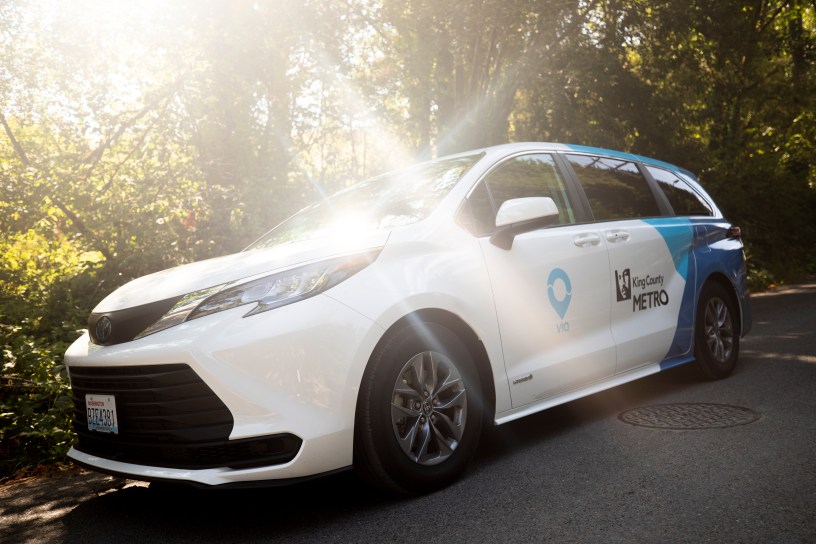
Increased mobility options arrive in Rainier Beach, Skyway, and beyond with expanded Via to Transit.
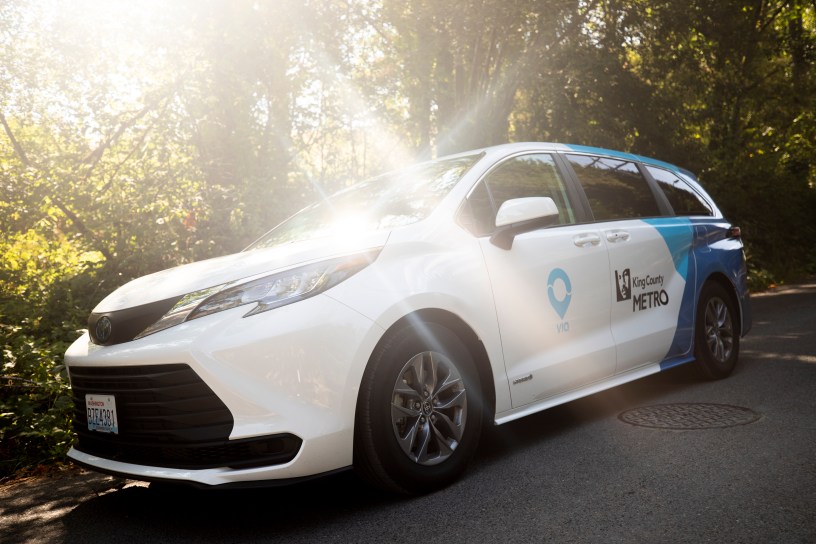
King County Metro has expanded their Via to Transit pilot to provide better connections to frequent transit service and improved mobility for people who live, work, and go to school in the Renton Highlands, Rainier Beach, Skyway, and beyond.
Via to Transit is public transportation that comes to you. Book rides straight from your phone, get picked up steps from your front door, and travel to or from the following places without needing a car:
- Rainier Beach Link Light Rail Station
- Kubota Garden
- Skyway Library
- Renton Transit Center
- Plus, check out nearby service areas and hubs.
Via to Transit in Rainier Beach and Skyway is available Monday thru Saturday 5 a.m. – 1 a.m. and Sunday 6 a.m. to 12 a.m.
Use your employee ID/ORCA card for FREE rides! Accommodations can be made for riders with disabilities and bike racks are available by request.
Learn more, download the app, and start riding at kingcounty.gov/metro/via.
For more information about your all employee transportation benefits, visit the Employee Transportation Program (ETP) website or call your ETP manager, Hossein Barahimi at 206-477-5853.
Share this:

Take care working outdoors during hot weather

(Updated August 12, 2021)
Hot weather has arrived with temperatures into the high 90s now upon us. It’s important to take steps to stay cool while continuing to follow mask requirements and public health guidance.
Some of our work needs to be performed outdoors. Executive Branch departments should evaluate planned field work to determine if this work can be postponed to a later time when temperatures moderate, where possible. If work must be performed, departments should attempt to adapt schedules wherever possible so work can be performed in the morning.
This week’s forecast calls for:
- Thursday: highs in the low to mid 90s, overnight lows in the mid-to-upper 60s
- Friday: highs in the upper 90s, overnight lows in the upper 60s to low 70s
- Saturday: some cooling, but still hot, overnight temps will be higher than normal
- Sunday: temperatures should be at or near normal.
Please see the following guidance and tips (this guidance applies to employees in the Executive branch: employees who report to the Assessor, Elections Director, the Sheriff, and the County Executive. Employees in other branches of County government may receive additional guidance from their leaders):
For managers and supervisors
- If an employee normally performs field work outdoors for extended periods, please consider curtailing all non-critical outdoor work on the hottest days
- Consider adjusting employee work schedules, locations, or regularly assigned duties during extreme heat days if these are options
- If employees must work outdoors, please attempt to have work completed in the morning and avoid work in direct sunlight
- Ensure employees take frequent breaks in the shade or air-conditioned locations (e.g., office space, library, community center, grocery store), and reduce drive times, if possible
- Wherever possible, employees should avoid outdoor work in direct sunlight from 9 a.m. to 6 p.m. on the hottest days.
For outdoor workers
- Talk to your supervisor about adjusting scheduling to avoid all non-critical outdoor work on the hottest days, or perform critical outdoors tasks in the morning only
- Take breaks in the shade or in an air-conditioned space
- Stay hydrated. Have a beverage with you at all times, and sip or drink frequently. Don’t wait until you’re thirsty to drink
- Avoid sunburn. Use a sunscreen lotion with a high SPF (sun protection factor) rating and wear protective clothing.
Remember that mask mandates remain in place.
- Employees and members of the public are required to wear masks in indoor spaces that are open to the public and in public spaces, whether or not they are vaccinated. This includes public lobby and meeting spaces, public indoor recreation spaces, public service counters, and similar spaces open to the public
- It is strongly recommended that all employees wear a mask when working in indoor areas not open to the public, whether or not they are vaccinated, to provide additional protection to themselves, co-workers, and customers
- Employees who are still required under CDC guidance to wear masks in their work settings include those in correctional facilities, homeless shelters, schools, public transportation, long-term care, and healthcare settings.
Tips for everyone
- Check on at-risk friends, family, and neighbors
- If you’re outdoors, take breaks in the shade or in air-conditioned buildings. Avoid direct contact with the sun
- Avoid exercising or strenuous activity in direct sunlight from 9 a.m. to 6 p.m. on the hottest days when the heat is most intense
- Stay hydrated. Drink plenty of water and don’t wait until you’re thirsty to drink more
- NEVER leave infants, children, or pets in a parked car, even if the windows are cracked open! It only takes a few minutes for severe medical problems and even death to occur
- Watch for signs of heat exhaustion or heat stroke. Seek medical care immediately if you know someone who experiences symptoms.
- Certain health conditions and medications make people more sensitive to heat. Check with your doctor about whether you are at greater risk.
Signs of heat exhaustion
- Heavy sweating
- Weakness
- Cold, pale, and clammy skin
- Weak pulse
- Fainting
- Vomiting.
Signs of heat stroke
- High body temperature (103° F or higher)
- Hot, dry skin
- Rapid and strong pulse
- Possible unconsciousness.
More information: www.kingcounty.gov/BeatTheHeat.
Share this:

How to get your vaccination status verified

King County will require all employees to be fully vaccinated, effective Oct. 18, 2021, and you have a couple of options for providing proof of vaccination for verification.
To have your vaccination status verified, you can:
- Initiate the COVID-19 Vaccination Declaration process through your NEOGOV Dashboard (click on Dashboard > Forms > COVID-19 Vaccination Declaration) and attaching a copy of an official document (see list below), OR
- Show one of the following to an HR professional or other designated department representative:
- your actual vaccination card, or a photo or a copy of it,
- a copy of your state vaccine record, or
- a verified medical record.
Departments will not keep copies of vaccination cards, state vaccine records, or vaccine medical records; however, they will document that the employee has been vaccinated, which vaccination was received (Pfizer, Moderna, or Johnson & Johnson), and the last date of the vaccination.
If you have any questions, please contact your department’s HR Manager (SharePoint link).
Share this:

Tips to stay cool

Originally posted in the Department of Executive Services Express
With temperatures already forecast to be above normal this week, keep these tips in mind to stay cool:

- Keep window blinds or curtains closed when outdoor temperatures skyrocket. This reduces indoor temps and reduces the strain on the HVAC equipment.
- Keep windows and doors closed in locations with HVAC.
- Hydrate, hydrate, hydrate!
- The county recommends against using indoor fans, as they can create “hot zones” in other places in the building and can create a fire hazard. Please don’t block or manipulate air vents or returns.
- Dress in layers to manage varying temperatures.
- The County standard for building temperature range is 70-74 degrees.
- Minimize extended time outside.
If you must be outside:
- The most important thing to do is to drink lots of water. When it’s really hot, drink up to a quart of water every hour with moderate to heavy physical activity.
- Carry a water bottle.
- Consider sports drinks for electrolyte replacement when sweating a lot.
- Wear loose, light clothing with materials designed to wick sweat.
- Wear a hat with a brim.
- Check with your supervisor about adjusting your work hours to start earlier, when it’s cooler.
- Stop all activity if you become lightheaded, confused, weak, faint or have a pounding heart or trouble breathing. Tell your supervisor if you or a colleague experience any of these symptoms of heat-related illness.
The county offers training for supervisors about how to help employees deal with the heat and keep employees safe. Keep in mind that personal factors, such as fitness level, age, obesity, alcohol use (even the night before), nicotine use, etc., affect an individual’s susceptibility to heat illnesses.
Helpful resources:
Share this:

Actions we’re taking for safer workplaces

King County is working to enhance safety for employees and has launched several new and expanded initiatives to make workplaces, building, and structures safer. These include:

- Enhanced security presence: We’re increasing security presence in the King County courthouse and other county buildings. Additional officers will be patrolling inside and outside the Courthouse and providing an enhanced security presence within entire the downtown campus.
- Employee-only restrooms: Some restrooms are being designated for employee use only and will only be accessible with a keycard or code. Work began this week on a two-phase effort to install keycard locks, with Phase 1 involving installation of push button cypher locks (codes will be distributed to staff, anticipated completion by August 23), and Phase 2 involving preparation of electrical distribution and doors, and installation of card readers (6–8-week timeline for procurement and installation).
- Security escort program: Upon request, the County provides security in downtown Seattle for individuals moving between their workplace and their commute. Facilities Management Division security can escort you for several blocks from the building you work in, from downtown buildings to Goat Hill Garage or immediate vicinity bus stops. Please contact the emergency dispatch center at 206-296-5000 to arrange for a security escort whether coming in to work or leaving work. Advance notice for a Security Escort is appreciated.
- Security Assessment: The County is engaging a professional security firm specializing in physical security for a rapid security assessment of the downtown campus and to recommend further improvements. It is expected to be a 30-day deliverable once a contract is signed.
Additional programs and resources are also available to employees, and further actions are under review. You can find more information on our Personal Safety at Work section of our Future of Work site (employee access only).






 Employee News