
Tech Tip: Identifying and reporting scams and malicious emails

By Ralph Johnson, Chief Information Security and Privacy Officer

Ralph Johnson, Chief Information Security and Privacy Officer
On July 6, 2017 the Federal Trade Commission (FTC) issued an alert on scammers posing as FTC officials who contact individuals and claim they have won prizes from a charity contest. The scammers ask for money to cover taxes or insurance costs associated with the prize. While this is a new malicious campaign, scammers use these basic tactics time and time again with slightly different wording to take advantage of unsuspecting individuals. It may seem like a day doesn’t go by without scammers contacting you online or by phone seeking money and/or personal information. Since this is so commonplace, it is worth exploring how to identify these schemes, and how to go about reporting them in the event that scammers target you.
Identifying the scam
Two common financial schemes involve coercing individuals into paying money to prevent a negative outcome, such as a tax audit or police investigation, or asking the individual to pay a fee up front to claim a prize. A third type of scam seeks individuals’ personally identifiable information (PII), such as Social Security numbers and birthdates, to commit identity theft. Individuals providing information to scammers may suffer large financial losses, as well as negative impacts to their credit. It is important that you know how to spot these scams so you can easily ignore them.
One final thing to be aware of is that scammers create convincing emails that may look like official communication from your employer, bank, credit card issuer, or a retailer. These emails often include a link to a very convincing, yet fraudulent website that will ask you to log in with your username and password. If you provide your credentials, the criminal can then use them to gain access to your legitimate account. From there, they can steal your personal information or generate fraudulent transactions. If you ever receive an email asking you to click a link to log in and update your account or change your information, be safe and use your browser to directly type in the legitimate website address for that account in order to complete this request. By doing this, you will always be sure you are on the right website.
Scammers constantly target individuals by email, false advertisements, and phone calls to bring these types of scams to fruition. Being wary of any communication that meets any of the above criteria will go a long way in keeping your information and money safe!
Reporting scams
Finally, it is very important that targets of online or phone scams report this to the proper authorities. Although it can be a bit embarrassing to have been hit by such a crime, reporting is the only way to direct investigators and regulators to pursue the criminals behind the scam or identity theft. Aside from reporting the scam to law enforcement, it is important to work with your bank, credit card issuer, or the business where your account was compromised to take the necessary steps in preventing further financial loss.
If you are the target of a financial scam, report it to the FTC at www.ftc.gov/complaint. If this scam was via email or over the Internet, also file a complaint with the FBI’s Internet Crime Complaint Center at www.ic3.gov/complaint.
Targets of identity theft can also file a report at www.identitytheft.gov and receive a recovery plan detailing how to move forward based on the type of scam committed.
It’s most likely a scam if you…
- Have to pay money to claim a “prize” or “winnings”
- Are asked for money to stop or prevent a police, FBI, or other federal investigation
- Have to provide your bank account number and information
- Are specifically asked to purchase any form of prepaid gift card to be used as payment
- Are approached with no prior contact to give out your date of birth, social security number, password, username or other personal sensitive information online or over the phone
- Are approached online or by phone in an unprovoked manner and asked for payment or personal information by someone claiming to be a government employee on official business
Share this:

Invasive knotweed control workshops a great success

The early bird gets the worm. This summer, the Riparian Noxious Weed Team offered free workshops on knotweed control for local homeowners.

Pictured: From left, Erin Haley and Sayward Glise.
Knotweed, a noxious bamboo-like plant is growing in backyards, community gardens and most successfully along river systems of King County and throughout North America.
Two project leads that are doing work on King County Rivers are Erin Haley (Green-Duwamish) and Sayward Glise (Cedar River Team).
“We currently have knotweed control projects on the South Fork Skykomish and Tye River, the Upper Snoqualmie River, the Cedar River, and the Green-Duwamish River. In 2016 our team and its contractors treated 17 acres of knotweed and surveyed 2,100 acres,” said Sayward. “Other than control work, the Riparian Team also conducts workshops to homeowners throughout the county on how to successfully control knotweed on their property.”
“KCNWCP has been providing these free homeowner workshops since 2008,” added Sayward.
Learning how to control the spread of knotweed can greatly improve local vegetation, water quality and habitat for fish and wildlife. Also, it can prevent damage to roads, pipes, and building foundations.
“It feels good to provide a service and a resource to empower our community to stop the spread of invasive knotweed,” concluded Erin.
Click here to get more information about current knotweed control projects.
Share this:

Senior leaders meet with Veterans Program employees
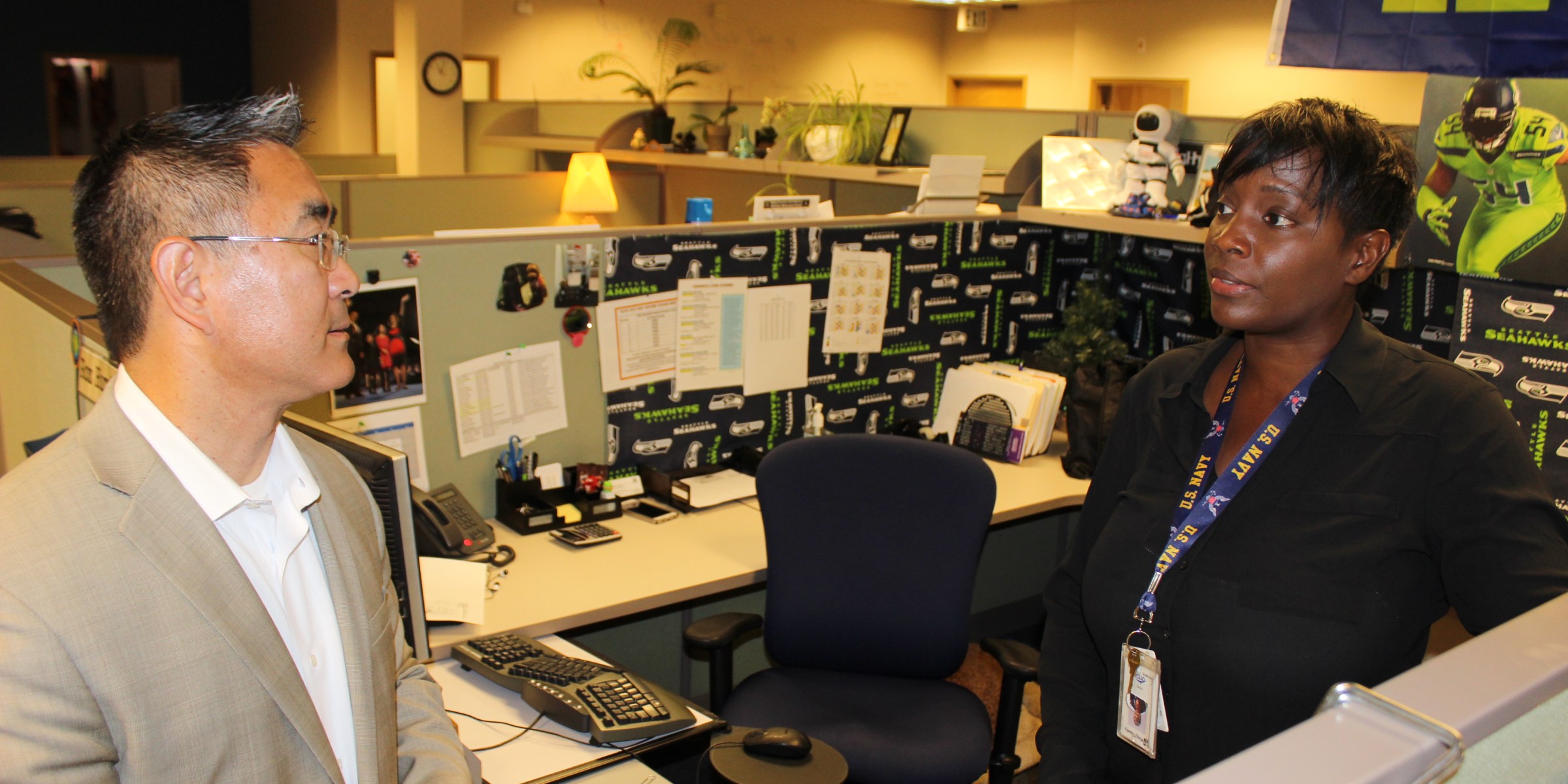
Two members of King County Executive Dow Constantine’s leadership team visited the King County Veterans Program facility in Belltown, Seattle, last week to learn more about how employees are helping local veterans live healthy and productive lives after their military service has ended.
Pictured: From left, Assistant Division Director for Community Services Division Pat Lemus, Senior Deputy County Executive Fred Jarrett and Program Manager Bryan Fry.
Senior Deputy County Executive Fred Jarrett and Gary Kurihara, Lean Transformation Director, met with Program Manager Bryan Fry and Pat Lemus, Assistant Division Director for Community Services Division, to tour the facility, talk with some employees and find out more about their work.
The King County Veterans Programs serves veterans and current service members at two locations, Seattle and Renton, and assists approximately 2,400 veterans each year, roughly split across the two locations. But the client needs are somewhat different between the two offices.
“About 50% of clients who present to the Seattle office at the time of presentation are homeless, whereas in south King County it’s 25%,” Fry said, explaining that clients in Renton often have more protective factors in place. “They are currently housed but they present with a three day ‘pay or vacate’ notice or they might not be working but they’ve worked within the last year and have a resume and skills that are ready to transition. This client population [in Seattle] is a little bit more in the chronically homeless, high system utilizer population.”
Fry and Lemus discussed the challenges facing veterans and the types of services they can access through the program. They also talked about their goal of bringing stability to the lives of clients so they reach a place where they no longer need to access services.
They also shared the success story of a 72-year-old Air Force veteran who was already struggling to make ends meet on a fixed income with the rising cost of living in King County when his landlord advised him that he was remodeling the building and rents would be going up $400 a month, making it ineligible for housing authority vouchers. So he came to the Veterans Program for help getting back to work.

Pictured: From left, Lean Tranformation Director Gary Kurihara and Social Service Professional Roz Hurskin.
His case manager worked with him on updating his resume and did interview training with him. Within a month he landed a job at SeaTac Airport. Now the program is helping him transition to a new affordable senior housing facility.
Jarrett and Kurihara also spoke with some social work and case work employees, including Fran Nowak, Roz Hurskin and Kenjamine Jackson, to hear their perspectives on the program.
“I am inspired by the dedication of Veterans Services employees and the difference they help local veterans make in their lives, removing barriers and making sure they get the support and services that help them make their lives healthy and successful,” Fred Jarrett, Senior Deputy County Executive, said. “It was a great opportunity to hear some of the stories from these employees about the work they do in connecting veterans to affordable housing, job training and employment opportunities, or behavioral health services, and the difference they make for veterans in our community.”
Executive Constantine has proposed replacing the Veterans and Human Services Levy when it expires at the end of 2017. The Metropolitan King County Council approved legislation putting the Veteran, Seniors and Human Services Levy on the November 7, 2017 General Election ballot.
Share this:

Keeping employees safe delivers cost savings

“Prevention is the best cure” might sound like a cliché but it’s an important part of keeping King County employees safe at work and decreasing injury-related costs.
King County’s Safety and Claims section is implementing a multifaceted approach to reduce costs on workers compensation claims and lost work days as a result of occupational injuries and illnesses, and their efforts are delivering an estimated $7 million in annual savings in liabilities – funds that can go to providing services to more customers.

“It’s not any one thing in isolation that is moving the needle for us but a combination of several different programs and strategies,” said Manager of Safety and Claims Tim Drangsholt.
Safety & Health, Claims and Disabilities Services are three main groups that Tim manages that provide confidential assistance to employees both at work and at home – all part of the County’s Investing in You strategy. Their work ranges from ergonomic evaluations to fraud prevention to return-to-work programs for employees recovering from injuries.
“Return-to-work light duty programs create cost-savings for the County and also benefit the injured workers,” Tim said. “All the studies show they recover faster when they get back to work sooner.”
Safety and Claims has also reduced workers’ compensation rates for administrative positions within the County through a robust Ergonomic Evaluation program. Currently, the Safety & Health administrators receive 300-400 requests per year and are an important preventative measure in mitigating injuries and reducing rates among those that work at computer station or office environment.
The Workers’ Compensation Fraud Program has also played a tremendous part in saving King County unnecessary payouts. “Fraud prevention saves King County one to two million dollars,” Tim said.
 In addition, Safety and Claims has recently migrated to an electronic claims management system. This has increased team collaboration within the unit as the members are now able to access and update workers’ compensation cases, building a sense of “team effort” in between cases.
Tim credits his team’s head-on approach to reducing costs in workers’ compensation and lost work days in part to King County Executive Dow Constantine’s best-run government mindset.
“I have found that Dow’s leadership in government and Lean thinking have been instrumental,” Tim said. “Once Dow challenged us to become the best-run government, every department – including ours – got the message that we need to do more to become better.”
Share this:

Tech Tip: Saying no to 9
Please do not dial “9” when making a “206” area call. A resident with the number “920-6263” is getting many calls intended for King County agencies, as most agency numbers begin with the prefix 263.
When sending a fax, employees who have not yet migrated to using IP fax, should still dial 9 first.
For any issues, please contact the KCIT Service Desk at 206-263-HELP or log a ticket at helpticket@kingcounty.gov
Share this:

Social Media spotlight: All Home Twitter

 All Home is a community-wide partnership to make homelessness in King County rare, brief and one-time.
Follow All Home on Twitter today!
Click here to view all King County social media pages.
Share this:

Employee learning priorities: Online resources survey

 Your learning and growth are important to us. If you haven’t had a chance to complete our quick survey yet, please do. It will help us in the short-term to tailor our online learning portal, KC eLearning. Results also will be used to identify priorities for future development of learning resources.
Complete the survey by July 25 and be entered to win a prize! Details can be found using the survey link above.
Share this:

Explore farm fresh food in King County

A new virtual tour of farm fresh food in King County will spark inspiration in foodies and newbies alike. Explore the farmers markets, farm stands, and CSA programs in our community with a dash of history and helpful shopping tips.
Share this:

You belong here: Welcome Inclusion Symposium supports 2018 Special Olympics

Shared from the DCHS Touching Base Newsletter
The Special Olympics USA Games are coming to Seattle/King County in 2018! Thousands of athletes and their families will travel to the Pacific Northwest to compete in the games.
Businesses and governments across King County are actively preparing for those visitors. More than 300 people attended the Welcome Inclusion (WIN) Symposium hosted by Microsoft at their Redmond Campus on June 27, 2017. Sponsored by the Arc of King County, WIN is a public awareness campaign to promote a community of inclusion for children and adults with intellectual, behavioral and social differences. It is a grassroots movement to dispel misunderstanding and promote the benefits of including people of all abilities in daily relationships, workforces and civic activities. Businesses can receive special designation and decals as WIN-friendly locations.
The symposium is one of several events taking place in 2017 in advance of the 2018 games. King Executive Dow Constantine, as the keynote speaker, talked about King County’s Equity and Social Justice Initiative and the County’s core value of ensuring that our region provides opportunities for people of all ages and all abilities to achieve their full potential and be involved in and contribute to their community.
The campaign will continue now through next spring. The opening ceremony for the Special Olympics USA Games will take place at Husky Stadium on July 1, 2018.
To learn more about what DCHS is doing in our community, read the most recent issue of the Touching Base Newsletter (on SharePoint).
Share this:

The 2017 King County Trans Resource and Referral Guide is now available

 The Department of Community and Human Services is excited to announce that the 2017 version of the King County Trans Resource and Referral Guide is now available! Thanks to Mental Illness and Drug Dependency (MIDD) funding provided last year, the Coalition Ending Gender-Based Violence, in partnership with several community organizations and with support from King County, was able to produce this updated guide. The online version is available here and is live – available in both Spanish and English versions now. The web hosting has been donated by a community member and will be updated ongoing.
In 2014, the Coalition was able to produce the very first King County Trans Resource and Referral Guide (2014 Community Draft Project) via the LGBTQ Access Project, which was funded under a Department of Justice Grant to the Coalition and the NW Network to promote access for LGBTQ folks to many social services throughout King County, including behavioral health. King County DCHS ESJ supported this work and provided resources to print the guide, as well as the Public Health Department. The Guide, only the fourth or so in the county of its kind, was distributed widely throughout King County to both trans folks and providers of social services. There has been demand for an updated version ever since.
This is another ESJ milestone for DCHS and King County that will benefit our trans community members in King County – and educate and support our Contractors to provide excellent trans competency services! Thanks to the MIDD Oversight committee and the MIDD staff for assistance in funding this important work!






 Employee News