
Dry summer means we still need to conserve more water
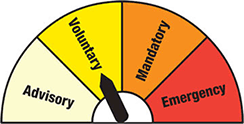
 Think we’ve had enough rain? Think again.
That’s the message from public water utilities that continue to urge businesses, governments and residents to take aggressive measures to conserve water by 10 percent. While recent precipitation and cooler temperatures did provide some relief, the extended hot, dry weather we experienced over the summer and the lack of snowpack in the mountains continue to create serious water management challenges.
In King County, water conservation efforts are essential to maintaining water quality conditions needed to support our salmon populations. Low instream flows combined with high water temperatures cause problems for young salmon as well as adults trying to return to their home streams and rivers to spawn. Our conservation measures today can help keep water in our rivers, streams, and aquifers for people and fish.
As King County employees, we need to do our part, both at work and home.
Share this:

Kudos! Four employees spotlighted in The Seattle Times’ Women in the Trades feature

 Four King County employees were featured in The Seattle Times’ portrait series “Women in the Trades,” a look into Puget Sound’s hardworking women.
Mari Jane Friel (pictured right) and Liesel Brus with Road Services Division, and Kate Osborn and Stacey Walker with Wastewater Treatment Division, spoke about their jobs in what have been traditionally male fields, and what they love about their work.
“I love what I do,’’ Friel, a laborer with Road Services Division, said. “It’s something different every day.”
Share this:

Kudos! David Yoshizumi, Senior Animal Control Officer, Regional Animal Services of King County
Hello Tim and Gene,
We had a recent experience with one of your Field Agents who services Carnation, WA. I do not have his card in front of me, but I wanted to pass on my deep appreciation for the service he provided to us!!
Our situation was that an elderly neighbor had left their cat (healthy and older) with us when they sold their home and went to assisted living. The cat was an outdoor cat with a “friend” who hung around with him who was quite sickly. Like the neighbor couple, we felt sorry for the sickly guy and were feeding him, but it was quite evident that nobody was looking after him, so he was a stray.
This cat was bloated and sickly and moving along very slowly. He was most likely 10-15 years old, but we aren’t sure. We decided that we needed to call Animal Control because the animal appeared to be ailing and unable to continue to care for himself and we were concerned about his safety. We also didn’t know if he might get the other cat or other animals sick.
Share this:

Restorative Mediation making a difference for youth

Earlier this year, Juvenile Court implemented a Restorative Mediation Pilot option for youth in diversion. The pilot has since expanded beyond diversion and is now available to adjudicated youth. It provides youth with the opportunity to reduce time on supervision or in place of court-ordered community service hours.
Restorative Mediation is an opportunity for an offender to have a facilitated conversation with the victim, giving the victim an opportunity to express how the event affected him/her, to provide space for understanding what took place for both parties, and to restore relationships that were harmed as a result of the offense.
During the first week of August, the first restorative mediation was held at Juvenile Court and was more successful than anyone could have expected. The offense at the center of this first mediation was a Theft 3; the youth had shoplifted from a neighborhood supermarket. Participants at the mediation included the youth, two of the youth’s family members, two representatives from the supermarket, a mediator from the KC Office of Alternative Dispute Resolution (ADR), a youth co-facilitator from Garfield High School, and two selected community representatives.
Share this:

Women in Trades: King County Road Services


Mari Jane Friel | Photo by Bettina Hansen, The Seattle Times
Mari Jane Friel is up to her knees in mud as dark as chocolate cake and smiling broadly.
“I love what I do,’’ she says. “It’s something different every day.”
Friel, 58, a laborer with King County’s Road Services Division 2, previously worked in corrections and as a chef in downtown Seattle. Her first day on the job, she was assigned to dig a ditch.
Today, she’s wielding a shovel and a siphon to clear a drainage ditch of mud and weeds so that salmon can pass through during the rainy season. It doesn’t matter if it’s raining, snowing or hotter than a diesel engine: the crew works in all weather.
“Some days, you’re sore, using different muscles than usual,’’ she says.
Friel grew up on a farm, and occupied herself with Girl Scouts and riding horses.
There are a few other women on the job, but most of the time, it’s her and “the boys.”
“My husband says, ‘Men are like magazine covers. Women are like “War and Peace.”‘ I tell it like it is, and I appreciate the same.”
Mari Jane Friel was featured in The Seattle Times story Women in the Trades
Share this:

Kudos! Metro Transit names Operator, Vehicle Maintenance Employees of the Year
Metro Transit employees John Boone and Ryan Stringfellow were recently honored with the Operator and Vehicle Maintenance Employee of the Year awards.

John Boone (middle), named Metro’s 2014 Transit Operator of the Year
Bellevue Base operator John Boone was honored on June 24 as Metro’s 2014 Transit Operator of the Year. At the surprise ceremony, held in the East Base Vehicle Maintenance bay, he was interviewed by local TV outlets before being escorted on stage. Boone was chosen by his fellow 2014 Operators of the Month because of his long and excellent record of providing high-quality customer service to his riders. One of his satisfied customers urged us to “Hire more drivers like him.” Another said, “He had lots of info for people new in the area and is just a great, great guy with a positive attitude.”
Boone has earned a 34-year safe driving award, has received 35 commendations, and has been named Operator of the Month numerous times. Outside of work, he volunteers at the hydroplane races and the Unlimited Hydroplane and Race Boat Museum, and is a diehard Seahawks fan. In fact, he was the driving force behind Metro’s “Blue Friday” tradition, which permits Metro employees to wear Seahawks attire during a playoff season. So perhaps his favorite trophy of the day was a Seahawks jersey emblazoned across the back with “Op of the Year,” presented to him by Supervisor Rickey Moore and Acting Superintendent Ramona Dudley-Moore.
At a Hawaiian-themed celebration on May 27, North Base Superintendent of Vehicle Maintenance Elie Kourdahi named Ryan Stringfellow (on left in photo) as VM’s 2015 Employee of the Year. Speakers praised Stringfellow for his many achievements, including leading Metro’s maintenance roadeo teams to multiple wins at the local, state, and national levels. Stringfellow also racked up several first-place finishes in the non-operator Maverick Division of Metro’s Metroadeo driving competitions.
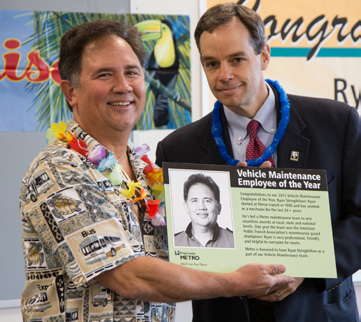
Ryan Stringfellow (left) receives Vehicle Maintenance’s 2015 Employee of the Year from Rob Cannon (right)
He was first on the scene at two accidents near North Base, and received the Governor’s lifesaving award for his actions at one of them. As his lei-clad family members looked on, Stringfellow received a congratulatory banner from Kourdahi, a plaque from county Transportation Director Harold Taniguchi, a mockup of a sign to be placed on Metro buses from Deputy General Manager of Employee and Internal Services Rob Gannon, a certificate for a paid day off from VM Manager Randy Winders, and a personalized sign for a well-earned reserved parking spot from VM Assistant Manager John Alley.
Share this:

CASA program needs volunteers

Each year in King County, more than 12,000 children are separated from their families due to abuse or neglect. With the support of foster programs, many of the children are placed in foster care for the time being their parents are in court. But who represents the children in court?
Court Appointed Special Advocates are trained volunteers who represent the children and their best interests during the legal process.
“We say that a CASA is the voice of the child,” Pamela Beatty, a CASA volunteer said. “We do the speaking for the children. We have heard the children, we have talked to the children, we’ve visited their schools, we’ve talked to their families and we get a sense of what is going to be best for the child in the long run.
But CASA is facing a problem – a shortage of volunteers. In King County, there can be upwards of 300 kids waiting to be matched with a CASA volunteer. The program especially needs volunteers from diverse communities, and male volunteers to be role models. Watch a short KCTV video to learn more.
Share this:

Going mobile to manage hazardous waste

How can King County keep dangerous, hazardous materials from finding their way into landfills and the environment? One solution is the Local Hazardous Waste Management Program’s Wastemobile.
Rather than a fleet of vehicles driving to various locations in King County, each “wastemobile” is a temporary tent location set up on the weekends, usually in parking lots of businesses or schools, where small businesses and home owners can bring their hazardous waste to be properly disposed of.
“A little hazardous waste in the environment goes a long way and is very bad for human health and the health of the environment,” Julie Mitchell said. “Any time I can do something to keep the public safe, it is a good feeling.”

Share this:

Fun Fest teaches teamwork, cooperation and more to detained youth

 As part of King County Juneteenth celebrations, King County Juvenile Detention threw a Fun Fest for youth detained in the facility. For the youth, it was an opportunity to expand their learning during the break between school sessions. For those volunteering, it was opportunity to teach young people different life lessons.
Spanning three days, Fun Fest offered three different programs for youth to participate in, picking one that interested them. The most popular was the Football Camp, which taught the youth the importance of teamwork and trust as well as football fundamentals. Another program, Mind, Body & Soul Workshop, included a range of activities from crafting signs reflecting positive, inspiring thoughts challenged participants to making smoothies from fruits and vegetables and learning about nutrition and healthy lifestyles. The final program, Play to Win, had the young participants learning to play games such as Monopoly, Bunco, Bingo, and Charades. Like the Football Camp, Play to Win stressed cooperation and teamwork.
“We wanted to give the youth the opportunity to engage in learning during the school break,” Lisa Hymes-Davis, Juvenile Detention Supervisor, said. “We wanted them to have fun, but learn valuable lessons at the same time. Some of them don’t have the opportunity to learn about nutrition or positive teamwork.”
Share this:

Transportation program helps employees, environment and the region

 With congestion on our roads growing as King County continues to grow, the Employee Transportation Program (ETP) is helping employees save money and time while reducing our impact on the environment with benefits including free rides on all regional buses, Sounder trains, Link light rail, Seattle Streetcar and the West Seattle and Vashon Island Water Taxis.
But the benefits don’t stop there.
“We aim to make it as easy as possible for our employees to leave their cars at home,” Hossein Barahimi said. As ETP Manager, Barahimi is in charge of developing new partnerships and programs for employees, all with the aim of reducing the number of people who are driving on their own. Barahimi develops partnerships with Employee Health and Well-Being, Department of Natural Resources and Parks, Metro Sustainability Program and others to create programs that allow employees to make healthy choices, cut the cost of travel, reduce gas consumption and help the environment.






 Employee News