
Black History Month Stories of Hope: Naisha Williams


The King County MLK Day Committee is sharing Stories of Hope first presented during the 2022 Martin Luther King Day celebration in honor of Black History Month.
Watch this video to meet Naisha Williams, a Manager in Public Health working on the COVID-19 Vaccine Equity Program, as she shares her story of hope.
Share this:

Join King County’s ‘Stream Team,’ the environmental scientists who hunt for bugs to monitor the health of local watersheds
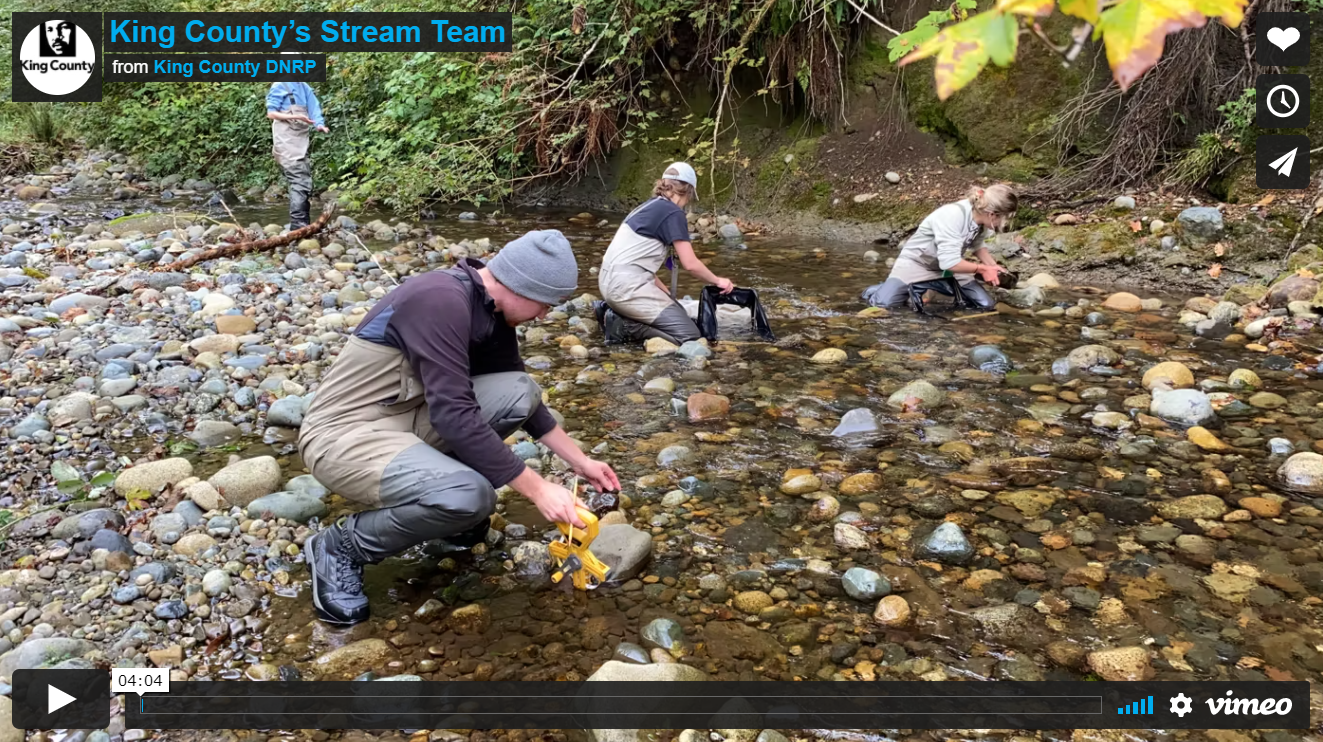
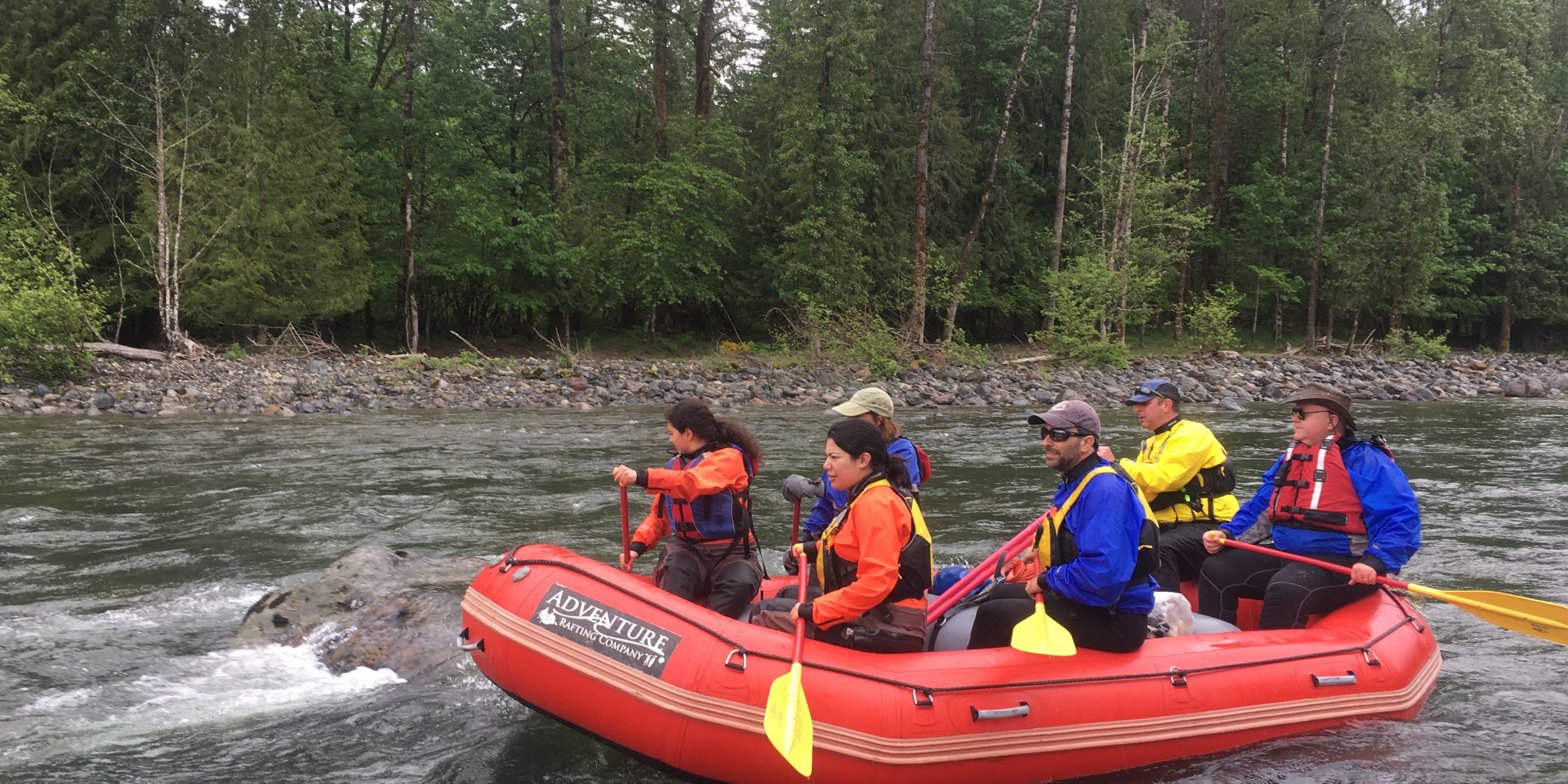
King County is tracking the health of local watersheds by deploying a small, elite team of young environmental scientists who capture and study bugs in local streams.
Recruiting for the 2022 Stream Team roster begins soon. Each summer, the paid Environmental Aides put on boots and waders to bushwhack their way to 200 streams throughout the county to collect samples as part of an ongoing research project to track trends on water and habitat health.
Cick here to watch a video to learn more about the program and how to apply.
Share this:

Black History is American History — Ride Metro to visit local African American historical sites

Cross-posted from Metro Matters
In a collaborative project, community activists, the Black Heritage Society of Washington State and King County Metro created 40 photo murals installed in seven bus shelters in the Central District recognizing the living legacy of African Americans in this community—shelters you of course can reach by bus.
Click here to read more about these installations and how to experience other historic locations in the community.
Share this:

Have you had your COVID-19 booster shot?

Boosters significantly cut down your risk of getting severely ill. You’re eligible for a booster if it’s been at least five months since your primary vaccination series with either Pfizer or Moderna, or at least two months since your Johnson & Johnson vaccination.
Free Community Vaccination Centers
Community Vaccination Centers are open for first dose, second dose, and boosters for adults and children.
- Federal Way Performing Arts Center now through Feb. 18, and Feb. 20 to Feb. 28 from noon to 7 p.m. Appointments and drop-ins are welcome. Click here to schedule an appointment.
- Auburn Community Vaccination Center is open now through Feb. 12 from noon to 7 p.m. Appointments and drop-ins are welcome. Click here to schedule an appointment.
For more options, visit www.kingcounty.gov/vaccine.
Share this:

Executive proclaims February to be Black History Month in King County

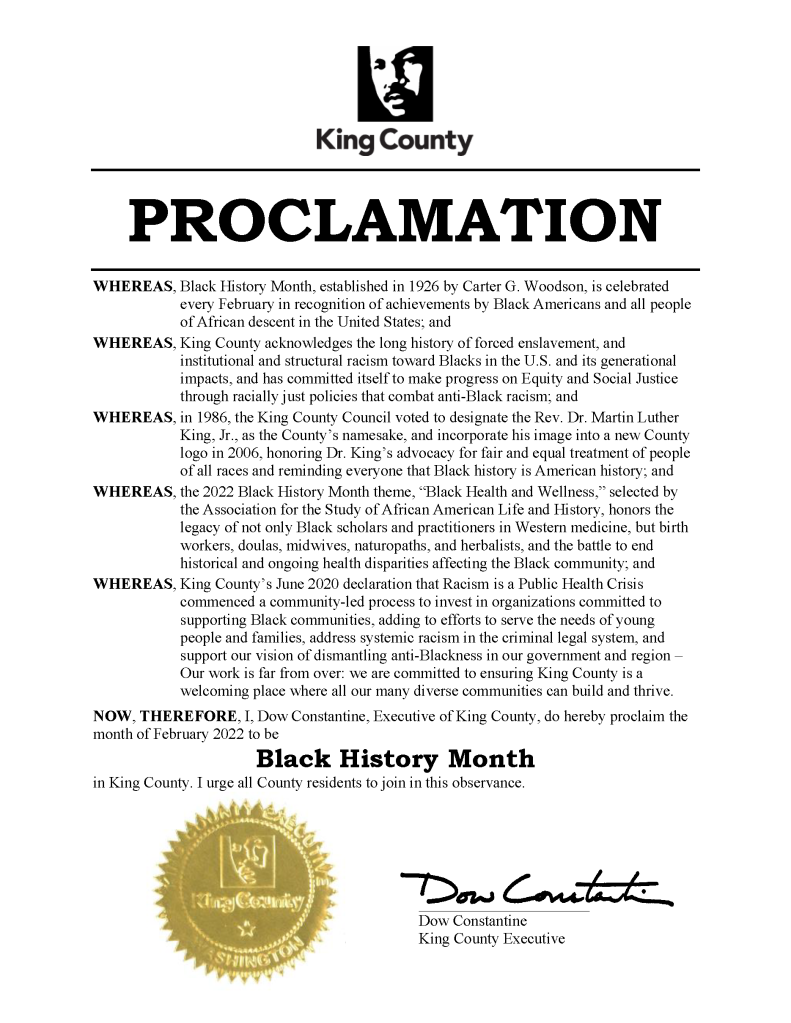
King County Executive Dow Constantine has proclaimed February 2022 to be Black History Month in King County. Established in 1926 by Carter G. Woodson, Black History Month is celebrated every February in recognition of achievements by Black Americans and all people of African descent in the United States.
The 2022 Black History Month theme, “Black Health and Wellness,” selected by the Association for the Study of African American Life and History, honors the legacy of not only Black scholars and practitioners in Western medicine, but birth workers, doulas, midwives, naturopaths, and herbalists, and the battle to end historical and ongoing health disparities affecting the Black community. This theme is reflective of King County’s June 2021 declaration that Racism is a Public Health Crisis.
Read the Executive’s full proclamation below.
Share this:

Better cybersecurity, fewer password resets

Password resets every 90 days have been an essential part of our cybersecurity and compliance routine for decades. But starting this February, expired passwords will become less frequent thanks to modern cybersecurity practices such as Multi-Factor Authentication (MFA).

Instead, King County employees will only receive password reset prompts when our system detects a security incident has compromised your current login info; at that point, you’ll need to verify your identity with MFA and immediately set a new password before you’re allowed to log in.
“About 15 percent of KCIT’s daily calls are for password reset help,” said Mike Kaser, King County’s Chief Information Security and Privacy Officer. “This new password policy will streamline employees’ online experience and reduce call volume to the Helpdesk.”
Does this apply to all King County systems?
Not yet – this new password policy only applies to systems that are integrated with King County’s Single Sign-On (SSO) solutions. This includes your Microsoft 365 accounts, PeopleSoft, and your King County email. Other systems that are not protected by modern security such as MFA will still require regular password changes.
Do I need to reset my password if I recently received a prompt?
You should respond to all password reset requests. However, you should see fewer of them!
I’m getting a lot of password reset prompts – should I be worried?
If you start receiving frequent password reset prompts, it may be that your account has been compromised. Please submit a Security Incident ticket to the KCIT Helpdesk for assistance.
Share this:

Meet the Benefits and Retirement Navigators

Navigators are available to help you understand the complexities of your robust King County employee benefits and learn everything you need to know about preparing for retirement.
The Benefits Navigator and the Retirement Navigator are part of the Department of Human Resources’ Benefits, Payroll, and Retirement Operations Section and they are available year-round to talk with you about your benefit and retirement-related questions and concerns.
Benefits Navigator Matt Munson: Matt.Munson@kingcounty.gov

Talk with Matt to learn more about:
- Employee benefit choices
- New employee benefit education sessions
- Selecting a medical plan that fits your family’s needs
- Understanding how your benefits work
- Changing your benefits outside of the normal enrollment periods
- Benefit Access Fees, deductibles, FSAs, and more
Matt hosts Benefits Information and Q&A sessions for newly-hired employees, but all are welcome to attend to get more information about employee benefits. Please email Matt for more information and to register. Future classes and sessions forthcoming—stay tuned!
Retirement Navigator Carmen Johnson: Carmen.Johnson@kingcounty.gov

Talk with Carmen to learn more about:
- Planning for retirement and eligibility
- Your Washington State Department of Retirement Systems (DRS) pension
- Medicare, COBRA, and Medicare Advantage plans available to King County retirees
- Social Security
- The Deferred Compensation Plan and purchasing service credits
- Retirement forms, procedures and more
Carmen also leads a variety of classes that focus on the retirement process. Learn more and register using the links below:
Road to Retirement (R2R) – Everything you need to know to retire from King County
Medicare 101 – The basics of Medicare and information about the Medicare Advantage Plans offered by Regence and Kaiser Permanente
Your PERS Pension – Information about your pension through the DRS Public Employees’ Retirement System (PERS)
Introduction to Social Security– The basics of Social Security and retirement
Please feel free to reach out to Matt Munson or Carmen Johnson with your benefits and retirement questions—they are always happy to help!
Share this:

Make your nominations for Executive’s Performance Excellence Awards

Nominations are now open for the Executive’s Performance Excellence Awards to recognize individual employees and workgroups whose innovations and improvements are delivering excellence for our customers, our organization, and our region.

This year, we will honor Executive branch employees and teams for their exceptional contributions in leadership, innovation, and Lean maturity in the past 12 months. We have three award categories: Innovation awards for Cost, Equity and social justice, People, Service, and Sustainability; Leadership Excellence awards for people leaders and individual contributors; and the Road to Excellence awards for divisions that achieve one of three levels of progress in the Lean Maturity Model.
The nomination period is now open through February 22, and anyone can nominate individual Executive branch employees or teams for the Innovation and Leadership Excellence Awards. Please look back over the past year and make your nominations now while 2021 projects are still fresh in mind. You may review the nomination criteria here.
Thank you for helping us recognize the successes and accomplishments of our colleagues – individually and collectively.
Share this:

At-home COVID-19 tests now covered by your medical plan
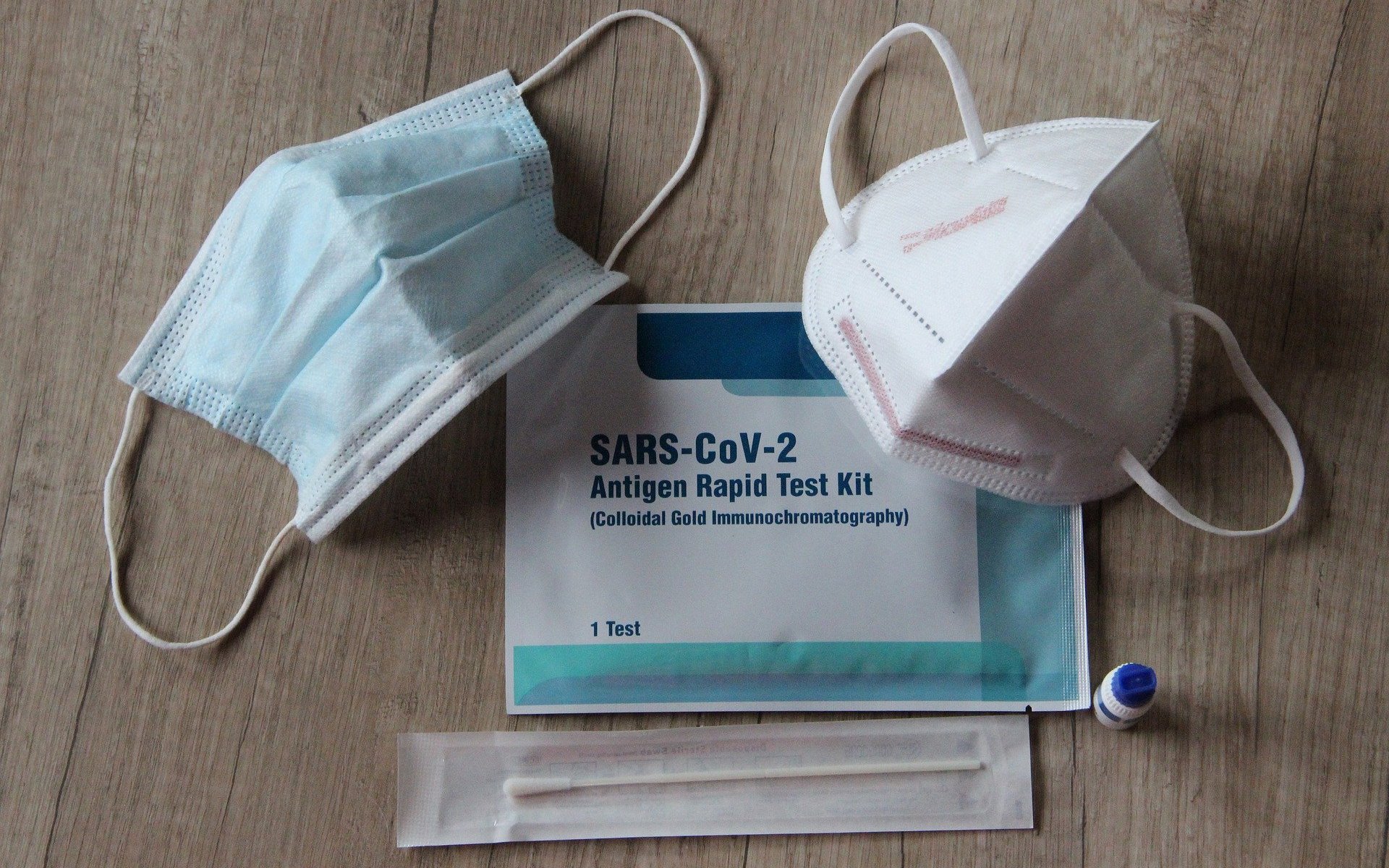
 Federal guidelines were released last week that require all health plans to pay for FDA-approved over-the-counter (OTC) at-home COVID-19 tests purchased on or after Jan. 15, 2022.
If you’re covered by a King County employee medical plan, see the information below about how to get reimbursed. The processes are still being worked out by the health plans, and plans are working to obtain adequate supplies as soon as possible. For now, be sure to save your receipts for at-home COVID-19 tests purchased on or after Jan. 15, 2022.
For SmartCare (Kaiser Permanente) members:
Mail a Member Reimbursement Form and your receipt(s) to Kaiser Permanente. Visit Kaiser’s COVID-19 testing web page for up-to-date information. You can also schedule an in-person COVID-19 test at a Kaiser Permanente facility, if medically appropriate.
For KingCare and KingCare Select (Regence/CVS) members:
CVS, the pharmacy benefit manager for Regence plans, is currently developing its process with network pharmacies to directly bill CVS for at-home COVID-19 tests, but it’s not complete. If your local pharmacy has COVID-19 tests available, you may be able to get them at no cost. If the pharmacy can’t direct bill, you’ll need to buy the test and submit a claim for reimbursement to CVS online or through the CVS app. If you need help, call CVS at 800-552-8159. Have your CVS member ID card handy. The King County group ID number is 0385.
For more information, see the At-home COVID-19 tests FAQ and go to How to get your At-Home Over-The-Counter COVID-19 Test for Free. More information will be shared with employees as it becomes available.
Share this:

Flood control to Major Tom: River and Floodplain Management Section keep King County high and dry
The heavy rains and melting snows have brought upon King County its annual river flooding season. As the most common winter weather occurrence, flooding is a danger in both rural and urban areas. King County’s River and Floodplain Management Section (RFMS) within the Water and Land Resources Division of the Department of Natural Resources and Parks (DNRP) works to overcome these flooding challenges and educate the public about safety.
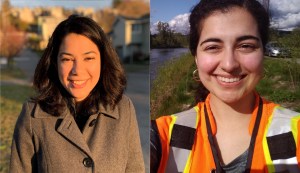
Pictured: From left, Capital Project Manager Stella Torres and Engineer Heather McPherson
Capital Project Manager Stella Torres and Engineer Heather McPherson shared about their work with this team, and how important it is to be prepared. Stella has been with King County since August 2017. Her work includes overseeing the implementation of capital improvement projects from design through construction, including leading interdisciplinary teams in construction of infrastructure to reduce risk of flooding and erosion, and conducting stakeholder and community outreach to garner support and address concerns. Heather has been with RFMS since February 2019 and helps to design and implement projects to repair damaged levees and revetments on rivers, while improving riverbank habitat. She also inspects facilities, creates maps, works with permitting agencies, and coordinates with her team to consider stakeholder needs.
The nature of their work requires both women to be outside in a variety of locations, based on project sites and flood patrol routes. The work can be challenging, with reconciling many interests and beliefs about how rivers and floodplains should be managed, juggling multiple projects and priorities, and potential overnight flood patrol shifts. The challenges are outweighed by the positives though, with each woman explaining what about this work is special to her.
“I enjoy the consistent fieldwork opportunities and working on a team that cares about each other, the project outcomes, the communities we impact, and the ecosystems we affect,” said Heather. “It’s great to have a variety of project sites and flood patrol routes so there’s opportunities to work on rivers throughout the county.”

Pictured: Capital Projects Manager Stella Torres out in the field.
Stella also agrees. “I love the problem-solving nature of my work,” she said. “I also love getting to work in and around rivers. Rivers are incredibly complex ecosystems.”
“Humans have gathered around rivers from the beginning of human history to make use of their natural resources and I find it rewarding to do work around these natural features that are a hugely important part of life for humans and animals,” she added.
Heather and Stella explain how being “flood ready” requires the RFMS team to be proactive and stay ahead of weather forecasts that indicate potentially dangerous levels of flooding from October through April. The team has a variety of trainings and tools available to them, as well as knowledgeable colleagues in the River and Floodplain Management Section who support the Flood Patrol and Flood Warning Center programs.
“They are super on top of monitoring weather events and do their best to give us a heads up,” said Heather. “It often seems we have large flood events near the holidays so being mentally prepared and having gear ready if we get called for a flood patrol shift is important.”
“The staff help keep people safe and prepared by operating the Flood Warning Center, which maintains a 24-hour line of communication between King County personnel and members of the public to provide assistance during flooding,” said Stella.

Pictured: The icon for the KC Flood mobile app.
In addition to the Flood Warning Center, available at 206-296-8200 or 800-945-9263, the public can also access flood information through KC Flood, a mobile app available to both employees and the public. Each year, the King County Flood Control District also updates their “Be Flood Ready” print brochure, available in 21 languages as a PDF online at www.kingcounty.gov/PrepareForFlooding or in print, by request.
“We have a robust system in place for getting out warnings of dangerous levels of flooding to vulnerable communities through our website, use of apps and informational brochures,” adds Stella.
Stella and Heather share how it is necessary for King County to prioritize flood risk reduction programs to ensure a good quality of life for residents and the region overall.
“Damage to people, property and important infrastructure due to flooding is costly,” said Stella. “It’s important in this region that experiences frequent flooding to prioritize this work and be prepared in order to save lives, mitigate risks and reduce spending on damage to infrastructure.”
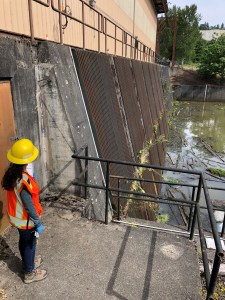
Pictured: Engineer Heather McPherson at the upstream side of the Black River Pump Station, a flood control facility.
“It’s important we do this work and prepare for flooding because of climate change, aging infrastructure, and equity – ensuring everyone living in or near flood plains has the resources needed, knows how to prepare, is aware of risks, and feels empowered,” Heather adds.
Because flood management and preparedness cannot be accomplished by a single division or work group alone, it is also critical that King County employees know about these efforts, and how they are connected to it. Various departments and divisions collaborate with the RFMS group to provide the wide range of services required to respond quickly to flooding and mitigate flood risk.
“A majority of the work we do in the River and Floodplain Management Section, as a service provider to the King County Flood Control District, requires collaboration across divisions and departments,” said Stella. “Support from King County’s Roads Division, Emergency Management Services, and many other departments is key.”
“We want to help make others aware that flood resources exist, especially for employees that might work or communicate with people living in floodplains or who are new to the area,” said Heather. “And the interconnectedness of King County policies, missions, and department work – where our actions may affect other actions and vice versa – are opportunities to provide more benefits for the community.”
For more information about King County flood services, visit www.kingcounty.gov/FloodServices. To see current flood conditions, sign up for flood alerts, or download the app, visit www.kingcounty.gov/Flood. To learn more about the work Stella, Heather, and other King County employees in the Water and Land Resources Division are doing, read The Downstream Blog , follow King County DNRP on Twitter at @KCDNRP, or on Facebook at @KingCountyDNRP.






 Employee News