
Kudos! Kyle M. Gulke, Metro Transit Operator

Good Morning, This message is overdue by a couple of weeks, and I apologize. But I want to make sure that this bus driver gets kudos. This happened on January 30th, 2015. His name is Kyle, and he was driving bus number 9540z (not sure if there was a z on the end of that number or if I accidentally hit it when putting it in my phone). It was the 522 bus at 7:58am south bound on the Bothell Way and 153rd St in Lake Forest Park stop.
This was a stressful day for me, as it was the day before my birthday, and I had just been diagnosed with breast cancer and was on my way to go have a consultation with the surgeon up on First Hill. I decided to take the bus instead of trying to drive downtown.
I had already just missed the bus I intended to take, and I was feeling flustered as I don’t know the bus system well, and was unsure of which was the next best bus to take. While I had my smart phone, I was not fast enough with it, and was worried that I would miss the next bus I needed to catch. I could not be late for this appointment, and was on the verge of tears when Kyle’s bus pulled up. I knew enough to know that the 522 went downtown, and decided to get on and figure it out from there.
When I stepped on, Kyle, with a genuine friendly smile says “Good Morning! Welcome to the bus!” Relief washed over me as I could tell immediately, that this was a friendly face that would help me sort things out. And that he did! He helped me get where I needed to go, but more importantly, when he found out I was going to the Swedish Cancer Center, he shared that his good friend was going through the same thing and offered some great advice. We parted ways with him genuinely and warmly telling me good luck and wishing me the best. I don’t know if I will ever be lucky enough to have Kyle as my driver again, as I’m not sure they always have the same route and my appointment times vary. But I do hope our paths cross again. And I hope I have provided enough info for you to know who he is. He deserves recognition for sure! He filled my very stressful morning with compassion and kindness, and I have never been so grateful to have missed a bus! Thank you Kyle for being the angel that saved my day!
With much gratitude, Kathleen C.
Share this:

Trailblazing carpenter wants more women to follow in her footsteps

 When Linda Romanovitch joined King County 30 years ago she didn’t consider herself a trailblazer but she unwittingly broke through a barrier that would make it easier for other women to follow in her footsteps.
Linda became King County’s first female carpenter on December 4, 1984. Her interest in carpentry grew while helping her grandfather, also a carpenter, complete odd jobs. At 22 she joined an organization in Seattle that helped women and minorities become successful in the trades and she completed a six-week pre-apprenticeship. She went on to complete a full carpentry apprenticeship and in 1978 she worked on the first remodel of Seattle’s Uwajimaya store.
Being the only female in a mostly male field was rough at times but she had a secret weapon that helped her get past workplace difficulties. “My best defense was to respond with humor,” Linda said.
Share this:

Official launch of KCWeb & roadshow – Feb. 26, 2015

King County’s new KCWeb Intranet will officially launch on Thursday, Feb. 26, and we will be celebrating with a traveling roadshow, an online treasure hunt, prizes and giveaways to help you get to know your new one-stop shop for employee news, information and the tools you use every day.
Join us from 11 a.m. to 1 p.m. on Thursday, Feb. 26, for live demonstrations of the new KCWeb, tips and giveaways in:
- The Chinook Building lobby
- King Street Center lobby
- Administration Building 5th floor lobby.
If you can’t make it to one of the roadshow locations you can participate in an online treasure hunt and enter to win great prizes.

Share this:

Kent Public Health is a design winner
Th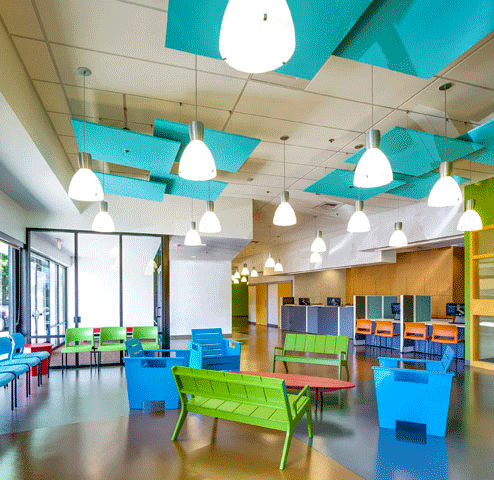 e new Kent Public Health Center received a national design award in the 2014 International Interior Design Association Healthcare Interior Design Competition.
The IIDA presented nine awards, including projects at major institutions in New York City, Cincinnati and Los Angeles. Designed by Buffalo Design, in collaboration with Public Health an the Facilities Management Division (FMD), the Kent project was the only winner in the Northwest.
In addition to winning the IIDA award, it’s important to note that this and other projects, managed by Public Health and FMD, achieved goals set forth by the King County Strategic Climate Action Plan including reducing the amount of energy use, maximizing recycling, and implementing the latest green building and sustainable development practices. The Kent Public Health Center and other facilities each achieved the equivalent of a Gold level ranking. They also completed these projects significantly under budget.
Find out more about all the IIDA winners here.
Share this:

New office is ready to harness new ideas to achieve social change


Matias Valenzuela, Director of the Office of Equity and Social Justice
 King County’s commitment to Equity and Social Justice is taking another step forward with the creation of an Office of Equity and Social Justice.
“This has been a progression. It has become one of the priorities for our leadership, especially for our Executive Dow Constantine. It’s essential to what he and our other County leaders are trying to accomplish,” said Matías Valenzuela, the Director of the Office of Equity and Social Justice (ESJ).
What started as an initiative by former County Executive Ron Sims has now evolved into a sustained effort that cuts across all County agencies with the aim of creating fairness and opportunity for all.
Share this:

Rebranded program helps people understand CSOs

 Protecting Our Waters is King County’s program to prevent pollution caused by excess stormwater in the sewer system on rainy days. The older parts of King County’s wastewater system use a single set of pipes to carry both sewage and rain running off streets and buildings. Most of the time, this polluted water goes to a wastewater treatment plant. But in heavy rains, the pipes can overflow into rivers, lakes, or Puget Sound. Overflow points called “combined sewer overflows” or CSOs are built into the system. CSOs prevent sewer backups into homes and streets.

“People from the public and outside our utility didn’t understand the term “CSO” and we struggled with how to explain CSO facilities to people – including why we are building them and how they are different from other wastewater treatment plants,” said Annie Kolb-Nelson, Communications Specialist with the Wastewater Treatment Division. “So we put together an internal team of experts in branding, marketing, communications, engineering, community relations, and operations and created a new “look” and language for the program.”
The new branding, which includes a name, tagline, and images, helps King County better tell our story of protecting water bodies and people from pollution on rainy days. This year, the “Protecting Our Waters” campaign was a finalist for the Water Environment Federation (WEF) Ingenuity Award.
Share this:

Five Questions with Jennifer Hills, Risk Manager, Department of Executive Services

 1. What was your first role at King County? I came to King County in April of 1999 as the Loss Control Manager in the Office of Risk Management. My position was new and was added as a result of a budget proviso. The council wanted more resources dedicated to preventing liability losses. One of my early attempts at sharing lessons learned with departments was through a publication called the Risk Management Recipe (I love to cook, hence the name!). The publication did not last but the concept of collecting, sharing, and disseminating lessons learned has remained.
2. What do you do as King County Risk Manager? I recently had the pleasure of meeting with a graduate student in the Evans School of Public Affairs about her interest in public sector risk management as a career. I described our lines of business within the Office of Risk Management: claims investigation and resolution, purchasing insurance coverages for county operations, consulting with agencies on appropriate risk transfer in their contracts, managing our insurance fund to finance our retained risk, and enterprise risk management which I’ll explain in a moment. It was so much fun describing my job to this student because I am certain I have the most interesting and enjoyable job in King County!
Share this:

Metro’s unofficial ambassador to seniors

 Once a month, on his own time, part-time Metro Transit operator David Waggoner (East Base) takes friends from the Issaquah Senior Center on bus trips that, he feels, profoundly improve their lives. “Just because you belong to a senior center doesn’t mean that the next thing is that you’re in a coffin and next you’re in the ground,” he said recently. “The best thing for seniors is travel.”
He has taken friends on bus rides from Issaquah to downtown Seattle, Northgate, the North Bend outlet stores, and Sea-Tac Airport. “It’s amazing to see them learn how to take the Route 554 and Link light rail to the airport. When they realize they don’t need a family member to take them to the airport, they’re so proud that they can get there on their own.”
When Waggoner started driving buses, for Metropolitan Transit in 1967, he could let riders off in Seattle but couldn’t pick up new ones because Metropolitan drivers weren’t allowed to steal fares from Seattle Transit as they drove into the city. The fares he collected went into a pouch, because the “Silversides” buses he drove, with giant shift levers on the steering columns, had no room for fareboxes.
Share this:

New Human Resources website makes navigation quick and easy
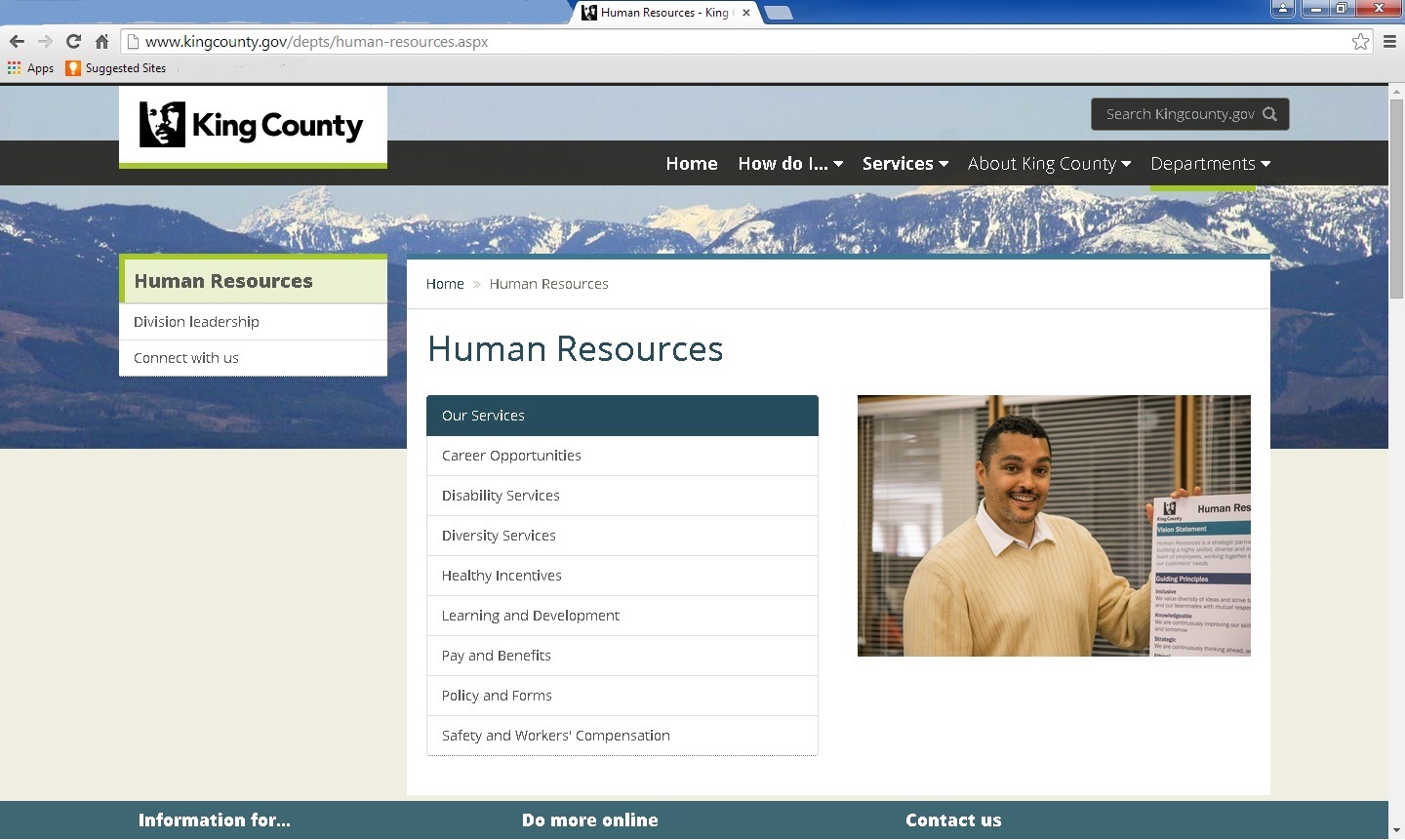
 King County’s Human Resources Division (HRD) has launched a new and improved website to help visitors to the site get quick and easy access to the content they are looking for.
The new site will make it easier for King County employees, human resources professionals, residents and job seekers to navigate the site and find what they are looking for, quickly and easily.
“We wanted to make sure that all visitors to our website, whether they are current employees or possible future employees, have a good experience with our website and leave with a good impression of King County government and the Human Resources Division,” said Nancy Buonanno Grennan, HRD Director. “Building a new website that is both easy to navigate and attractive to look at is just one way we can improve the service experience for our customers, both internal and external.”
Share this:

Stay-in-School program builds opportunity for local students

When a student is in danger of not graduating from high school in south King County, the Stay-in-School program is there to help. 
The federally-funded and County-operated program identifies students who are at risk of dropping out based on their grades and/or not passing the High School Proficiency Exam (HSPE) in their Junior year.
Each year about 120 youth in King County receive assistance through the program, and its results are impressive: in the 2013/14 academic year, 86 percent of participants completed their high school diplomas and 82 percent went on to college or employment.






 Employee News