
KCEGP Nonprofit Expos provide quality connections between nonprofits and employees
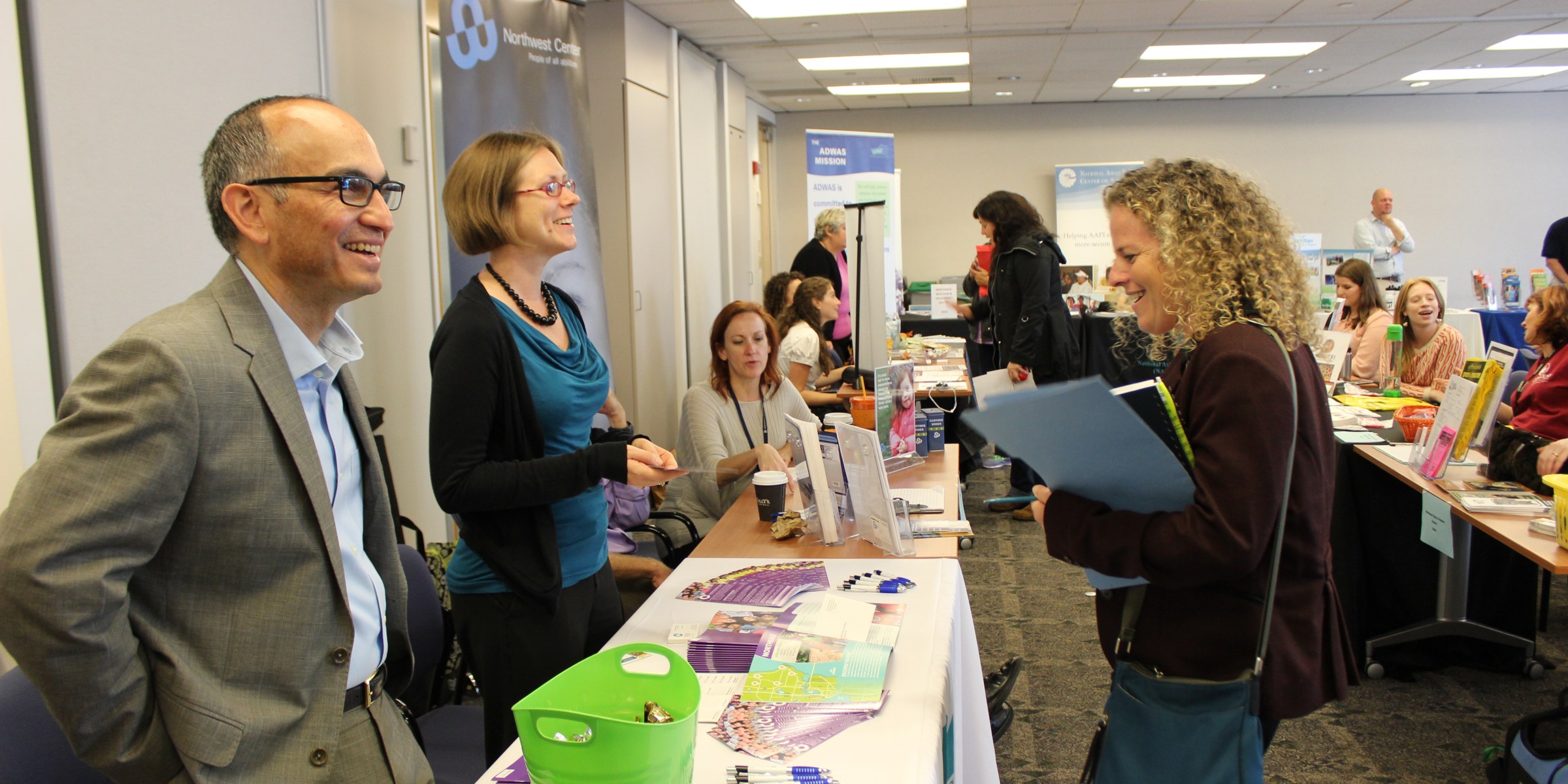
 The King County Employee Giving Program (EGP) hosted five Nonprofit Expos in September and October to help employees get a better understanding of how their contributions to the Annual Giving Drive have a real impact on the lives of people and animals, on the arts, and on the environment, both here and abroad.
The Nonprofit Expos featured more than 140 nonprofit organizations and reached more than 800 employees directly from every King County department and Separately Elected office.
“The Nonprofit Expos are about enabling quality conversations between employees and nonprofits,” said Junelle Kroontje, KCEGP Administrator. “The program not only provides opportunities for giving but acts as a resource, and these events are a perfect example of that. For example, Regional Animal Services of King County consistently adopts out animals brought to our events and employees tell me about finding a service that they needed for a family member who has just been diagnosed with a disease, or an opportunity to volunteer.”
Bringing nonprofits into the worksite is the number one way that employees learn about new organizations to support.
Share this:

Emergency Sign Language at your fingertips

Does your work ever require a sign language interpreter to assist a customer in an emergency situation?
The Emergency Sign Language Interpreter Program (ESLIP) provides sign language interpreters for emergency and time-sensitive situations on a 24-hour basis, every day for King County and City of Seattle programs. These services are provided to ensure effective communication during emergency encounters and situations with individuals who are Deaf, Deaf-Blind, or hard of hearing using on-call interpreters.
Situations when ESLIP interpreters should be called include, but are not limited to:
Share this:

Macklemore speaks at 20-year celebration of Drug Court
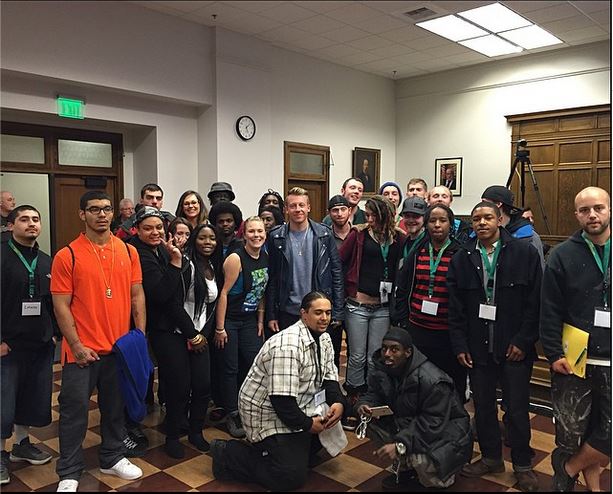
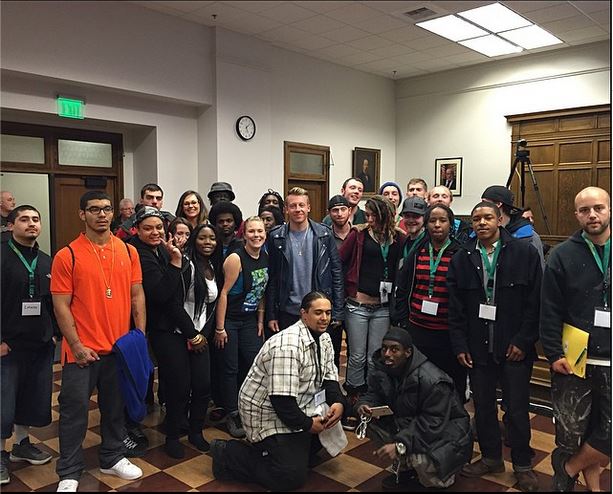
King County’s Drug Diversion Court celebrated 20 years of changing lives yesterday at an event at King County Courthouse.
Drug Diversion Court is a rigorous minimum 11-month, four-phase program that holds participants accountable for their sobriety. Drug Court participants are required to meet with a Drug Court judge once every two weeks, go to chemical dependency treatment three times a week and are randomly drug tested twice a week.
The celebration, dubbed “20 Years of Changing Lives,” was attended by County Executive Dow Constantine, King County Councilmembers Kathy Lambert and Larry Gossett, U.S. District Court Judge Ricardo Martinez, King County Superior Court Judge Gregory Canova, Director of the Department of Adult and Juvenile Detention Willie Hayes, scores of graduates, family and friends, and award-winning Seattle rapper Macklemore.
Share this:

KCIT employee gets some help from technology and four-legged friend

 Next time you contact KCIT for email or SharePoint help, you may be talking to an employee who has a four-legged friend helping him in his work day.
Dan Johnson, a Systems Engineer with King County’s Department of Information Technology, has been with the County since 1997, initially in the KCIT Help Desk, and now supporting a range of Exchange email, SharePoint and cloud-based services for employees.
“My work focus has expanded far beyond Exchange email to include unified communications, the Office 365 suite, and distributed administration and security,” Dan said. “I used to support one major application/service, Exchange Server. Now, I support many cloud-based services and also do much more project work along with also providing day-to-day operational support for all the systems mentioned above [SharePoint, Exchange Online Protection, CRM, Office Web Apps].”
Share this:

Get to know four participants in 2014 Annual Giving Drive

Whether your passion is protecting animals, improving literacy, preventing hunger, helping seniors or young people, or supporting the arts, there are more than 950 participating nonprofit organizations that you can choose to contribute to in the 2014 Annual Giving Drive, which kicked off September 24.
If you make a pledge to any of the more than 950 nonprofit organizations by 5 p.m. on Friday, Oct. 24, you will be entered into a random drawing for two lift tickets to Stevens Pass. If you have already made a pledge, you will be automatically entered into the drawing. Click here to make a pledge.
Meet four of this year’s participating nonprofits (see full list of participating nonprofits here):
Landesa (9556) works to secure land rights for the world’s poorest people – those 2.47 billion chiefly rural people who live on less than two dollars a day. Landesa partners with developing country governments to design and implement laws, policies, and programs concerning land that provide opportunity, further economic growth, and promote social justice.
Share this:

Kudos! Vickie S. Stanley, Metro Transit Operator

We took bus 7037 on route 14 Saturday, June 28th. We accidentally went the wrong direction but the bus driver, Vickie Stanley, was so helpful. She recognized we were from out-of-town and pointed out the sights we went by. And she assured us she would help us find our stop. She even offered to meet us later with coupons to get discount prices at the tourist places. We exchanged phone numbers and plan to keep in touch, especially if she ever makes it to Arizona. A bus driver became a fast friend – that’s amazing service
– Nancy Shippy.
Share this:

Ebola information and resources
As you know, the news coverage from Dallas and West Africa has heightened community concerns about Ebola. Public Health has been actively working to provide information and guidance to King County residents, health care providers, and partner agencies. They also want all King County employees to be up-to-date with information and resources about Ebola.
First, it’s important to know that no one in King County has Ebola and health officials have determined that the risk of an outbreak is extremely low. Although the healthcare system is getting ready to quickly identify and isolate anyone who potentially has Ebola, there are no immediate plans for any Ebola patients to be evacuated to King County hospitals.
Public Health is sending regular updates to health care providers and providing guidance on managing possible Ebola patients. In the event that someone in King County contracted Ebola, that patient would be isolated and cared for at a hospital. Hospitals in Washington and across the U.S. are well equipped to care for a person with Ebola by following normal infection control procedures.
Share this:

Teachers get Public Health immersion to help student career choices
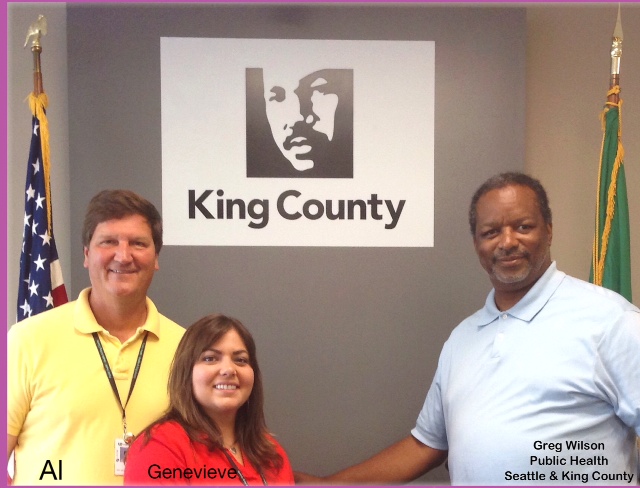
Two high school teachers spent an intense eight days with Public Health’s Environmental Health Services division (EH) – and set the stage for teaching students about career opportunities in Public Health.
Each teacher shadowed eight different staff in EH. They learned about food and facilities, solid waste and hazardous waste materials, how information technology serves the mission, and more.
The teachers are part of a Teacher Externship Program sponsored by the Washington Alliance for Better Schools which is affiliated with 11 school districts. The program trained 22 local teachers in Science, Technology, Engineering and Math (STEM) this summer. The goal is to improve the teaching of STEM by making the subjects more relevant to students, showing them real-world applications.
Share this:

Five Questions with Roxanne Vierra, Disability Compliance Specialist, Office of Civil Rights & Open Government
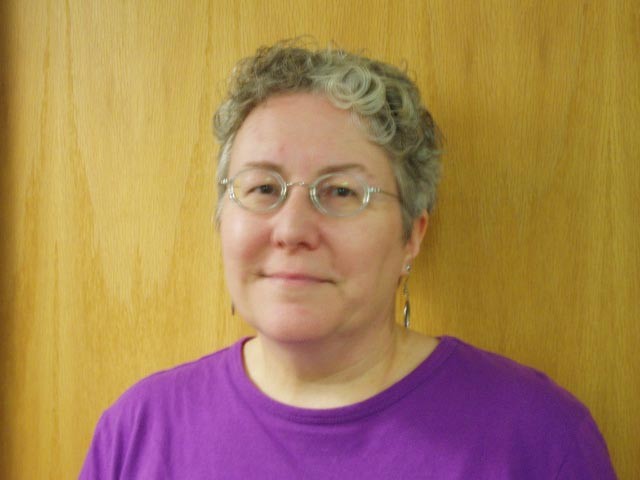
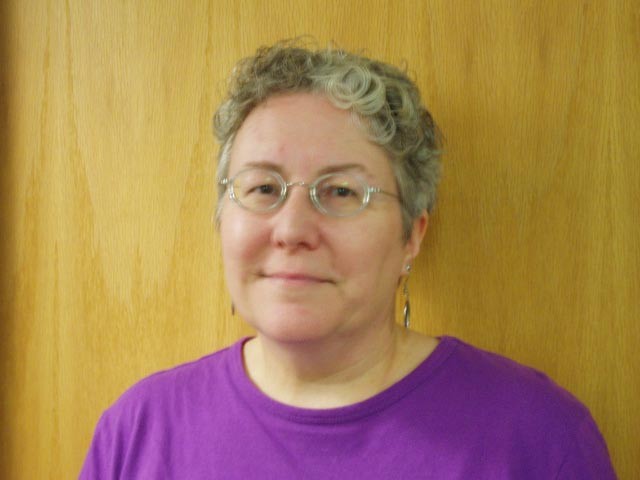 1. What was your first role at King County? I’d previously worked 10 years at the U.W. Disabled Student Services office, then 10 years at the Seattle Office for Civil Rights, where my position included primarily fair housing investigations and a bit of public disability access. When I was offered this job with King County 16 years ago, I was excited because it allowed me to use my Disability Specialist experience in a more active way. While I still handle fair housing enforcement and outreach, my role as Disability Compliance Specialist enables me to provide a much wider range of awareness and access assistance to county employees and members of the public.
2. What do you do as Disability Compliance Specialist? My role is to assist County departments and staff in providing accessible services, programs and activities for members of the public who have disabilities. I provide technical assistance about access laws, available resources, and information about accommodations. I conduct several disability awareness workshops for County staff. Many departments consult with me regarding access in the construction and remodeling of County facilities. I also handle grievances filed by residents who feel they didn’t obtain access or accommodations when dealing with County programs.
Share this:

Employee Giving Campaign comes to Renton
All King County employee are invited to meet some 30 nonprofit organizations at the Employee Giving Program Renton Expo at Elections on Oct. 8 from 11 a.m. to 1:30 p.m., and learn more about how their dollars can help our community, 
A sampling of Expo offerings:
- Have a wacky or serious picture taken at a photo booth
- Enter to win prizes, including “Fitbits”
- Sample bake sale goodies and support Northwest Harvest
- And more!
Check out #KCEGPEXPO in social media to follow what’s happening at Expos.
Last year, Elections employees pledged more than $18,000 through the Annual Giving Drive, helping King County raise a record-breaking $1.77M for non-profit organizations. The top six nonprofits Elections employees selected were:
- Northwest Harvest (9013)
- Pasado’s Safe Haven (9112)
- Seattle Humane (9148)
- Operation Homefront – Pacific Northwest (2780)
- New Beginnings (9365) and
- KUOW Puget Sound Public Radio (9069).
You can go online or use a paper form through Friday, Nov. 21 to make a pledge to a nonprofit or cause that you are passionate about. Three ways you can donate:
- One-time, monthly, or semi-monthly donations by payroll deduction;
- Personal checks; or
- Donate vacation or compensatory time to be converted to dollars.
King County Elections is located at 919 SW Grady Way in Renton. Learn more about the campaign.






 Employee News