
Improving hiring to reflect our community
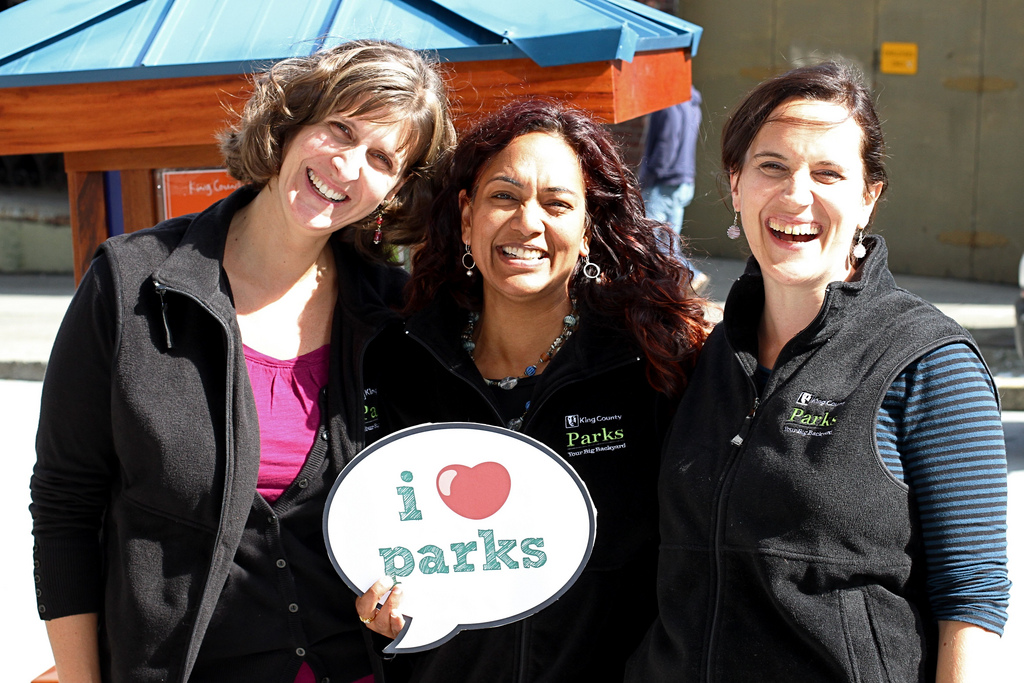
 The Department of Natural Resources and Parks Human Resources (DNRP HR) is looking for new ways to attract a diverse workforce that is more reflective of the King County community at large, and a new pilot project to address that issue is already paying off.
A successful “Direct Hire Fair” on April 7, held at Renton WorkSource and sponsored by DNRP HR and its partners in the King County Employment and Education Resources (KCEER) Division, allowed DNRP divisions to interview job candidates on site. The innovative hiring fair resulted in 25 offers being made and 20 people hired, with overall hiring figures including seven females and 13 people of color.
Share this:

Kudos! Linda Nelsen wins Customer Service Hero award for exceptional service


Pictured left to right: Deputy County Executive Fred Jarrett, Linda Nelsen and Customer Service Director Natasha Jones
Linda Nelsen in the Department of Executive Services Finance and Business Operations Division recently received “Customer Service Hero” recognition for going above and beyond in providing excellent customer service to County Customers. Linda exemplifies our commitment to providing proactive, “no wrong door” service to customers.
As a Business and Finance Officer in Treasury Operations, Linda works to provide great service day in and day out to customers. But recently, a customer wrote about the extraordinary help Linda provided with challenges he had after purchasing an historic cabin from the federal government on Snoqualmie Pass last year.
The sale and transfer of deed for the property went fairly smoothly, until the customer realized that the paperwork incorrectly listed him – not the federal agency – as being responsible for unpaid taxes and fees on the land going back to 2011! As a result, the customer received a letter of foreclosure on the property.
Share this:

Cascadia Rising earthquake exercise underway

 Crossposted from KC Emergency News
Our region is vulnerable to earthquakes. A major threat lies just off the Pacific Coast, in an area known as the Cascadia Subduction Zone. This fault, when it ruptures, could cause a catastrophic magnitude 9.0 earthquake. A quake of that size would also cause a massive tsunami that would inundate the coast.
This week, King County Emergency Management will join with federal, state, and local partners to test earthquake response and recovery plans in the Cascadia Rising exercise. More than 20,000 first responders, emergency management professionals, military personnel, and local residents will take part in this multi-state, multi-jurisdiction exercise. The drill will run in various phases from June 7 through 10.
For more information about the Cascadia Rising exercise, visit www.fema.gov/cascadia-rising-2016.
For emergency preparedness tips and information about our region’s earthquake hazards, visit www.kingcounty.gov/prepare.
Share this:

Featured Job: Registered Nurse – Juvenile

Closing Date/Time: Tue. 06/28/16 4:30 PM
Salary: $33.82 – $47.35 Hourly, $70,345.60 – $98,488.00 Annually
Job Type: Career Service, Full Time, 40 hrs/week
Location: King County Youth Service Center – 1211 East Alder Ave, Seattle, Washington
Department: Department of Adult & Juvenile Detention
Description: Department of Adult and Juvenile Detention (DAJD) is seeking a highly motivated individual to occupy the position of Registered Nurse for our Juvenile Division, located at 1211 E. Alder in Seattle. This position is responsible for providing nursing services to detained youth that may possess a range of physical, mental health and behavioral problems.
The Juvenile Division Health Services team works within the secure perimeter of the King County Juvenile Detention Facility. This Health Services team consists of mental health professionals, MDs, ARNPs, and nursing assistants. If you are the type of person who enjoys working both independently and as part of a team serving a diverse group of at-risk youth, then you are the type of person we are looking for. Youth detained at our facility are generally here due to alleged new offenses, probation violations or failure to abide by court ordered stipulations. Come join our team in a rewarding career, making a positive contribution in the lives of at-risk youth.
Learn more about this position or view all available jobs.
Share this:

Social Media Spotlight: Quiero Una Familia Sana Y Segura Facebook

 This Spanish language page shares information on how to protect families from everyday household hazards so Hispanic families can live a healthy lifestyle, and be safe at home, at work and in the environment.
Follow Quiero Una Familia Sana Y Segura on Facebook today!
Click here to view all King County social media pages.
Share this:

Kudos! Water Taxi a stress reliever and bird friendly transit
 A recent regular rider on the water taxi shared praise for what the water taxi has done for her commute and her stress levels.
“I became a regular rider on the West Seattle-downtown morning ferry a couple of months ago. It’s been a great experience and has lowered my stress level WAY down (now that I’m not driving to work). I absolutely love my commute now!”
The same passenger also shared a story about how the staff rescued a baby bird, and what a great job the staff do overall.
“Some of us passengers noticed a baby pigeon in the water floating near the water taxi dock. We were concerned because pigeons don’t swim and it was a baby with no other pigeons around. We asked the ‘water taxi guys’ if they could rescue it with a net. They did rescue the baby pigeon with a net on the next run after ours, and then put the baby pigeon somewhere safe away from the water.”
“I just wanted to express my thanks that they did this. What a bunch of great guys you have working on the water taxi!”
Share this:

Weight Watchers At Work – Open House At The Courthouse

 “Motivation is what gets you started. Habit is what keeps you going.” -Jim Ryun, Olympic track and field athlete
Change doesn’t start by chance. You can learn how to eat healthier, move more, live happier and lose weight. Weight Watchers is a safe and supportive environment with other people going through what you go through. The program provides tools, coaching, and a basic, easy-to-understand-and-follow plan.
Have you been struggling with a health issue or just would like to lose those few additional pounds? Losing just five to 10 percent of your body weight can improve your mood, give you better sleep, reduce the risk of developing Type 2 Diabetes, reduce cholesterol and improve your blood pressure.
King County now subsidizes your path to better health. As part of the Healthy Incentives program, you can attend a meeting right here at work, AND – by being an “At Work” member you can make this year your healthiest year yet.
Come and join us for a free open house at the courthouse (floor 12 – look for the signs), downtown Seattle, June 7 from 12 p.m. to 12:30 p.m. Hear inspirational stories from our members, ask questions and find the new you.
Share this:

Are you one of our 11,000 LinkedIn followers?

More than 11,000 King County employees, residents and job seekers are getting up-to-date news and information, job opportunities, trainings, discounts and more by following King County on LinkedIn. Are you one of them?
To follow King County on LinkedIn, go to the King County company page and click “follow” (you will need to create a LinkedIn account if you do not have one).
You can also get employee news and information by following us on these platforms:
- Twitter @kcemployees
- Blog www.kcemployees.com
- Tumblr www.kcemployees.tumblr.com
- YouTube King County Employees
- Twitter @kingcountyjobs
Accessing Employee News is an acceptable use of IT assets.
Share this:

First survey of ORCA LIFT users confirms high satisfaction, more bus trips taken

Crossposted from Metro Matters
More than a year after the launch of the ORCA LIFT reduced fare program, customers tell us they love their card. Now we have the data to support that feedback.
We’ve just wrapped up our first survey of more than 400 ORCA LIFT customers, and the results show a 95 percent satisfaction rate. In fact, more than half of those participating in the program are first time ORCA users; 44 percent say they are taking more trips on Metro and Sound Transit Link Light Rail since receiving their ORCA LIFT card. That tells us this innovative program is accomplishing what it set out to do – provide an affordable travel option for county residents struggling to make ends meet.
Our nationally recognized ORCA LIFT program is approaching 30,000 users.
Share this:

Snohomish County leaders learn about Lean in King County

Crossposted from Lean in King County
On Friday, Deputy King County Executive Fred Jarrett briefed Snohomish County leaders on our successful (and ongoing!) efforts to improve customer service and find greater efficiency in county government. Snohomish County Executive Dave Somers invited Fred to speak with his staff to share the King County story and Lean lessons learned, as Snohomish County moves forward with their STEP Initiative (Service, Technology, Excellence Program).
“We appreciate the opportunity to learn from King County’s experience. Fred has been fighting hard to bring better customer service and effective technology to the residents of King County, and we look forward to implementing best practices from their experience,” said Executive Dave Somers.
Read more at Lean in King County






 Employee News